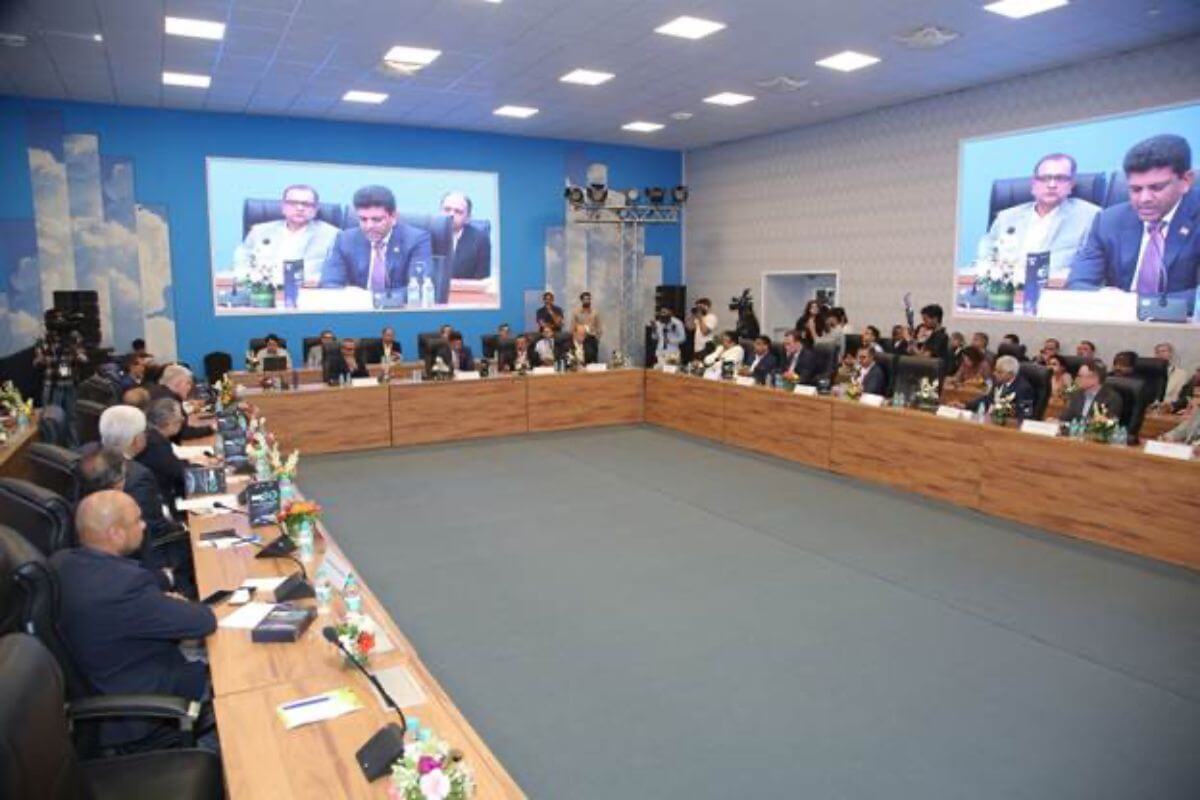
Addressing the session, “Shaping the Intelligent Infrastructure for 6G: A Technology Leadership Dialogue, CTO Round Table”, held on the sidelines of IMC 2026, Pemmasani credited industry stakeholders for helping India expand telecom connectivity across the country.
The Minister of State underscored that India has connected more than a billion people, connected every district with 5G through almost 5.6 lakh Base Transceiver Stations (BTS), connected villages with 4G and developed its own indigenous 4G stack. He acknowledged the hard work of industry stakeholders in making these achievements possible, according to Ministry of Communications.
Referring to the strengthening of the telecom sector over the last year, Pemmasani said most rules under the Telecommunications Act, 2023, have now been notified. He said the objective is to create a regulatory framework that is simpler, technology-neutral and suited to the needs of the modern technology era.
He also highlighted the BharatNet and 4G saturation projects aimed at taking high-speed fibre and connectivity to every village and every home.
Rs 500 Crore Backing for Telecom R&D
The Minister said nearly 136 research and development projects worth around Rs 500 crore have been funded under the Telecom Technology Development Fund (TTDF).
These projects are working on 5G, 6G, quantum communications, non-terrestrial networks, advanced optical systems, indigenous core and telecom security.
He also highlighted the 5G testbeds in academic institutions for students, researchers and startups to experiment and build.
Push for Indigenous Technology
Outlining the priorities ahead, Pemmasani called for identifying 10–20 critical network technologies currently being imported and for developing Indian alternatives, particularly in component manufacturing, chipsets, radios, routers and optical systems.
10 Percent Share in Global 6G Patents and Standards
Reiterating the objective of leading in 6G, the Minister of State highlighted the target of securing at least 10 percent of global 6G patents and standards.
He called for major telecom operators to have measurable annual and quarterly targets for contributions to standards, standard-essential patents (SEPs) and university research, along with industry collaboration.
Quantum Communications and AI-Native Networks
On quantum communications, Pemmasani urged C-DOT to begin real operator trials, including quantum-safe encryption on critical links and Quantum Key Distribution (QKD) wherever economically justified, rather than leaving these technologies in research laboratories.
The Minister of State also emphasised moving from AI-assisted to AI-native networks, with greater focus on national security, equipment security, supply-chain security, fraud prevention and protection of critical telecom infrastructure.
Industry-Government Collaboration
Pemmasani called for closer cooperation between government, telecom operators, equipment manufacturers and technology companies. He invited industry stakeholders to present their wish lists, particularly areas requiring simplification and policy changes in line with technological developments.
“The last decade was Digital India. Our goal is to make the next decade an Intelligent India,” said Dr. Chandra Sekhar Pemmasani
Also in the IMC 2026 Series:
Reference 1: Union Minister of Communications Jyotiraditya Scindia Reviews Final Preparations for IMC 2026
Reference 2: IMC 2026: PM Modi Discusses Digital Inclusion, 6G, AI With GSMA Board
Reference 3: IMC 2026: Bharti Airtel Announces Free International Roaming With All Its Postpaid Plans
Reference 4: IMC 2026: Vi to Showcase AI-Powered Innovations and Intelligent Connectivity Solutions
Reference 5: IMC 2026: Reliance Jio Showcases India-Built AI and Connectivity Innovations
Reference 6: IMC 2026: Ericsson Showcases 5G, AI and 6G Innovations
Reference 7: IMC 2026: Ericsson Scales Up AI-Ready Antenna Manufacturing in India
Reference 8: IMC 2026: Starlink Has Set Up Over 20 Gateway Sites in India, Says VP Lauren Dreyer
Reference 9: IMC 2026: Scindia Reviews Airtel’s Future-Ready Digital Infrastructure at Airtel Booth
Reference 10: IMC 2026: Jio Developing Indigenous Satellite Stack, Files Pre-6G Patents, Says Akash Ambani
Reference 11: IMC 2026: Jio Plans Satellite Network to Connect Over 600,000 Villages, Maritime and Border Areas
Reference 12: IMC 2026: Vi Business, Hindalco Partner to Deploy Private Network at Odisha Bauxite Mine
Reference Out of IMC: Average Revenue per GB of Wireless Data Drops 10.59 Percent to Rs 8.02 in FY26: TRAI
Reference 13: IMC 2026: Cost of 1 GB of Data Has Fallen from Rs 268 in 2014 to Rs 8 Now, Says Scindia
Reference 14: IMC 2026: India Moving Towards End-to-End Telecom Value Chain, Shaping the Rules, Equipment and Innovation: Scindia
Reference 15: IMC 2026: Viksit Tech 47 Report Sets Target of 50 Indian Tech Brands With Rs 1 Lakh Crore Revenue by 2047
Reference 16: IMC 2026: Jio Will Always Stand for Affordability, Says Akash Ambani
A small group of TelecomTalk readers helps keep this platform running. Support us if you find our work valuable.
 Support Telecomtalk