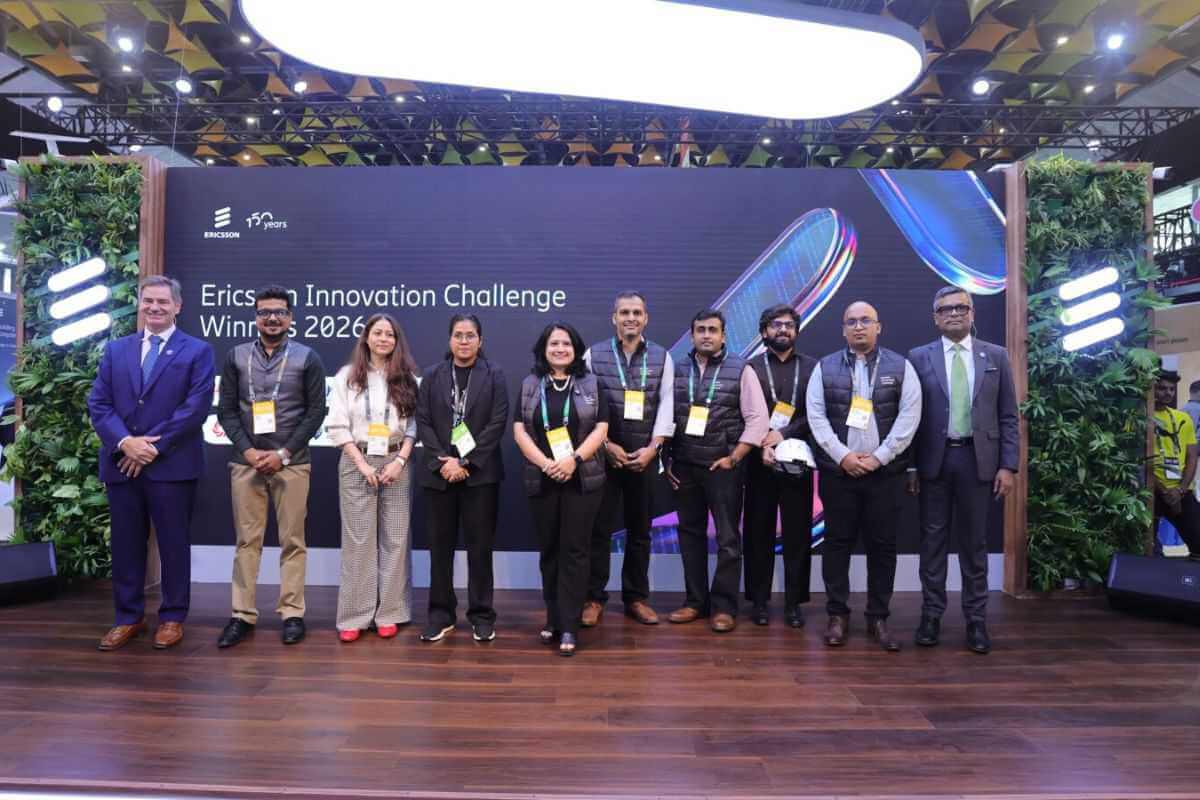
The company’s showcase combines its telecommunications infrastructure and technology capabilities with innovations emerging from India’s startup ecosystem. A key highlight at the booth is the Ericsson Innovation Challenge 2026, with six winning startups demonstrating solutions that use 5G and AI to address challenges in agriculture, healthcare, digital inclusion, advanced manufacturing and environmental sustainability.
Turning India’s innovation ecosystem into real-world applications
The six winning startups demonstrate the breadth of applications that can emerge when India’s innovation ecosystem combines with advanced connectivity and emerging technologies.
1. Torchit is developing assistive technology for people with vision disabilities, with its proposed standalone AI reader designed to operate offline while using 5G for AI updates, remote support, analytics and connected learning.
2. Skye Air Mobility is using 5G as a key component of its autonomous drone logistics ecosystem, connecting aircraft, telemetry, payload sensing and network handovers, while exploring 5G-enabled air corridors.
3. ScanO is applying AI to oral health screening, with 5G enabling real-time specialist review and confirmation of suspicious cases during screening programmes in underserved communities.
4. Okulo Aerospace is exploring 5G-enabled High Altitude Pseudo Satellites (HAPS) that can function as aerial cell towers, with the potential to extend connectivity to underserved areas and provide additional capacity during emergencies and disasters.
5. Proxgy embeds a Physical AI interface into PPE-compatible, hands-free assets and workflows, running a Perceive (video, audio, vitals, location) to Understand (edge and cloud models) to Act (alert, assist, control) to Learn (evidence, workflow improvement) loop. 5G is positioned to strengthen this existing edge-plus-cloud loop with higher-bandwidth, lower-latency connectivity for real-time video, audio, AI assistance and command.
6. KissanAI is applying voice and vision AI to agriculture through its Dhenu platform, helping farmers access crop-related assistance through voice and images. 5G can enable live photo and video-based diagnosis, edge inference and faster outbreak alerts at scale.
Together, the solutions demonstrate how connectivity can evolve from simply connecting people and devices to enabling new applications, services and experiences across industries and communities.
The Ericsson Innovation Challenge was launched in partnership with IAN Mentoring and Incubation Services and TiE Delhi-NCR. The six winning teams being recognized at IMC 2026 have emerged through a multi-stage selection and evaluation process.
The Final jury comprised of eminent representatives from DoT, TEC, Bharti Airtel, RJio, IAN and India’s investor community.
Ericsson’s IMC 2026 showcase: Powering what’s next
Alongside the Innovation Challenge, Ericsson demonstrated how networks are evolving to support the next generation of AI-powered applications and services. The showcase spanned network evolution, enterprise transformation, consumer experiences, monetization and mission-critical connectivity.
1. Evolve networks with AI
The Evolve Networks with AI zone demonstrates how AI is helping networks become more intelligent, automated and autonomous. The showcase brings together several capabilities across the network, including:
- Ericsson radio system, demonstrating how advanced radio technology, built-in AI capabilities and intelligent automation can help optimise network performance and improve energy efficiency.
- AI in networks, showcasing AI-powered RAN architecture and AI-native capabilities for applications such as traffic management and accurate positioning.
- Intelligent operations with agentic AI, demonstrating how AI and agentic AI can transform OSS/BSS into more autonomous, business-driven platforms by automating decision-making and improving operational efficiency.
- Drive RAN autonomy with rApps, showing how AI-powered rApps can automate RAN deployment and optimisation, intelligent assurance and self-healing, supporting the evolution towards more autonomous networks.
The zone also demonstrates network capabilities that support AI applications and devices, including enhanced uplink, lower latency through 5G Advanced, accurate positioning, dynamic slicing with 5G Core and guaranteed SLAs across an energy-efficient, AI-enabled network.
2. Rethink monetization
Demonstrates how 5G Standalone and differentiated connectivity can enable communication service providers to move beyond traditional connectivity and create new, customer-centric services. The demonstrations include:
- Build business with network APIs, showcases programmable network capabilities such as Quality on Demand and SIM Swap APIs, and how these can enable secure, high-performance applications, new services and improved customer experiences.
- Redefining consumer experiences in a stadium environment, demonstrates how AI-enabled smart glasses, 5G Standalone networks and network APIs can come together to deliver personalised content, real-time navigation, virtual shopping and interactive avatars.
- Rethink monetization with differentiated connectivity, highlight how tailored connectivity can address specific customer needs and create new opportunities for service providers to monetise “moments that matter.”
- Experience AI smart glasses, demonstrate hands-free experiences such as live translation, low-latency navigation and entertainment, enabled by AI, 5G Standalone, stronger uplink and differentiated connectivity.
3. Get ready for 6G
This zone looks beyond faster speeds to explore how pervasive intelligence and connectivity can reshape industries, economies and everyday experiences.
- The 6G capabilities for the 2030s showcase technologies and use cases that could enable new levels of performance, intelligence and digital inclusion, while highlighting the importance of preparing for the next generation of networks.
- The zone also features collaborative robots and sensing, demonstrating AI-native, edge-orchestrated Physical AI in a warehouse environment. Collaborative robots showcase capabilities including collaborative navigation, dynamic obstacle avoidance and intelligent handovers, illustrating how edge intelligence can support autonomous decision-making and coordination.
4. Next generation mission critical networks
This zone demonstrates how secure, resilient and always-on connectivity can support public safety, national resilience and critical operations. It features:
1. 5G KAVACH, demonstrates how Ericsson’s 5G connectivity can support India’s indigenous Automatic Train Protection system through reliable, real-time communications, helping enable safer and more efficient railway operations.
2. Ubiquitous mission critical networks, shows how standardised 3GPP technologies can deliver always-on mission-critical services for end users, first responders and network operators across everyday and emergency scenarios.
3. Drone-assisted connectivity for mission critical services, showcases an aerial tower using a tethered drone carrying a 5G radio and antenna to rapidly extend or restore coverage where ground infrastructure is unavailable. The use case highlighted applications across defence, paramilitary, homeland security and disaster management.
5. 150 years of reaching new horizons
Marking 150 years of Ericsson innovation and 123 years of partnership with India, this experience takes visitors through the evolution of connectivity and the landmark moments that have shaped Ericsson’s journey globally and in India.
An immersive cinemograph gallery traces this journey from pioneering telecommunications breakthroughs to the connected future, bringing together Ericsson’s global innovation legacy and its long-standing contribution to India’s technology journey.
6. Make in India
The Make in India zone showcases Ericsson’s commitment to India as a strategic hub for telecommunications innovation, research and advanced manufacturing.
The zone highlights how Ericsson is leveraging India’s engineering expertise and manufacturing capabilities to develop and produce next-generation radio equipment and antennas that support high-performing, energy-efficient networks for the evolving demands of a connected world.
It also features Ericsson’s R&D capabilities in India, including the role of local semiconductor talent in advancing ASIC development for the Ericsson Silicon platform.
Together, these capabilities demonstrate India’s growing role within Ericsson’s global technology ecosystem and reflect Ericsson’s commitment to building technology capabilities in India that contribute to the country’s digital future.
— End —
Also in the IMC 2026 Series:
Reference 1: Union Minister of Communications Jyotiraditya Scindia Reviews Final Preparations for IMC 2026
Reference 2: IMC 2026: PM Modi Discusses Digital Inclusion, 6G, AI With GSMA Board
Reference 3: IMC 2026: Bharti Airtel Announces Free International Roaming With All Its Postpaid Plans
Reference 4: IMC 2026: Vi to Showcase AI-Powered Innovations and Intelligent Connectivity Solutions
Reference 5: IMC 2026: Reliance Jio Showcases India-Built AI and Connectivity Innovations
Found this useful? You can support us.
 Support Telecomtalk