Can Mobile Data Offload Help Address India’s Growing Data Challenge?
Mobile data offload can help telecom operators shift traffic from licensed cellular networks to managed Wi-Fi infrastructure. This can reduce congestion, improve connectivity in high-demand locations and offer operators a more cost-efficient way to manage growing data consumption.
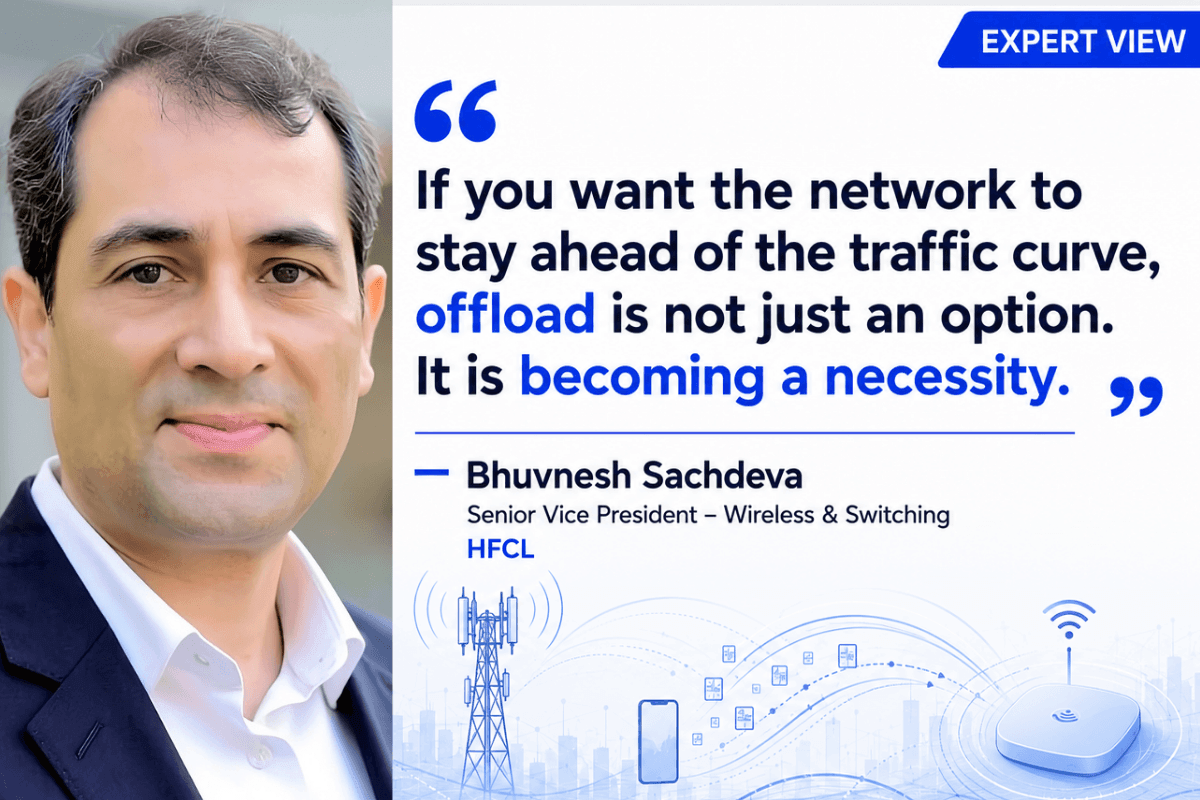
ByBhuvnesh SachdevaSenior Vice President Wireless & Switching, HFCL,
Mobile data demand is rising faster than traditional network capacity, and that imbalance is becoming one of the biggest strategic challenges for telecom operators. Users now expect seamless connectivity for video, collaboration, cloud applications, navigation, streaming, gaming, and AI-driven services, while moving across homes, offices, campuses, transport hubs, and public venues. As traffic grows, the pressure on licensed mobile networks intensifies, and so does the cost of keeping pace. In that environment, mobile data offload is no longer just a technical optimization; it is a practical capacity strategy that can help operators relieve congestion, improve subscriber experience, and make network investment more efficient.
Make Telecom Talk My Trusted Source
Key Highlights
Mobile data demand is increasing across video, gaming, cloud and AI-powered services.
Offload transfers eligible traffic from cellular networks to managed Wi-Fi infrastructure.
Network selection can be based on signal strength, throughput, latency, jitter and operator policies.
Dense urban areas, campuses, airports, transport hubs, stadiums, hotels and shopping centres can benefit significantly.
Mobile data offload complements cellular networks instead of replacing them.
Operators can use offload to relieve congestion and potentially defer certain infrastructure upgrades.
The approach requires automated authentication, intelligent traffic steering and centralised policy control.
Mobile data offload is likely to become increasingly important as network traffic continues to grow.
This challenge is especially visible in India, where telecom scale is massive and usage continues to deepen. India’s telecom subscriber base has crossed 1.33 billion, creating an enormous footprint for data consumption and network load, and Wi-Fi is already carrying meaningful traffic in the country. Offload, in other words, is not a theoretical concept but an active part of the connectivity landscape, one that will only grow in relevance as mobile data demand keeps rising sharply through 2031.
What Offload Really Means
That is where mobile data offload comes in. In simple terms, it shifts part of the traffic burden from licensed cellular networks to managed Wi-Fi infrastructure. Rather than relying only on mobile spectrum to carry every packet of data, offload creates a controlled pathway for devices to move onto Wi-Fi when conditions are right, resulting in a more balanced network, better performance in dense environments and a more cost-effective way to scale capacity.
This matters most through the lens of spectrum economics. Licensed spectrum is finite, expensive, and often slow to acquire or deploy, and it remains a significant CAPEX pressure point for operators, particularly as 5G adoption grows and traffic patterns become more intensive. Every layer of growth, from video to cloud tools to AI-based services, demands more capacity, but adding it through traditional mobile means is not always the fastest or most economical option. Offload addresses this tension by using managed Wi-Fi on unlicensed spectrum to take pressure off the mobile layer.
Seamless by Design
What makes offload especially useful is that it can be deployed without sacrificing service continuity. A modern offload architecture is designed to make the transition between mobile and Wi-Fi nearly invisible to the end user, with access points connected back to the network through secure tunnelling mechanisms, allowing traffic to be routed securely and centrally managed. User authentication happens automatically through standards such as 802.1X/EAP authentication with AAA integration and Hotspot 2.0/Passpoint, which simplifies access while keeping security intact. Devices then switch between mobile and Wi-Fi based on network conditions such as RSSI, throughput, latency, and jitter and operator-defined policies, routing traffic to wherever it delivers the best subscriber experience.
This seamless behaviour matters because offload only works well when it feels native to the user.
If switching between networks is cumbersome or unreliable, the experience breaks down and the value of the model is reduced. That is why features such as intelligent steering, authentication automation, and centralized policy control are so important. They make offload behave less like a manual fallback and more like a coordinated extension of the operator’s network. Done right, the user does not need to think about which network is carrying the traffic. The connection simply remains stable, efficient, and usable.
Where the Impact Is Greatest
The strategic value of offload is strongest in high-demand environments. Dense urban zones, campuses, transport hubs, stadiums, shopping centers, hotels, and public venues all generate traffic spikes that challenge traditional mobile infrastructure. In these settings, offload lets operators use managed Wi-Fi to absorb a large share of the load while keeping the mobile layer free for the users and use cases that need it most.
Public Wi-Fi growth is another signal that the market is already moving in this direction. India’s public hotspots are carrying thousands of terabytes of traffic in a single quarter. The opportunity now is not just to add more hotspots, but to make them smarter and better integrated with cellular infrastructure, delivering Wi-Fi’s capacity benefits while preserving subscriber experience, visibility, and security.
The Business Case
The business case extends beyond raw traffic relief. Mobile data offload can reduce pressure on capital spending by delaying certain mobile infrastructure upgrades, and improve customer satisfaction by reducing congestion where mobile networks are under heavy load. For operators, this means better network efficiency and monetization of existing infrastructure. For enterprises and venues, it means more stable connectivity and a better digital experience for users. As traffic growth continues, operators need capacity strategies that are scalable and economically sound, and offload fits that need well because it does not replace the mobile network. It strengthens it.
Preparing Networks for the Next Wave of Data Growth
Looking ahead to 2031, the case for mobile data offload is likely to become even stronger. As traffic volumes rise, the networks that perform best will be the ones that adapt intelligently, absorbing growth, protecting network quality, and extending the value of existing assets.
In the end, mobile data offload is about more than shifting traffic from one access type to another. It is about creating a network architecture that can keep pace with demand, control costs, and deliver a consistently good experience even under pressure. For telecom operators facing a future of heavier usage and tighter economics, that makes it one of the most relevant strategies available today. If you want the network to stay ahead of the traffic curve, offload is not just an option. It is becoming a necessity.
Every article you read here is the result of time, research, and effort. If you feel it adds value, you can support TelecomTalk.
 Support Telecomtalk