How Telecom Operators Can Turn AI Investment Into Measurable Business Value
Telecom operators are investing heavily in AI, but proving technical performance is not the same as creating measurable business value. Kaye Hau explains that operators must establish how value is measured, redesign processes to capture it and build organisational trust before deploying AI at scale.
ByKaye HAUManaging Partner of Stratenium Consulting,
The evidence of AI producing measurable value for telecom operators predates the age of generative AI. Vodafone’s TOBi virtual assistant handles approximately one million customer conversations daily across 15 markets. NVIDIA’s 2026 State of AI in Telecommunications survey found that 90% of operators reported that AI helps to increase revenues and reduce costs, with autonomous networks now the leading use case for return on investment.
Make Telecom Talk My Trusted Source
Key Highlights
AI value should be classified as direct, indirect or inferred, with separate confidence levels and assumptions.
Baselines and success criteria must be agreed upon before an AI pilot begins.
Productivity improvements create business value only when costs fall, expenditure is avoided or additional capacity is used.
Operators must redesign processes, responsibilities and decision-making structures to capture the value created by AI.
Trust must be built gradually through guardrails, monitoring, human oversight and proven results.
However, these remain pockets of success and not industry-wide norms. GSMA Intelligence puts around 81% of operators worldwide as in the stages of testing generative AI. So why are operators still struggling to make the case for AI with measurable value?
The answer sits in three interlinked disciplines across establishing the value that AI creates, redesigning the operating model to capture it, and building sufficient trust to deploy at scale.
Establishing Value
AI use cases span the network core, operational and business functions. Each layer measures value differently.
At the network core, some benefits are directly observable, such as faster provisioning, shorter fault resolution, and higher utilisation of existing capacity. Others though, depend on a counterfactual. The value of a self-healing network that averted a network outage depends on estimates of what would have happened otherwise.
In operational functions such as monitoring and maintenance, attribution gets harder further downstream. An improved NPS score could have been the combined causal effect of AI, CRM programme, and a retention campaign running in the same period. Untangling which factor moved the needle requires more than a before-and-after comparison.
Even in business functions where some of the most mature AI use case sit across customer service, finance and procurement, the problem is perennial. A productivity gain only becomes business value when actual cost falls, expenditure is avoided or the excess capacity is used to absorb additional workloads. Time saved on its own doesn’t equate to money saved. The further the outcome sits from the original intervention, the harder it is to isolate AI’s value contribution.
As the distance from the original intervention varies, the confidence level of these values should flex accordingly as well. One useful approach is to classify the values into 3 categories: direct, indirect and inferred.
Direct value has a close, observable connection where AI is the sole cause, while indirect value sits further down the value chain whereby AI is one of the contributors. Inferred value on the other hand depends entirely on a counterfactual of avoidance, where an event was averted, and the value is an estimate from historical data or comparable cases.
Each of these three categories should be assigned with their own confidence levels and discounting rates, reported separately, and with the assumptions stated upfront instead of being folded into a single headline number.
Baselines and success criteria should also be agreed upon before a pilot starts, including how the value is to be identified and measured. Otherwise, success can become arbitrary and while stakeholders may agree that the technology works, they may disagree on whether it created enough value to justify scaling. This is a common disagreement that usually surfaces when the investment committee starts asking for a number.
Cost and benefit can land in different parts of the organisation as well. The department that funds the investment may not receive the resultant benefits, making it hard for its own sponsor to defend the business case at renewal. There is also risk of cross-functional double-counting whereby multiple teams claim credit for one underlying improvement.
Operators also need to be mindful that while having a systematic approach to coordinate the tracking, validating and recording of the value realisation, telecom operators are usually large and highly interconnected where outcomes are rarely clinical or binary. Attribution is seldom perfect and waiting for perfection can result in the organisation to be stuck in perpetual limbo.
Capturing The Value
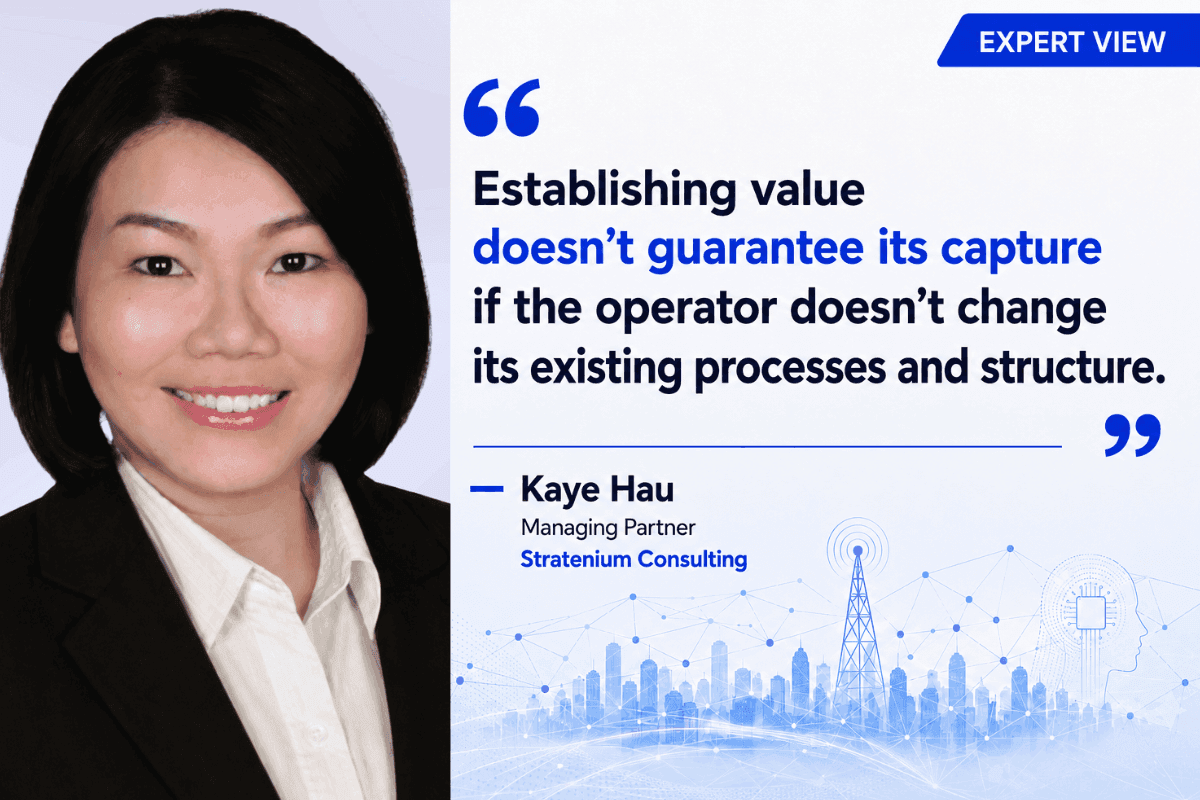
Establishing value doesn’t guarantee its capture if the operator doesn’t change its existing processes and structure. An AI system can flag a network fault earlier, but the benefit disappears if field teams can’t respond on time. A customer service assistant cuts handling times, but value is not translated if staffing or service capacity remains at where it was before the deployment.
Many AI business cases tend to stall at this stage. A pilot works when one team controls both the technology and the process around it, within a contained environment where feedback loops are short, and the ownership is clear.
Full scale deployment gets harder when the outcome is dependent on several functions, while the person accountable for it lacks the authority to change how those functions coordinate. Benefits demonstrated during the pilot get eroded as ownership fragments, decision-making slows, and operational constraints emerge while baselines shift with evolving customer behaviour, network conditions and technology updates. Therefore, accountabilities and authority need to be reassigned to ensure that those accountable also have the authority to change the processes.
Capturing value also involves redesigning the work itself. AI rarely replaces a role outright; it changes the shape and points of demarcation of the task. An engineer investigating a fault that the AI has already flagged, or a customer service executive reviewing a case even though it has been resolved. Leaving the new boundaries undefined creates duplication rather than excess capacity, and the old workload gets reshuffled instead of being reduced.
Building Trust to Scale
The final hurdle is scale. Scaling up introduces new pressures and variables that a small-scale pilot can’t really test. Wider regulatory scrutiny, more stakeholders with a stake in the outcome, exceptions and outliers that never surface in controlled environment.
At this stage, the obstacle has less to do with technical performance and more to do with confidence. The organisation has to trust the system enough to grant it more operational authority than a pilot ever required, and that kind of trust needs to be earned, not assumed just because the pilot was successful.
The key factors that slow down trust building regardless of how well the technology performs are unclear roles, fear of displacement, reduced authority, and decision rights not formally reassigned as the pilot moves into deployment. These are organisational friction that required proactive change management and process redesign.
Trust is accumulated and built in stages. Autonomy is extended gradually with each proof point while the operator put in guardrails, monitoring, and human oversight.
The telecommunications industry doesn’t lack AI use cases, or evidence the technology improves operational performance. The real question is whether operators are prepared to make the organisational changes needed to capture what it creates, and that question rarely gets asked with the same rigour applied to the technology itself.
ERP and CRM went through the same cycle. Their value came from the processes, responsibilities and decisions that changed around the technology, not the technology itself, and the operators who struggled with those rollouts were rarely the ones running inferior software. Better models will keep expanding what’s technically possible but can’t resolve unclear ownership, unused capacity, or an organisation unwilling to act on evidence that’s good enough, even if it isn’t perfect.
The operators who create measurable value from AI will be the ones who change how work gets done, once the technology has proven itself worth the disruption, and who treat that organisational work as seriously as the deployment itself.
A small group of TelecomTalk readers helps keep this platform running. Support us if you find our work valuable.
FAQs
How can telecom operators measure the business value of AI?
Telecom operators can classify AI-generated value into direct, indirect and inferred categories. Each category should have its own confidence level, discounting rate and clearly stated assumptions.
Why should AI success criteria be established before a pilot begins?
Agreeing on baselines and success criteria before deployment helps operators determine whether the technology has created enough value to justify scaling. Otherwise, different stakeholders may assess the same pilot differently.
Does time saved through AI automatically translate into cost savings?
No. Time saved becomes business value only when actual costs fall, expenditure is avoided or the available capacity is used to absorb additional workloads.
Why do successful AI pilots struggle during full-scale deployment?
Full-scale deployment involves multiple teams, fragmented ownership and slower decision-making. Value demonstrated during a controlled pilot may be reduced if accountable teams lack the authority to redesign processes.
How can telecom operators build trust in AI systems?
Trust can be built gradually by extending AI autonomy after each successful proof point while maintaining guardrails, monitoring, human oversight and clearly assigned responsibilities.
 Support Telecomtalk