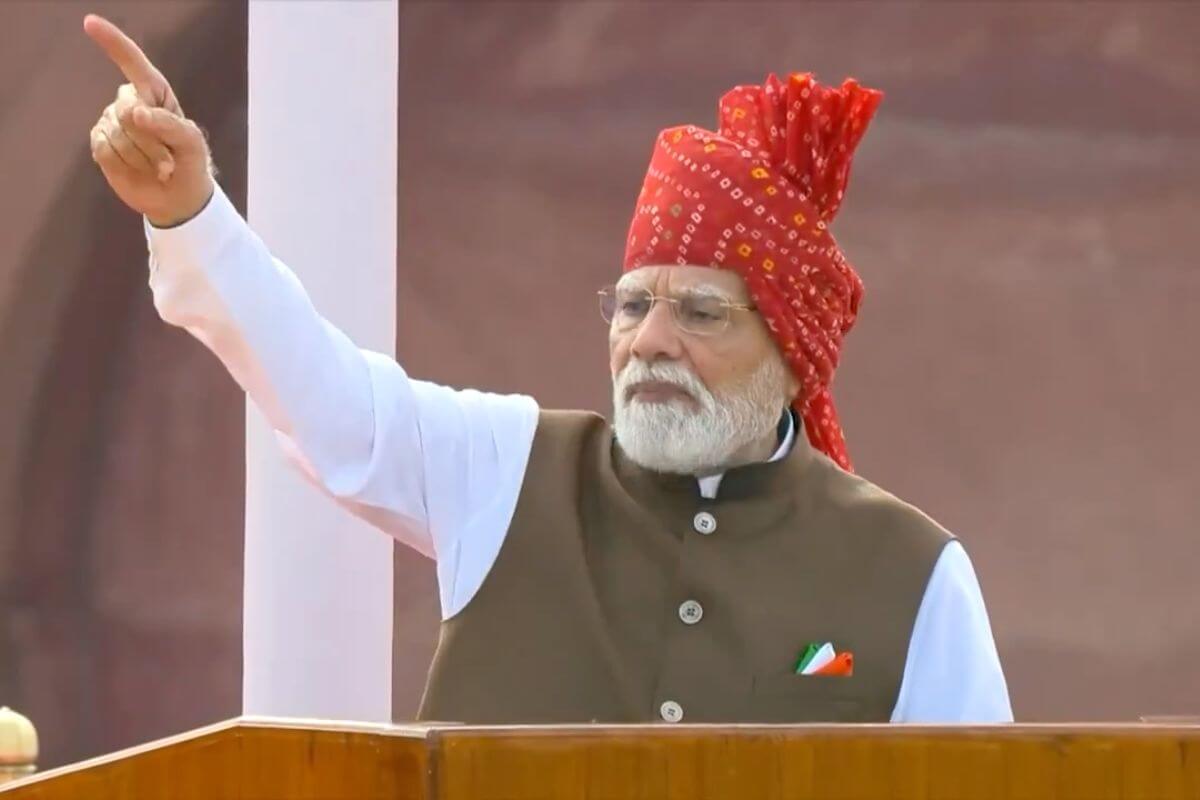
Prime Minister Narendra Modi, in his Independence Day address, highlighted India’s transformation over the past 12 years, outlining the progress made across manufacturing, digital infrastructure, basic amenities, energy security, youth empowerment, innovation, social security and other key sectors.
The Prime Minister said that the number of internet users in the country had increased nearly fourfold during this period, while patent grants had risen fourfold and digital transactions had grown around 100 times. He said India had built a significantly larger digital and innovation ecosystem.
India has also recorded sharp growth in manufacturing. Defence production has increased nearly fourfold, electronics manufacturing nearly sevenfold, and mobile phone production 35 times. The production of modern railway coaches has risen 21 times, while output from Khadi and Village Industries has increased nearly fivefold.
On emerging technologies, the Prime Minister said India has moved from having no major semiconductor manufacturing plant to building a complete domestic semiconductor ecosystem. Three semiconductor plants have been initiated and India has also begun exporting chips.
He also highlighted the National Critical Mineral Mission, the proposed Critical Mineral Corridor and agreements with other countries to secure supplies of strategic minerals.
The Prime Minister underlined that energy security is an essential condition for building a developed India, particularly as technologies such as chips, AI and data centres require huge quantities of electricity. He cited the SHANTI Act, progress in Fast Breeder Nuclear Technology and efforts to expand domestic nuclear fuel capabilities.
Solar energy capacity has risen from about 2 GW in 2014 to around 160 GW today. The PM Surya Ghar Muft Bijli Yojana has crossed 50 lakh households, enabling families to reduce electricity costs and, in some cases, earn by selling surplus power.
Railways: Electrification and Future Fuels
The Prime Minister also pointed to the near-complete electrification of the railway network and the development of India’s first indigenous hydrogen train. “India has started work on its first Made-in-India hydrogen train. It is being developed as the world’s longest and most powerful hydrogen train,” the Prime Minister said.
India’s Resilience During Global Crises
He said the country’s capabilities built over the past decade were tested during the Covid-19 pandemic, the Russia-Ukraine war and conflicts in West Asia.
Affordable Fertiliser for Farmers
On agriculture, Modi said the government had shielded farmers from high international fertiliser prices. While a bag of urea costs around Rs 3,000 internationally, Indian farmers receive it for less than Rs 300, while DAP priced above Rs 5,000 internationally is available to farmers for Rs 1,350.
Trade and Export Opportunities
India has also expanded its trade opportunities, with free trade agreements covering around 40 countries since 2014, opening new markets for agriculture, fisheries, MSMEs, textiles and other sectors.
Youth at the Centre of Viksit Bharat
Emphasising the role of youth in building a developed India, Modi highlighted Startup India, the Rs 1 lakh crore research fund, Digital India, Skill India, private participation in the space sector, the National Drone Policy and Khelo India. He said these initiatives were creating new avenues for entrepreneurship, research, innovation and employment.
Education and Innovation
The education sector has also expanded, with the National Education Policy introduced in 2020 after a gap of 35 years. The Prime Minister said the number of universities had risen from fewer than 350 during 2004–14 to around 650 new universities in the subsequent decade. Medical colleges have increased from fewer than 400 before 2014 to around 850 today, while more than 10,000 Atal Tinkering Labs have been established to promote innovation among school students.
Startups, Space and AI
India’s startup and space ecosystems have expanded rapidly, Modi said, noting that the country now has around 2.5 lakh registered startups and that an Indian space startup has launched a Made-in-India rocket. He also highlighted opportunities emerging from artificial intelligence and India’s hosting of the AI Impact Summit.
New Sectors and New Opportunities
The Prime Minister cited the growth of the bioeconomy, which has expanded from around Rs 60,000 crore in 2014 to nearly Rs 20 lakh crore.
Electric Vehicles
Annual electric vehicle sales have risen from around 1.5 lakh towards the end of the previous decade to nearly 25 lakh last year.
Aviation
Growth in aviation, airport infrastructure and maintenance, repair and overhaul services is also creating new employment opportunities, while India is moving towards domestic aircraft manufacturing.
Rural Empowerment through SVAMITVA
In rural areas, Modi highlighted the SVAMITVA scheme, under which around 3.25 crore families have received property cards. He said the formalisation of property ownership had unlocked economic potential estimated at around Rs 140 lakh crore and enabled villagers to use property records to access bank credit.
Growth in Defence Exports
Defence exports have increased more than 50 times, with Indian defence equipment now being exported to around 100 countries.
Women-Led Development: Lakhpati Didi
On women-led development, the Prime Minister said the target of creating three crore Lakhpati Didis had been achieved, with women from diverse social backgrounds becoming financially empowered through livelihood opportunities.
Expanding Social Security
Social security coverage has also expanded sharply, Modi said, from around 25 crore people before 2014 to nearly 100 crore today under one or more social security schemes. Under Ayushman Bharat, beneficiary families have collectively avoided an estimated Rs 2 lakh crore in medical expenses, he added.
Modi said the transformation across these sectors reflected the government’s broader objective of building a self-reliant and developed India, with greater opportunities for citizens, particularly farmers, women, youth and entrepreneurs.
In his 80th Independence Day address from the ramparts of the Red Fort, Prime Minister Narendra Modi gave a series of clarion calls aimed at accelerating India’s journey towards Viksit Bharat by 2047. Calling for a change in the country’s work culture, thinking and scale of ambition, the Prime Minister underlined the need for collective action by citizens, governments, industry, farmers, youth and other sections of society.
Key points from the Prime Minister’s address include:
The Prime Minister gave a call from the Red Fort for seven streams of strength, “Sapt Dhara”, to take India to new heights and give the country new momentum in the coming five-seven years. The seven streams, according to an official release by the Prime Minister’s Office on August 15, 2026, are:
1. Manufacturing Power: India must develop the complete value chain, from components and design to manufacturing of complete products, and become a trusted centre of the global supply chain. The Prime Minister stressed cost, quality and scale, competitive factories, user-friendly products, attractive packaging and zero-defect precision manufacturing. Calling for no compromise on quality, he said, “Quality, Quality, Quality” should be the mantra of Indian manufacturing.
2. Agriculture and Food Production: The Prime Minister called for moving from the farm to the export market and turning India’s traditional foods, millets, spices, fruits and flowers into global brands. He also emphasised chemical-free farming and agricultural products that meet global parameters.
3. Technology and Innovation: Referring to emerging areas including AI, Quantum, Space, Robotics and Data Centres, the Prime Minister said India should not remain merely a market for the world but become an innovation hub. He said Made-in-India 6G reaching every corner should be the country’s goal.
4. Gati Shakti: The Prime Minister called for seamless and fast connectivity through high-speed rail connecting cities, modern highways, inland waterways, airports and multimodal logistics. He said ports should move beyond loading and unloading goods and become drivers of port-led development and growth.
5. Defence Shakti: The Prime Minister called for self-reliance in defence and said India must move towards becoming a global supplier by developing next-generation defence technologies. He specifically called for developing drones and counter-drone systems and taking leadership in hypersonic defence technologies. He also highlighted cyber security as an area where the capabilities of Indian youth could be utilised for India and the world.
6. Green Economy and Blue Economy: The Prime Minister called for achieving global scale in green hydrogen, renewable energy, energy storage, green mobility and green manufacturing. He also highlighted the opportunities offered by India’s coastline in fisheries, coastal tourism, ocean technology and other areas of the Blue Economy.
7. India’s Soft Power: The Prime Minister called for taking India’s strengths in Yoga, Ayurveda, holistic healthcare and Heal in India to the world. He also highlighted handicrafts, culture, films, VFX, animation, gaming and digital content as areas where India could establish its strength globally. He called for greater efforts to attract foreign tourists, global sporting events and concerts to India.
Raise the Scale of India’s Ambitions:
Calling upon the country to think bigger, the Prime Minister asked why India should not have 50 companies among the Fortune 500 in the coming decade. He said an Indian bank should be among the world’s top five banks and one or two Indian pharmaceutical companies should find a place among the world’s five biggest pharma companies. He also called for Indian law firms, rating agencies, consulting firms and accounting firms to emerge among the world’s leading firms, Indian technology companies to become global leaders, and Indian brands to become identities of the country that attract the world.
Make Indian Quality a Global Identity:
The Prime Minister made a strong appeal to manufacturers, entrepreneurs and MSMEs to make reliability and quality the identity of Indian products in global markets. He said India must meet global benchmarks in cost, quality and scale and offer products that can compete successfully in world markets. He urged MSMEs to seize the opportunities created by India’s trade agreements and take Indian products to world markets while meeting global parameters on quality and competitiveness.
Change Work Culture and Match the Scale of India’s Goals:
The Prime Minister said that the next quarter of this century was extremely important for India and that the country could neither stop nor allow its speed to slow down. He called for changing the country’s work culture, thinking and pace of work and said that tasks which had not been accomplished in the previous five-seven decades would have to be accomplished in the coming five-seven years.
Turn Dreams into Resolve and Resolve into Success:
Concluding with a call for collective national effort towards Viksit Bharat, the Prime Minister said that the time, opportunity and resolve belonged to India. He called upon citizens to turn dreams into resolve, resolve into strength and strength into success; make every step a step towards development; move together; and collectively build a Viksit Bharat.
If this article saved you time or helped you decide better, consider supporting our work.
 Support Telecomtalk