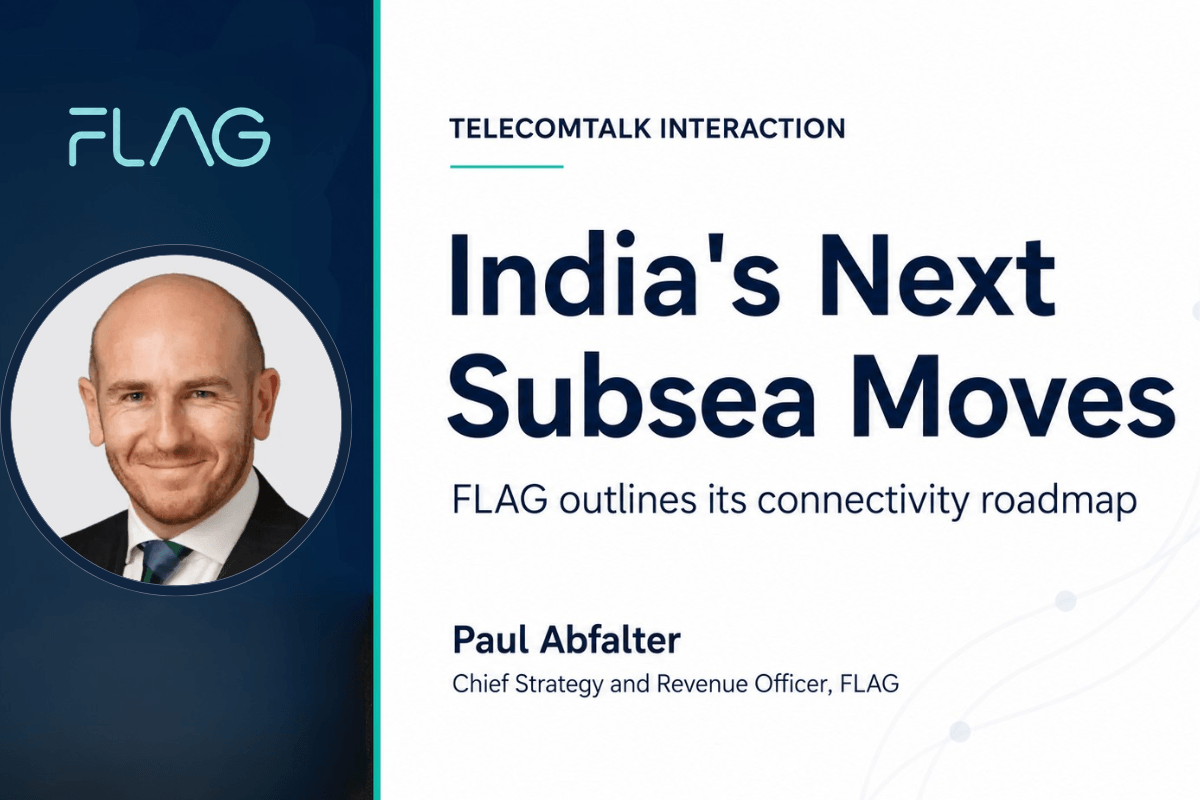
India is set to remain a central market in FLAG’s long-term global network strategy as the company plans further investments in subsea connectivity involving the country.
“India is a central market for FLAG, both in terms of growth and its strategic position within the global network,” Abfalter told TelecomTalk.
He said India’s location enables it to act as a key connection point between Asia, the Middle East and Europe. At the same time, the country’s ongoing digital expansion continues to drive international traffic flows.
India’s position within FLAG’s network is also reflected in the company’s plans to strengthen connectivity from both the western and eastern coasts of the country.
The Chennai-Singapore route forms part of FLAG’s Vision 2030 strategy and serves as a second India–Singapore segment. According to Abfalter, the route adds geographic diversity and path separation while integrating with FLAG’s wider subsea and terrestrial assets.
This is intended to support connectivity between India and Southeast Asia, along with onward routes to North America and Europe.
“As part of FLAG’s roadmap, you will see us invest in a new build to Chennai and another east coast landing; and in another Mumbai–Singapore system,” Abfalter said.
He added that these plans reflect India’s strategic importance to FLAG and will help strengthen resilience for both eastbound and westbound traffic.
Why FLAG Selected Chennai
Explaining why Chennai was selected as the company’s next strategic investment point after Mumbai, Abfalter said India’s connectivity requirements are becoming more distributed. Mumbai and Chennai, according to him, serve different but complementary roles within the country’s international connectivity infrastructure.
Chennai was selected to complement Mumbai and establish dual-coast connectivity into Singapore through the India–Asia Express, or IAX, system. Abfalter said relying too heavily on one landing point or one coast can limit routing flexibility.
The Chennai connection is expected to give customers more choices when moving traffic across India, Southeast Asia and onward international routes. It will also support demand across southern India. The Chennai-Singapore route provides customers with another option for connecting India to the rest of Southeast Asia. Its key benefit is a more direct east coast connection to Singapore.
For FLAG, it also creates further connectivity options for diversity, connecting India with the rest of Asia and westbound towards Europe.
Hyperscalers and Enterprises May Benefit First
Demand is shifting across FLAG’s customer base, including hyperscalers, enterprises, carriers and content providers operating in regional and global markets. Abfalter said each customer group has different requirements around scale, predictability, control, performance assurance and resilience.
However, hyperscalers, neoclouds and large enterprises are expected to benefit first because of the scale of their requirements into Chennai and Hyderabad.
Cloud, artificial intelligence and data centre growth are also changing how traffic moves across Asia. According to Abfalter, this is creating more demand for high-capacity connections between compute locations, landing points and major digital hubs.
The challenge is that these environments are often planned and operated across different layers of infrastructure. FLAG’s role, he said, is to help connect those layers more effectively so that subsea, terrestrial and data centre connectivity can work together.
This would allow customers to manage performance, scale and resilience more consistently.
Route Diversity and Business Continuity
Route diversity is now closely connected to business continuity, Abfalter said. Subsea infrastructure can be affected by physical cable outages caused by natural events or accidental damage. International connectivity can also be disrupted by geopolitical developments.
However, no single route can completely remove these risks. For organisations that depend on always-on connectivity, disruption can affect their operations, customer experience and revenue.
The Chennai-Singapore route adds an east coast path between key connectivity hubs. According to Abfalter, this gives operators more options for restoring traffic when networks come under pressure.
Creating More Flexible India–US Paths
Abfalter also discussed how customers could use the Chennai–Singapore route alongside other international cable systems.
He said India-US connectivity increasingly depends on how multiple network segments are combined rather than on any one cable system in isolation. The Chennai-Singapore route integrates with FLAG’s broader network and can be combined with other international systems, including transpacific routes such as ECHO.
According to Abfalter, the result is a more flexible, multi-path architecture for customers designing India–US connectivity.
Trends Shaping Asian Connectivity
Over the next five years, international connectivity across Asia is expected to be shaped by increasingly distributed traffic, the growth of data-intensive applications and rising expectations around resilience.
Abfalter said these trends are changing how operators think about network capacity, routing and architecture across Asia.
At the same time, infrastructure planning must account for regulation, geopolitics, physical risks and the long timelines required to build international networks.
The result, he said, will be greater focus on route diversity, path optimisation, efficiency and sustained investment across subsea and terrestrial networks.
For FLAG, these developments place India at the centre of its long-term network strategy, supported by plans for further east coast and Mumbai–Singapore connectivity investments under its Vision 2030 roadmap.
If this article saved you time or helped you decide better, consider supporting our work.
FAQs
Why is FLAG investing further in India?
According to FLAG, India is a central market because of its growth potential and its strategic location connecting Asia, the Middle East and Europe.
What new investments has FLAG outlined?
FLAG said its Vision 2030 roadmap includes a new build to Chennai, another east coast landing and another Mumbai–Singapore subsea system.
Why was Chennai chosen after Mumbai?
FLAG said Chennai complements Mumbai by creating dual-coast connectivity into Singapore, improving routing flexibility and supporting demand across southern India.
Which customers are expected to benefit the most?
FLAG expects hyperscalers, neoclouds and large enterprises to benefit first because of their connectivity requirements into Chennai and Hyderabad.
How does FLAG view the future of international connectivity in Asia?
FLAG believes distributed traffic, AI, cloud, data-intensive applications and resilience requirements will shape network investments across Asia over the next five years.
 Support Telecomtalk