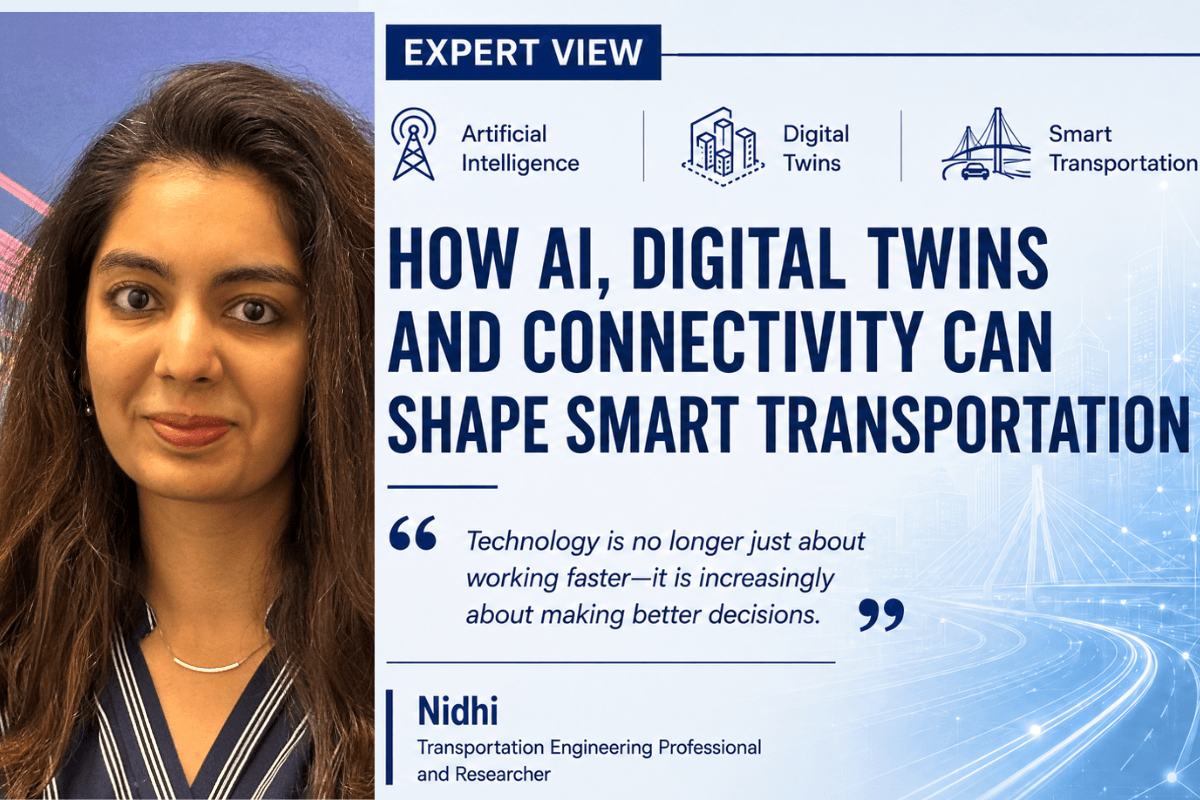
How AI, Digital Twins, and Connectivity Can Shape the Future of Smart Transportation
From AI-assisted engineering to digital twins, emerging technologies are transforming how transportation infrastructure is designed, managed, and maintained throughout its lifecycle.
Drawing on research in smart cities, the author explains how digital twins can support better infrastructure planning by connecting physical assets with real-world data.
Moving from reactive maintenance to predictive decision-making can help transportation agencies identify issues earlier and make more effective use of limited infrastructure budgets.
Successfully adopting AI and digital twins will require collaboration between engineers, planners, policymakers, technology developers, and data scientists to build more connected infrastructure ecosystems.
Highlights
Drawing on research in smart cities, the author explains how digital twins can support better infrastructure planning by connecting physical assets with real-world data.
Moving from reactive maintenance to predictive decision-making can help transportation agencies identify issues earlier and make more effective use of limited infrastructure budgets.
Successfully adopting AI and digital twins will require collaboration between engineers, planners, policymakers, technology developers, and data scientists to build more connected infrastructure ecosystems.
Artificial intelligence has become an integral part of modern society. With industry leaders continuously pushing the boundaries of innovation and automation, AI is no longer a concept reserved for the future – it is already reshaping the way we live and work. There is hardly any industry today that cannot benefit from its capabilities, and transportation and infrastructure are no exception. Across the sector, professionals are embracing a technological mindset, eager to understand how emerging tools can make infrastructure safer, more efficient, and more resilient.
Make Telecom Talk My Trusted Source
Key Highlights
AI is helping transportation engineers improve design efficiency, decision-making, and infrastructure planning rather than replacing engineering expertise.
Digital twins are evolving beyond 3D models into dynamic, data-driven representations that support predictive maintenance and smarter infrastructure management.
The future of smart transportation depends on integrating AI, digital twins, connectivity, and engineering judgment to build safer, more resilient infrastructure.
Among the many technologies gaining traction, Digital Twins have become one of the most talked-about developments in transportation infrastructure. The conversation has evolved well beyond creating three-dimensional models. Today, digital twins integrate real-time information, environmental conditions, operational data, and predictive analytics into living representations of physical assets. Alongside them, AI-powered design assistants are helping engineers automate repetitive design tasks, sophisticated modeling tools are recreating structures with remarkable precision, and simulation platforms are allowing us to evaluate scenarios before they unfold in the real world.
What excites me most about this technological evolution is not simply the sophistication of the tools themselves, but what they enable us to achieve. Technology is no longer just about working faster it is increasingly about making better decisions.
The Project That Changed My View of Infrastructure
My first introduction to this world came during my master’s program at the Georgia Institute of Technology, where I had the opportunity to work on a Smart Cities Digital Twin research project. Our goal was to reduce crime within a city in Georgia by developing a predictive deep learning simulation model capable of identifying future crime hotspots based on historical crime patterns.
At first glance, it seemed like a public safety problem rather than a transportation one. Yet, as the project evolved, I realized that the digital representation of a city could become a powerful decision-making platform with applications extending far beyond crime prevention.
For the first time, I witnessed how a virtual replica of a city could influence real-world outcomes. It fundamentally changed the way I thought about infrastructure. Roads, bridges, utilities, traffic systems, emergency services, and public safety are not isolated systems – they are interconnected components of one living network. Once we begin treating cities as connected ecosystems rather than individual assets, entirely new opportunities emerge.
That experience also made me wonder what similar technologies could accomplish for transportation infrastructure.
AI Is Changing Engineering, One Task at a Time
Today, the industry is buzzing with conversations about AI, and rightly so. We are already seeing practical applications that are transforming everyday engineering workflows. AI-assisted platforms are helping engineers automate design processes, reducing hours of repetitive work while allowing designers to focus on solving more complex engineering challenges. Rather than replacing engineering judgment, these tools enhance productivity by enabling engineers to spend more time evaluating solutions instead of creating repetitive design elements.
The opportunities, however, extend well beyond design automation.
From Reactive Repairs to Predictive Maintenance
Digital twins are increasingly being used throughout the lifecycle of infrastructure assets. By combining sensor data, inspection records, drone imagery, and historical maintenance information, engineers can assess the health of bridges, pavements, tunnels, and other transportation assets with greater confidence. Rather than relying solely on scheduled inspections or reactive maintenance, agencies can identify signs of deterioration earlier, prioritize interventions more effectively, and extend the service life of critical infrastructure.
Imagine a bridge whose digital twin continuously receives information from embedded sensors. Small structural changes that might otherwise go unnoticed could be detected early, allowing maintenance teams to intervene before the issue escalates into a costly repair or worse, a safety concern. The implications for infrastructure asset management are significant. Predictive maintenance not only improves public safety but also helps agencies make better use of limited budgets by prioritizing repairs based on actual asset condition rather than fixed schedules.
Where Connectivity Fits Into the Picture
Connectivity makes these technologies even more powerful.
Digital twins are transforming the infrastructure industry through their growing range of real-world applications and their ability to create meaningful change beyond the design phase. Far more than detailed three-dimensional models, they provide dynamic representations of physical assets that evolve throughout their lifecycle. From transportation networks and bridges to buildings, rail systems, and entire urban developments, digital twins are helping engineers better understand how infrastructure performs, allowing decisions to be made with greater confidence and foresight.
Across the world, transportation agencies and infrastructure owners are beginning to use digital twins to monitor asset conditions, evaluate proposed design changes, optimize maintenance activities, and improve the operation of increasingly complex infrastructure systems. Rather than relying solely on historical records or periodic inspections, digital twins bring together multiple sources of information to create a more complete picture of an asset’s health and performance. This allows agencies to identify potential issues earlier, improve operational efficiency, and build more resilient infrastructure.
Digital Twins Beyond Roads and Bridges
Their applications extend well beyond transportation. In the built environment, digital twins are improving the management of buildings and real estate developments. On major infrastructure projects, they are helping teams visualize construction sequencing, improve coordination across multiple disciplines, and reduce costly rework. As adoption continues to grow, digital twins have the potential to become the common thread connecting every phase of an infrastructure asset—from planning and design to construction, operation, maintenance, and eventual renewal.
The true value of digital twins lies in their ability to create smarter and more resilient systems. Whether it is a roadway network that can be managed more efficiently, a bridge whose condition can be monitored throughout its service life, or an entire city planned with greater insight into future demands, digital twins have the potential to transform the way we design, build, and manage infrastructure. In many ways, we have only begun to explore what this technology is capable of achieving.
Technology Works Best Alongside Engineering Judgment
Of course, technology alone is not the answer.
As engineers, we have a responsibility to ensure these tools complement sound engineering judgment rather than replace it. AI models are only as reliable as the data they learn from, and digital twins require accurate information, continuous updates, and thoughtful implementation to remain meaningful. Successful adoption will depend not only on better algorithms but also on collaboration between engineers, planners, policymakers, technology developers, and data scientists.
Perhaps the greatest challenge facing our industry is not technological capability but technological integration. Many organizations already possess valuable datasets, advanced software, and experienced professionals. The real opportunity lies in bringing these pieces together so they can work as one connected ecosystem.
Building Infrastructure That Evolves With Time
This is why I believe the future of smart transportation extends beyond AI, beyond digital twins, and beyond automation. It lies in connectivity in creating infrastructure that communicates, adapts, and supports better decisions throughout every stage of its lifecycle.
As someone who began this journey studying how digital twins could improve public safety and now works in transportation infrastructure, I find it inspiring to see how rapidly our industry is evolving. Every new advancement reinforces the idea that infrastructure is no longer just something we build it is something we can understand, predict, and continuously improve.
The possibilities are immense. Smarter transportation networks, safer infrastructure, more resilient communities, and better-informed decisions are all within reach. As these technologies continue to mature and converge, the question is no longer whether they will transform our industry, but how boldly we choose to embrace them.
If the last few years have taught us anything, it is that innovation rarely happens by standing still. The future of transportation belongs to infrastructure that is not only well designed but also intelligent, connected, and capable of evolving alongside the communities it serves.
 Support Telecomtalk