Winning the AI Race With Scalable Intelligent Optical Line Systems
As AI workloads continue to grow, optical transport networks are becoming a critical part of digital infrastructure. This article explores how scalable and intelligent Optical Line Systems (OLS) help operators simplify network operations, expand capacity efficiently, and build future-ready connectivity for AI-driven data centres and cloud networks.
Much has been written about the rapid growth of AI and the strains it is putting on data centers in terms of graphic processing units (GPUs), energy grids and water use. However, data centers also rely heavily on interconnect networks where optical fiber capacity is critical. With the exponential growth of AI training and inference, we will need more data centers as well as optical transmission systems to connect them. Key innovations in optical line systems will be essential to enable this expansion.
Make Telecom Talk My Trusted Source
Key Highlights
AI infrastructure is driving unprecedented demand for high-capacity optical networks.
Modern Optical Line Systems (OLS) help operators scale capacity without rebuilding entire transport networks.
Intelligent automation and open architectures simplify deployment and reduce operational complexity.
Disaggregated optical networking enables multi-vendor flexibility and protects long-term investments.
Scalable OLS platforms are becoming critical for AI data centres, cloud providers, and telecom operators.
Currently, there are around 12,000 data centers worldwide whose capacity is expected to triple by 2030 due to cloud expansion, digital twins and AI workloads. To support this growth in compute resources, optical networks will be required to:
Move increasingly large datasets between data centers
Achieve zero-loss, low-latency transmission for accurate AI model training
Link GPU clusters both within and across locations while quickly adapting intelligently to workload changes
To meet these needs, optical interconnection between data centers is required for campus, metro and long-haul transmission applications. To quickly scale across all of them, optical line systems will need to be compact, secure, programmable, easy to deploy and capable of supporting modern application programming interfaces (APIs), all while maximizing the capacity of precious fiber assets.
Based on the latest generation of coherent optical engine technology, however, the current fiber transmission capacity has reached the theoretical upper limit for error-free communication in the presence of noise, typically referred to as the “Shannon Limit.” Just as cars reached speed limits for safe operation on highways, we expanded roads, added lanes and built new capacity. To meet the needs of AI, we will need to expand the capacity of optical line systems.
The first place to start is expanding the usable spectrum. The industry has already expanded from the C-band into the L-band, doubling fiber capacity with an additional 4.8 THz of spectrum. “Super” C-band and L-band technologies further expand the number of channels and useable fiber spectrum by over 20 percent to a total of 11.6 THz. Using fewer amplifiers and systems to cover longer distances, we can now transport more data with lower power consumption and at lower cost to a maximum of 104 Tbit/s over a single fiber pair.
There are other spectrum bands like the S- and O-bands, which hold promise. Amplification in these bands, however, faces practical and economic constraints, making it suitable for only specific scenarios today. In most cases, parallel deployment of multiple fibers is a more efficient and operationally friendly solution.
Next-generation fiber technologies
The most promising evolution involves changing the transmission medium itself. Traditional fiber optic cables transmit signals through solid silica glass. New hollow-core fiber (HCF) uses gases in its transmission core, reducing non-linear effects and chromatic dispersion. It enables higher transmission power, broader bandwidth and spectrum, lower latency and less loss. It will be a key solution to addressing the needs of AI once several operational challenges are resolved, including splicing, fiber bending and the integration of multiple HCFs into a single cable. Large industry players have begun deploying HCF in their networks, and it will be interesting to see the outcome of these initial trials.
Designing for data interconnect
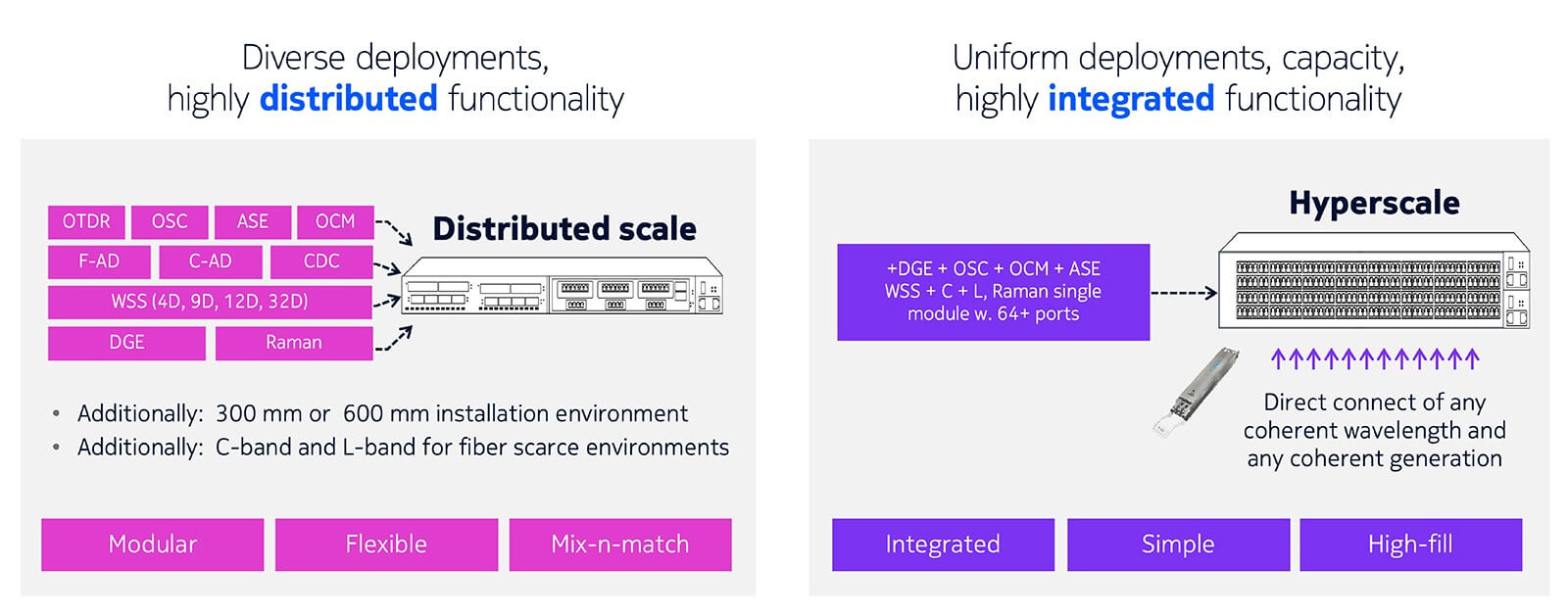
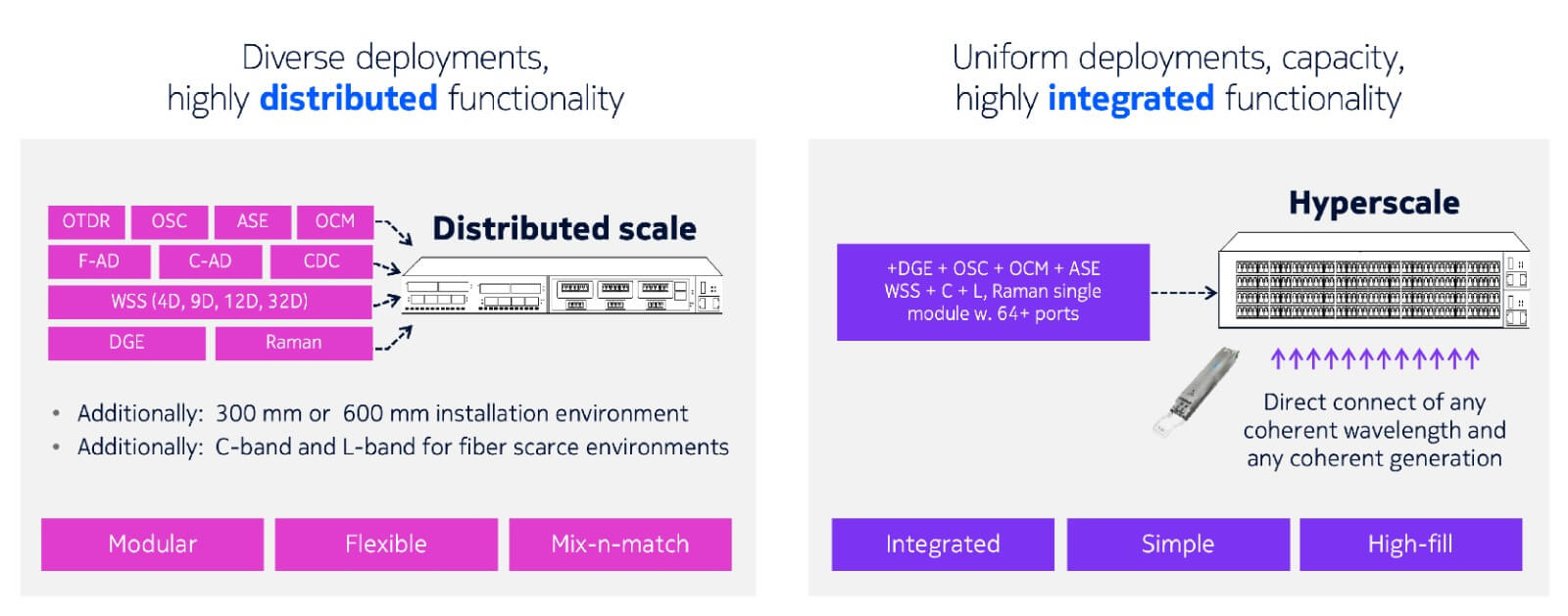
In contrast to traditional telco operations, which have widely varying requirements by site, data center interconnect applications generally use common optical interfaces and deployment environments, and they require significantly higher capacities. In many cases, data centers are connected using multiple fibers in multi-rail deployments to meet their capacity requirements. These line systems need to meet high transmission performance as well as operational simplicity, scalability and low power consumption. Single devices, which integrate all necessary optical line system functions, eliminate the need for intra-system interconnections and simplify operation, scale quickly and save on power.
Figure 1: Diverse Optical Line System building block options
These hyperscale systems are built to support future evolution as well. With automated dynamic power equalization, generalized OSNR (G-OSNR) optical power management and support for any coherent transponder generation (baud rates, modulations and wavelength speeds), these systems operate fully automated at maximum performance.
Security in the quantum Era
As the value of confidential data transmitted across networks increases, it has become an increasingly frequent target for unauthorized access. Simultaneously, emerging practical quantum computers create a pressing challenge for safeguarding data integrity. Optical transport networks must implement physical layer and quantum-safe encryption, ideally through a unique symmetric key management architecture. This approach equips data center interconnect operators with a first line of defense by encrypting all transmitted data and rendering it useless if in the wrong hands.
Summary
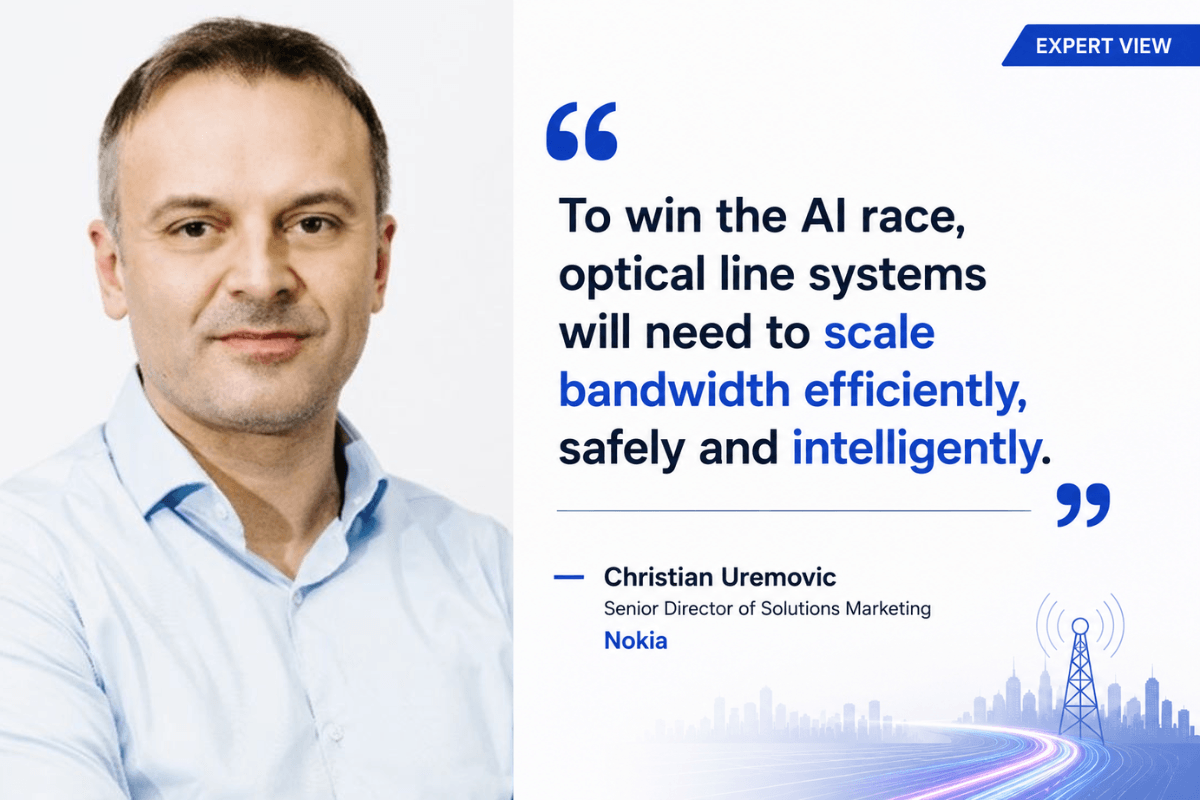
Advances in optical line system technologies are creating the foundation for intelligent, fully programmable network infrastructure. AI workloads, cloud-based applications and digital twins require optical networks capable of supporting fast provisioning, efficient spectrum utilization and scalable quantum-safe connectivity. To win the coming AI race, optical line systems will need to scale bandwidth efficiently, safely and intelligently.
Every article you read here is the result of time, research, and effort. If you feel it adds value, you can support TelecomTalk.
FAQs
What is an Optical Line System (OLS)?
An Optical Line System is the underlying optical transport infrastructure that enables high-speed data transmission across fibre networks while supporting amplification, monitoring and wavelength management.
Why are AI workloads increasing demand for optical networking?
AI training and inference generate enormous amounts of data movement between GPUs, servers and data centres, requiring scalable, high-capacity optical transport networks.
What are the benefits of disaggregated optical networks?
Disaggregated architectures allow operators to mix hardware and software from different vendors, improving flexibility, scalability and long-term investment protection.
How does automation improve optical transport networks?
Automation simplifies provisioning, monitoring and fault management, reducing operational costs while improving service reliability and deployment speed.
Why are intelligent optical line systems important for future networks?
Intelligent OLS platforms help operators efficiently scale network capacity, support AI-driven traffic growth, and prepare infrastructure for future high-bandwidth applications.
 Support Telecomtalk