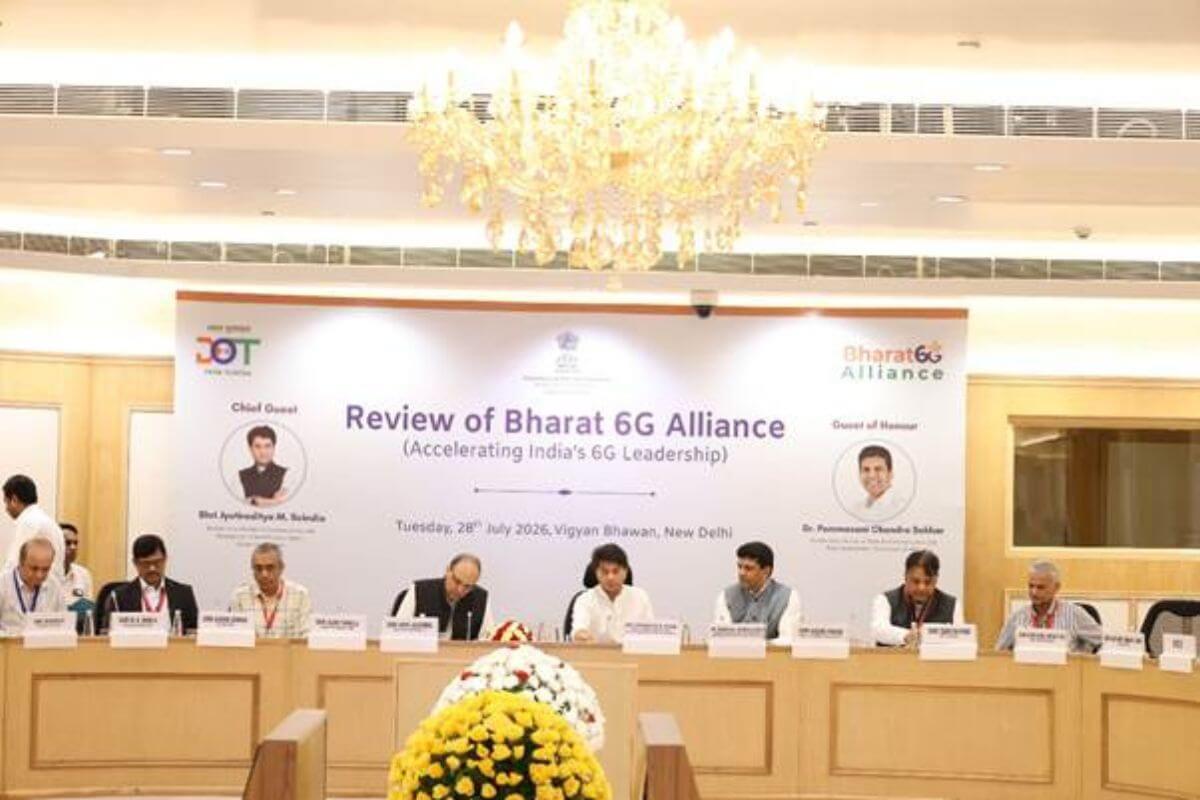
The meeting reviewed the progress of B6GA and its efforts towards advancing India’s 6G ambitions in line with the Bharat 6G Vision document released by Prime Minister Narendra Modi on March 22, 2023. The vision aims to make India a front-line contributor in the design, development and deployment of 6G technology by 2030.
The Bharat 6G Alliance operates through seven specialised working groups covering spectrum, device technology and manufacturing ecosystem, technology, applications, green and sustainability, outreach, and 6G use cases and revenue streams. The discussions focused on accelerating indigenous research and development, strengthening domestic capabilities and ensuring India’s active participation in global 6G standardisation efforts.
According to the official release, members of the alliance collectively hold more than 7,700 patent filings related to 5G and 6G technologies, including over 4,400 international filings, reflecting the growing strength of India’s innovation ecosystem. “India’s participation in the 3GPP has also increased significantly, with the number of Indian participants rising from 717 in 2020 to 1,787 in 2025, while technical contributions increased from 196 to 2,943 during the same period,” the Communications Ministry said.
An update on 6G technology standardisation efforts by the Telecom Standards Development Society, India (TSDSI) was also presented. The meeting highlighted the need for greater Indian participation in global standards development to ensure that the country’s innovations, technologies and use cases contribute to globally relevant 6G frameworks.
The quarterly updates from B6GA working groups highlighted key initiatives across technology development, emerging applications, sustainability, spectrum strategies, device and component manufacturing, and ecosystem outreach. Participants stressed the importance of building a strong end-to-end telecommunications ecosystem by strengthening collaboration among the government, industry, academia, startups and research institutions.
The meeting also witnessed the presentation of the 5G Labs Excellence Awards, recognising institutions for outstanding contributions in 5G and 5G-Advanced technology utilisation, engagement, innovation and overall excellence during January–June 2026.
IIITDM Kurnool dominates 5G Labs Excellence Awards
The Indian Institute of Information Technology Design and Manufacturing (IIITDM) Kurnool secured the top position across all four award categories — 5G Lab Excellence, Utilisation Excellence, Engagement Excellence and Innovation Excellence — for its outstanding performance among 5G Use Case Labs across the country. Other institutions recognised included DKTE Textile & Engineering Institute, IIT Roorkee, IIT Ropar, PEC Chandigarh, THDC Institute of Hydropower Engineering & Technology, Tehri, and IIIT Delhi.
“IIITDM Kurnool secured the first position in all four categories, reflecting its outstanding overall performance among 5G Use Case Labs across the country,” the Communications Ministry added.
Addressing the meeting, Jyotiraditya M. Scindia said India’s 6G journey must be anchored in indigenous research and innovation, strong standards participation, domestic manufacturing, sustainable technologies and global partnerships. He emphasised the need to benchmark India’s progress against global 6G initiatives and identify opportunities for collaboration among the alliance’s working groups.
“There has been a tremendous amount of progress since the last meeting. I would like to congratulate the team on accomplishing set targets and look forward to achieving next set of objectives in a dynamic manner. We should see where all other international grouping are in their progress of achieving 6G and how we compare to them. We should also identify areas of intersections amongst the working groups and how there can be scope of collaborations amongst them”, Scindia said.
The Union Minister suggested to focus on identifying areas of intersection among the seven working groups to foster greater synergy and collaboration, while benchmarking the country’s progress against international 6G groupings to identify gaps, learn from global best practices and further improve its performance. He also noted the participants’ suggestions for greater support from the Ministry and Government, alongside the need to foster a robust ecosystem encompassing academia, research and development, and world-class testing infrastructure to strengthen India’s capabilities in 6G technology.
The Minister also stressed the importance of creating a secure, resilient, sustainable and inclusive telecommunications ecosystem capable of supporting India’s digital aspirations and contributing to global technological advancement. He noted that the convergence of research, innovation, standards, manufacturing and applications will be critical to ensuring that India not only adopts next-generation technologies but also contributes significantly to their global development.
Chandra Sekhar Pemmasani, Minister of State for Communications and Rural Development, highlighted the importance of innovation, research and development, and collaboration among government, industry, academia and research institutions in creating a future-ready telecom ecosystem.
Pemmasani said, “I am pleased to see the remarkable progress made by the Bharat 6G Alliance in bringing together industry, academia, startups and research institutions to shape India’s 6G future. The collective efforts of its stakeholders and working groups have laid a strong foundation for innovation, indigenous technology development and global standardisation. As we move forward, it is essential to further deepen collaboration across all stakeholders, strengthen coordination among the working groups, and accelerate research, testing and standards development.”
According to the Ministry, the Bharat 6G Alliance Review Meeting reaffirmed India’s resolve to accelerate its 6G mission through coordinated efforts in technology, applications, sustainability, spectrum management, manufacturing, standardisation and outreach. “The discussions and interactions provided further momentum to the vision of developing an indigenous, globally interoperable and future-ready telecommunications ecosystem, enabling India to emerge as a significant global hub for 6G innovation, technology, standards and deployment.”
About Bharat 6G Alliance (B6GA)
The Bharat 6G Alliance is a multi-stakeholder collaborative platform comprising academia, industry, startups and public institutions, working towards building a world-class 6G ecosystem in India. The alliance focuses on research and development, innovation and standardisation to advance India’s vision of global leadership in next-generation communication technologies.
Every article you read here is the result of time, research, and effort. If you feel it adds value, you can support TelecomTalk.
 Support Telecomtalk