Reliance Jio Explores Smart Walls to Improve Mobile Coverage as Global Operators Test the Technology
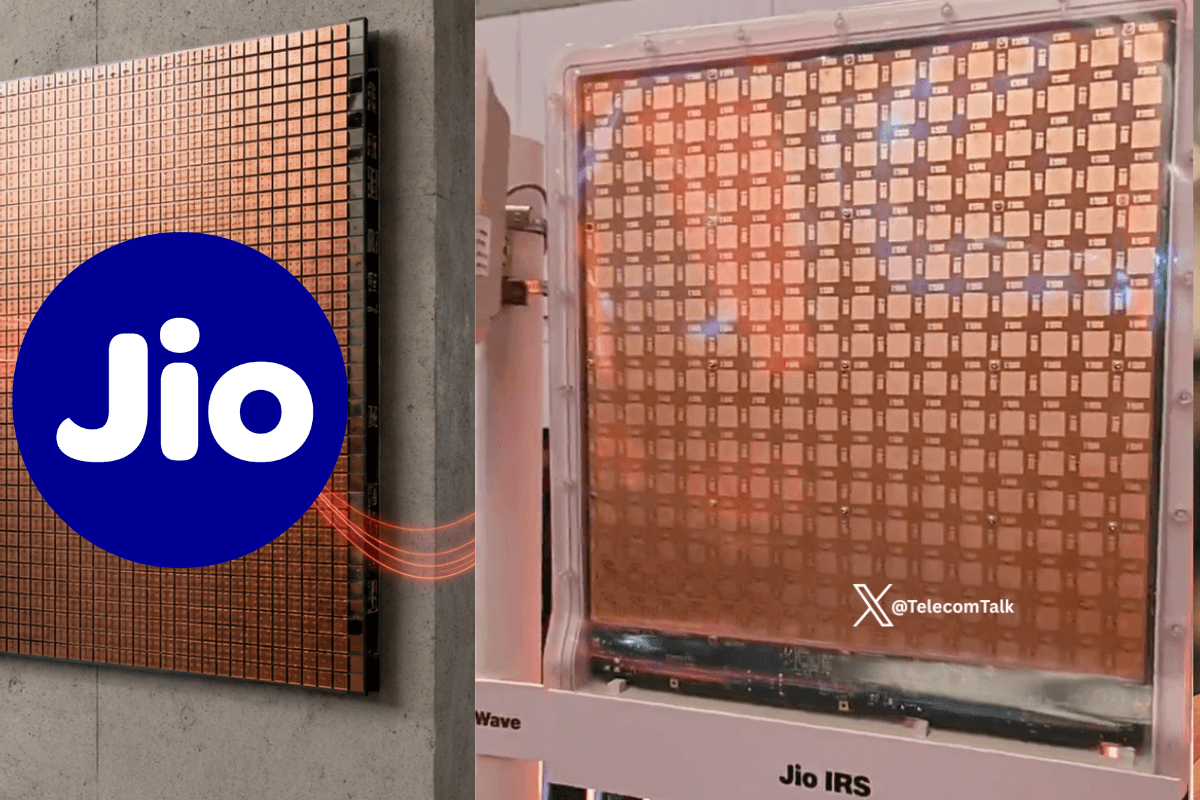
Reliance Jio’s intelligent reflecting surface prototype uses software-controlled beam steering, JioBrain optimisation and less than seven watts of power to redirect mobile signals.
Reliance Jio is exploring intelligent reflecting surfaces that could help mobile networks deliver stronger coverage in locations where conventional signals struggle to reach. Sometimes described as “smart walls,” these programmable panels can redirect radio waves towards areas affected by weak coverage.
Make Telecom Talk My Trusted Source
Key Highlights
Jio has developed an Intelligent Reflecting Surface prototype for future mobile networks.
The prototype uses software-controlled beam steering and JioBrain-based optimisation.
Jio says the low-power prototype operates at less than seven watts.
NTT Docomo and Orange have also tested intelligent-surface technology.
Commercial deployment timelines for Jio’s technology have not been announced
Jio showcased its Intelligent Reflecting Surface, or IRS, prototype as part of its indigenous 6G technology stack at India Mobile Congress 2025. While the technology is associated with future networks, intelligent surfaces could potentially complement existing mobile infrastructure as networks evolve from 5G towards 6G.
The development places Reliance Jio alongside global operators and researchers exploring how the surrounding physical environment can become part of mobile network design.
How Reliance Jio’s Smart Wall Works
An intelligent reflecting surface does not create a mobile signal like a conventional base station it consists of a flat programmable panel containing thousands of tiny reflective elements that can control how radio waves travel.
The idea can be compared to using a mirror to direct light towards a darker part of a room instead of reflecting visible light, however, an IRS redirects radio waves towards a selected location this could potentially help signals travel around obstacles or reach areas where direct coverage is difficult. Such technology could be used in built-up and indoor environments where walls and other physical structures interfere with mobile signals.
The IRS prototype showcased by Jio offered software-controlled beam steering for adaptive signal routing. According to Jio, the prototype also offered high gain, operated at less than seven watts and used JioBrain controllers for AI-driven, real-time adaptation.
Reliance Jio positioned its low-power operation as a feature that could support more sustainable mobile coverage.
A New Layer for Future Networks
Mobile operators traditionally address coverage problems by deploying additional towers, small cells or dedicated indoor coverage systems these solutions will remain important, but installing new equipment may not always be practical because of cost, space, permissions or building-related constraints.
Intelligent surfaces offer a complementary approach. Instead of generating another signal, the panel attempts to make better use of radio waves already available in the surrounding environment.
The technology could be particularly relevant for higher-frequency spectrum, where signals can deliver substantial capacity but face greater difficulty passing through physical obstacles. Structures that currently interfere with radio propagation could eventually carry surfaces designed to guide signals more effectively.
Jio’s exploration indicates that the company is looking beyond conventional network expansion and investing in technologies expected to shape future connectivity.
Global Operators Explore Intelligent Surfaces
Jio is not alone in studying this field telecom operators and technology companies in Japan and Europe have conducted their own intelligent-surface demonstrations.
NTT Docomo and Japanese glass manufacturer AGC announced a successful trial of a transparent dynamic metasurface using 28 GHz 5G signals in 2020 the prototype could control the reflection and transmission of radio waves while remaining transparent enough for potential installation on building windows, vehicles and billboards.
In 2021, Docomo and AGC also conducted a trial using a film-like metasurface lens attached to a window the companies said the technology successfully directed 28 GHz signals arriving from outside towards specific indoor locations and increased signal strength at the targeted points.
Orange presented a low-power reconfigurable intelligent surface prototype in France in 2022. The operator said the technology aimed to improve network coverage and speeds without generating additional radio waves. Orange positioned it as a promising technology for sustainable 6G networks.
These international projects have largely remained trials and research demonstrations rather than widespread commercial deployments. The industry must still determine how the technology performs at scale, integrates with operational networks and works economically across different environments.
Adding India to Emerging 6G Research
Jio’s work adds an Indian-developed prototype to a field being explored by established operators and research organisations globally a commercial deployment timeline has not been announced, and further development will be required before such panels become a regular part of mobile networks. Their performance will also depend on factors such as spectrum, available signal strength, panel placement and the surrounding physical environment.
Nevertheless, Jio’s prototype demonstrates India’s participation in the development of emerging network architecture. If intelligent surfaces prove commercially viable, they could provide operators with an additional tool for improving coverage while making future mobile networks more adaptive and energy-efficient.
Some people read for free. A few choose to support. If you found TelecomTalk useful, you can help keep us running.
FAQs
What is Jio’s smart wall technology?
It is an Intelligent Reflecting Surface containing programmable elements that can redirect radio waves towards locations where direct mobile coverage is difficult.
Does the intelligent surface generate a mobile signal?
No. It does not operate like a mobile tower or base station. It redirects an existing radio signal towards a selected area.
Is Jio’s intelligent reflecting surface commercially available?
No commercial availability or deployment timeline has been announced. Jio showcased the prototype at India Mobile Congress 2025.
How much power does Jio’s IRS prototype consume?
According to Jio, the prototype operates at less than seven watts.
Have other telecom operators tested this technology?
Yes. NTT Docomo conducted metasurface trials with AGC in Japan, while Orange demonstrated a reconfigurable intelligent surface prototype in France.
 Support Telecomtalk