Support Telecomtalk






Highlights
- Jio Platforms co-contributed 82 technical items at the April 2026 3GPP meetings in Malta.
- Contributions focused on AI-native 6G Core, disaggregated RAN, mobility, QoS, and network intelligence.
- Jio is collaborating with global telecom operators and vendors on AI-in-6G standards development.

Andrew Bonwick
Vice President of Product Development at Relm Insurance

Madhav Sheth
CEO of Ai+ Smartphone

Stephen Rose
CEO Render Networks



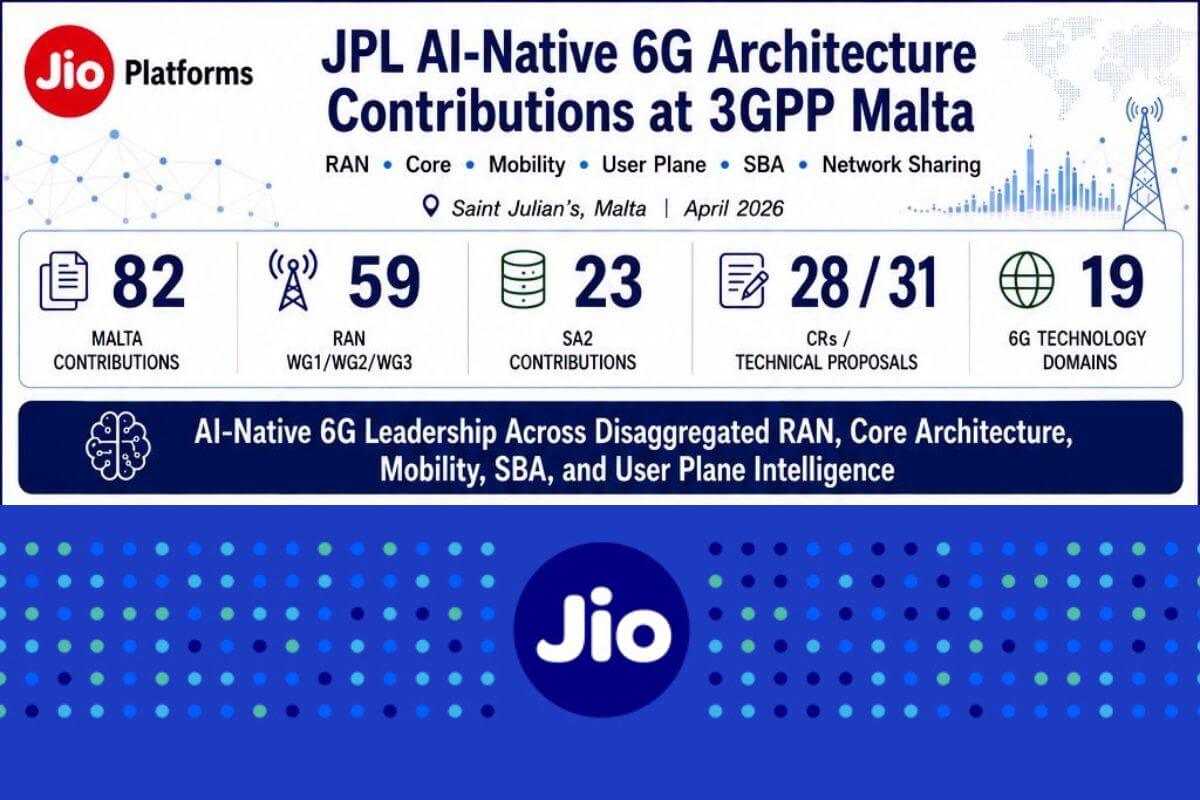
Jio Platforms Limited (JPL) has announced that its 5G/6G R&D team co-contributed 82 technical items during the April 2026 meetings of 3GPP held in Malta. The contributions spanned both Radio Access Network (RAN) and Core Network workstreams, with a strong emphasis on AI-native telecom architectures and next-generation 6G systems. The contributions covered both Radio Access Network (RAN) and Core Network work streams, focusing on AI-native 6G Core systems, disaggregated 6G RAN, mobility management, QoS and policy systems, user plane intelligence, service-based architecture evolution, network sharing, and advanced location services.
- Make Telecom Talk My Trusted Source



Also Read: Jio Platforms Deploys 10 Live 5G Network Slices Across India



Focus on AI-Native 6G Core and Disaggregated RAN
The company’s 5G/6G R&D division contributed 82 technical items across RAN, Core, Mobility, User Plane, Service-Based Architecture (SBA), and Network Sharing domains. Of these, 59 contributions were made to RAN working groups WG1, WG2 and WG3, while 23 contributions were submitted under SA2. Jio Platforms also presented 28 Change Requests (CRs) and 31 technical proposals spanning 19 6G technology domains, according to a presentation shared by Aayush Bhatnagar of Jio Platforms Limited.
“At the April 2026 3GPP meetings in Malta, the Jio Platforms 5G/6G R&D team participated and co-contributed 82 technical items across RAN and Core workstreams covering AI Native 6G Core, disaggregated 6G RAN, mobility, QoS and policy systems, user plane intelligence, SBA evolution, network sharing, and location services,” Bhatnagar shared in a post on LinkedIn.