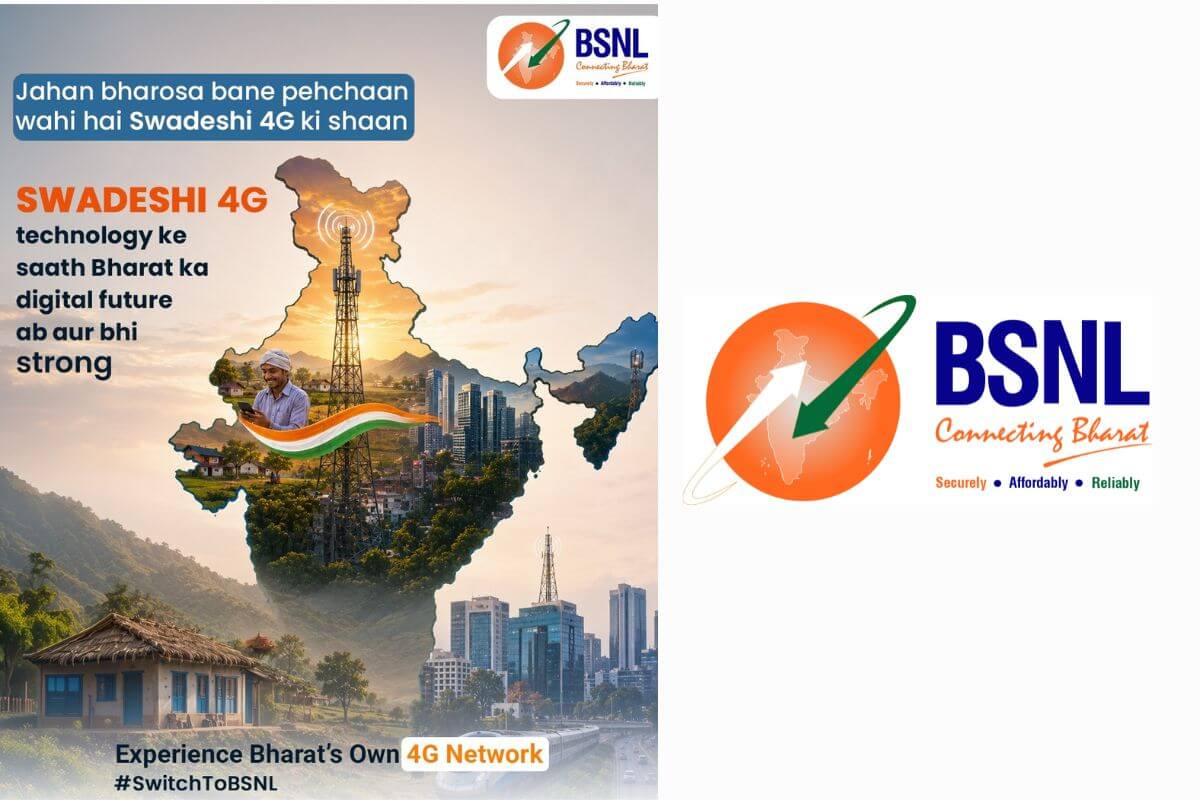
Government says BSNL’s homegrown 4G network has overcome scalability issues as India emerges as the fourth nation to develop indigenous telecom radio equipment.
Union Minister of State for Communications and Rural Development Chandra Sekhar Pemmasani reportedly said state-run Bharat Sanchar Nigam Limited (BSNL) has stabilised its fourth-generation (4G) network, marking a significant milestone in India’s indigenous telecom technology development. He said India has become the fourth country globally to develop telecom radio network equipment using homegrown technology.
Make Telecom Talk My Trusted Source
Key Highlights
Union Minister Chandra Sekhar Pemmasani said BSNL’s indigenous 4G network has now stabilised.
India has become the fourth country globally to develop telecom radio access network (RAN) equipment using homegrown technology.
Tata Consultancy Services, Tejas Networks and Centre for Development of Telematics deployed one lakh 4G sites for BSNL.
BSNL improved network uptime to over 95% after replacing nearly 50,000 batteries, power plants and ageing cables.
The government is closely monitoring BharatNet Phase-3 to connect over six lakh villages with high-speed internet services.
India Achieves Milestone in Indigenous Telecom Technology
“India is only the 4th country that has done (indigenously developed 5G radio) that, and not only installed 100,000 towers, which was a monumental task, but is now scaling the network,” Pemmasani told Economic Times, adding that the development has demonstrated the country’s technological prowess and resolve.
TCS, Tejas Networks and C-DoT Lead Deployment
Following the proof-of-concept (PoC), Tata Consultancy Services (TCS), along with Tejas Networks and the state-owned Centre for Development of Telematics (C-DoT), deployed one lakh 4G sites for BSNL.
The global telecom equipment market is largely dominated by Ericsson, Nokia, Huawei and ZTE. India’s progress in indigenous telecom technology aligns with the Atmanirbhar Bharat initiative and is expected to strengthen the country’s position in overseas telecom markets, according to the report dated May 22, 2026.
Tejas Networks, which has partnered with Japan’s NEC and Rakuten, is also in discussions with global firms to expand its homegrown telecom technology into international markets.
“We were under the impression of some technical problems, but after discussions with the BSNL chairman, the network is now perfected,” the minister added, according to the report.
BSNL 4G Network Overcomes Scalability Challenges
The indigenous network had initially faced scalability challenges. However, close coordination between BSNL and consortium partners helped resolve the issues, paving the way for network expansion.
TCS is expected to receive a follow-on order for nearly 23,000 additional sites after incorporating revised technical specifications recommended by a select committee. In August 2023, Tejas Networks received a Rs 7,492-crore purchase order from TCS to supply its latest 4G-5G radio access network (RAN) equipment for one lakh sites following successful trials in Chandigarh and Ambala.
In May 2025, Tejas Networks secured a Rs 1,525-crore advance purchase order (APO) through TCS for supplying 4G RAN equipment across 18,685 sites as part of BSNL’s network expansion. However, the formal purchase order (PO) is yet to be issued.
The Centre has administratively allocated spectrum to BSNL across the 700 MHz, 800 MHz, 1800 MHz, 2100 MHz, 2500 MHz and 3300 MHz bands at auction-determined prices for rolling out 4G and 5G services.
Government Focuses on Infrastructure and Network Expansion
Pemmasani reportedly said the Department of Telecommunications worked closely with BSNL to replace nearly 50,000 batteries and power plants, besides upgrading ageing cables, helping improve network uptime to over 95 per cent.
“We are not only perfecting the indigenous technology, but also ensuring BSNL has all the right equipment. Now the only thing that BSNL lacks today is additional towers. If we have them at par with the rest of the telcos, we will be able to get a good market,” he added, according to the report.
BharatNet Phase-3 to Boost Rural Connectivity
The minister also reportedly said the government is closely monitoring the amended BharatNet Phase-3 programme, aimed at connecting more than six lakh villages with high-speed internet services to take digital services to the last mile.
“Now, we have tendered (BharatNet) for most states, and we are monitoring like a private industry with a very data-driven and systematic approach,” Pemmasani reportedly said, adding that Phase-3 would ensure accountability among project implementation agencies.
According to the report, BSNL has awarded 16 BharatNet Phase-3 packages, funded by the Digital Bharat Nidhi (DBN), to multiple consortia, with implementation currently at an early stage. In August 2023, the Union Cabinet approved the amended BharatNet programme with an outlay of Rs 1.39 lakh crore.
A small group of TelecomTalk readers helps keep this platform running. Support us if you find our work valuable.
FAQs
What did the government say about BSNL’s 4G network?
The government said BSNL’s indigenous 4G network has stabilised after resolving initial scalability and technical challenges.
Why is India’s telecom achievement significant?
India has become the fourth country globally to develop indigenous telecom radio access network (RAN) technology, reducing dependence on foreign telecom equipment makers.
Which companies are involved in BSNL’s 4G rollout?
The deployment was carried out by TCS, Tejas Networks and C-DoT as part of the indigenous telecom initiative.
What infrastructure improvements were made by BSNL?
BSNL replaced nearly 50,000 batteries and power plants and upgraded ageing cables, helping improve network uptime to over 95 percent.
What is BharatNet Phase-3?
BharatNet Phase-3 is the government’s rural broadband initiative aimed at connecting more than six lakh villages with high-speed internet services across India.
 Support Telecomtalk