That permission may have been given while opening an account, registering for a service, downloading an application or completing a form. However, promotional communication often continues long after the original interaction, leaving customers questioning why they are still receiving such messages.
The fundamental problem is that consent is frequently treated as permanent, even though customer preferences can change.
People may develop different interests, stop using a product, move to another service provider or simply decide that they no longer want to receive communication from a particular brand. Consent granted in the past may therefore no longer represent what a customer wants today.
Should a single instance of consent be sufficient to permit promotional communication indefinitely?
This question sits at the centre of India’s continuing challenge with spam for nearly a decade, India has progressively strengthened the regulatory framework governing commercial communication. The Telecom Commercial Communications Customer Preference Regulations (TCCCPR), the implementation of Distributed Ledger Technology (DLT), entity-registration requirements, template-verification mechanisms and the proposed Digital Consent Acquisition (DCA) framework have together created a comprehensive anti-spam regulatory ecosystem.
The issue is no longer an absence of regulation. The more important question is whether customer consent is being enforced at the right point.
The current regulatory architecture places considerable emphasis on acquiring, recording and validating consent upstream within the messaging ecosystem. Under the proposed DCA framework, Originating Access Providers (OAPs) and associated ecosystem participants have a central role in onboarding enterprises, recording consent and facilitating message origination.
However, these entities do not manage the continuing relationship with the customer receiving the communication.
That responsibility rests with the Terminating Access Provider (TAP), which is the customer’s own telecom operator. The TAP manages customer preferences, handles spam reports and complaints, and carries the primary responsibility for customer protection and trust.
From the customer’s perspective, the TAP is the entity with which there is a direct relationship. It is also the first point of contact when the customer has a complaint or concern. Despite carrying this responsibility, the TAP does not exercise control over the consent-verification mechanism that ultimately determines whether a commercial message is delivered to the subscriber.
This creates a fundamental disconnect in the existing system the entities acquiring and maintaining consent can be several steps removed from the customer relationship. At the same time, the operator expected to protect the customer has limited control over the consent records used to determine whether a message should be delivered.
Consent acquisition and consent enforcement are consequently separated from each other.
The results of this mismatch are becoming increasingly visible within the DLT ecosystem. Of the 32,095 blacklisted entities currently identified on the platform, nearly 87 percent are associated with only two OAP-only telecom operators.
One operator accounts for approximately 53 percent of these blacklisted entities, while another accounts for around 34 percent.
In the quarter ended March 2026, nearly 40 percent of all blacklisted templates were associated with a single operator.
These figures highlight a structural concern. When consent verification is separated from the customer relationship, enforcement depends on records that may no longer reflect the customer’s current preferences consent represents a customer’s intention at a particular point in time. It should be capable of evolving as that intention changes.
In an increasingly digital economy, consent must therefore be treated as dynamic rather than static. It should reflect real-time customer preferences instead of relying exclusively on a historical record.
This is where a TAP-led approach to consent management deserves serious consideration.
Under a TAP-led DCA framework, the subscriber’s telecom operator would capture, validate, store and enforce customer consent. Before a commercial message reaches the customer, the TAP would verify that consent against the subscriber’s current preferences and consent status.
Such an approach would offer several important advantages.
First, it would align accountability with authority. The operator responsible for protecting the subscriber would also have the authority to determine whether a commercial communication should be delivered.
This would remove the existing separation between the entities maintaining consent records and the operator ultimately responsible for customer protection.
Second, a TAP-led approach would enable real-time enforcement. Instead of depending only on historical consent records, verification could consider current customer preferences, consent revocations, complaint history and ongoing engagement.
Third, it would strengthen data governance. Sensitive consent information could remain within the ecosystem closest to the customer. This would reduce unnecessary replication of consent records across multiple intermediaries while supporting stronger confidentiality and oversight.
Fourth, it would provide greater operational agility and support innovation. Customer-facing operators could introduce new security features, protection mechanisms and user controls more rapidly while maintaining interoperability through common industry standards.
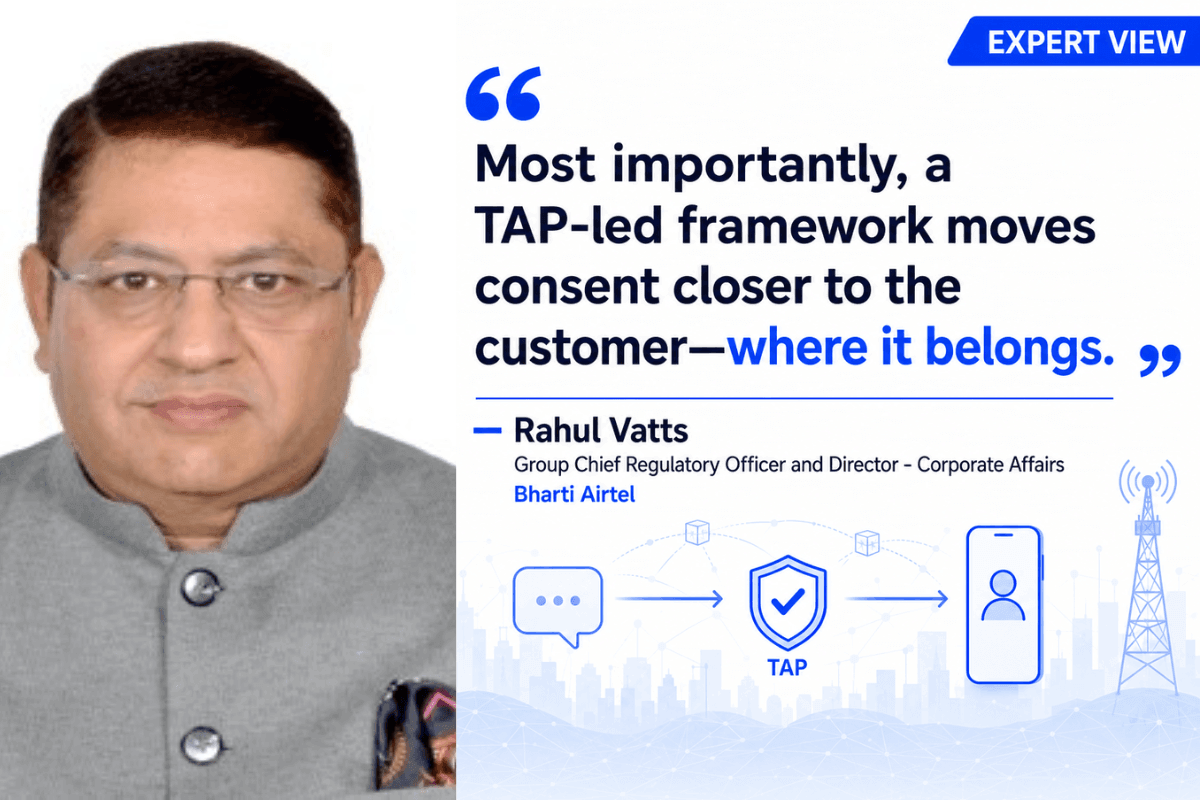
Most importantly, a TAP-led framework would move the enforcement of consent closer to the customer.
India has already established a strong foundation for addressing spam. Existing measures have significantly curtailed the misuse of telecom resources and created a robust compliance ecosystem.
However, fraudulent communication techniques continue to evolve. The focus must now extend beyond validating consent at its source to enforcing it at the point where it matters most: when a message is delivered.
India has demonstrated its ability to develop world-class digital infrastructure. The next step is to ensure that consent enforcement, accountability and customer protection function together within a unified framework.
As digital engagement continues to deepen, customer trust will increasingly depend on whether consent reflects present intent rather than permission granted in the past. Ultimately, meaningful consent should not be defined only when it is collected. It must also be enforced when a message is delivered.
A small group of TelecomTalk readers helps keep this platform running. Support us if you find our work valuable.
FAQs
What is a Terminating Access Provider?
A Terminating Access Provider, or TAP, is the telecom operator serving the customer who receives the commercial communication.
Why should consent verification rest with the TAP?
The TAP maintains the direct relationship with the subscriber, manages customer preferences, receives spam complaints and carries responsibility for customer protection. A TAP-led approach would align this responsibility with the authority to verify consent.
What is the problem with relying on historical consent?
Consent granted while opening an account, registering for a service, downloading an application or completing a form may no longer reflect the customer’s current preferences.
How would a TAP-led DCA framework work?
The subscriber’s telecom operator would capture, validate, store and enforce customer consent. Before delivering a commercial message, the TAP would verify consent against the subscriber’s current preferences and consent status.
What advantages could TAP-led consent verification provide?
The approach could enable real-time enforcement, align authority with accountability, strengthen data governance and allow customer-facing operators to introduce new protection mechanisms and user controls.
 Support Telecomtalk