SpeedGeo Study: India Leads South Asia in Mobile Internet Speed in 2026
India emerged as South Asia’s mobile internet speed leader in 2026, while its fixed broadband download speed increased from 22 Mbps to 69 Mbps between 2020 and 2026, according to SpeedGeo
India recorded significant improvements in mobile and fixed broadband speeds between 2020 and 2026, according to an analysis by SpeedGeo.net. The findings are based on more than 12 million download speed tests conducted through V-Speed apps, operated by SpeedGeo.net. The study covered India, Pakistan, Bangladesh, Sri Lanka, Nepal, Afghanistan and the Maldives.
Make Telecom Talk My Trusted Source
Key Highlights
India emerged as South Asia’s mobile internet speed leader in 2026.
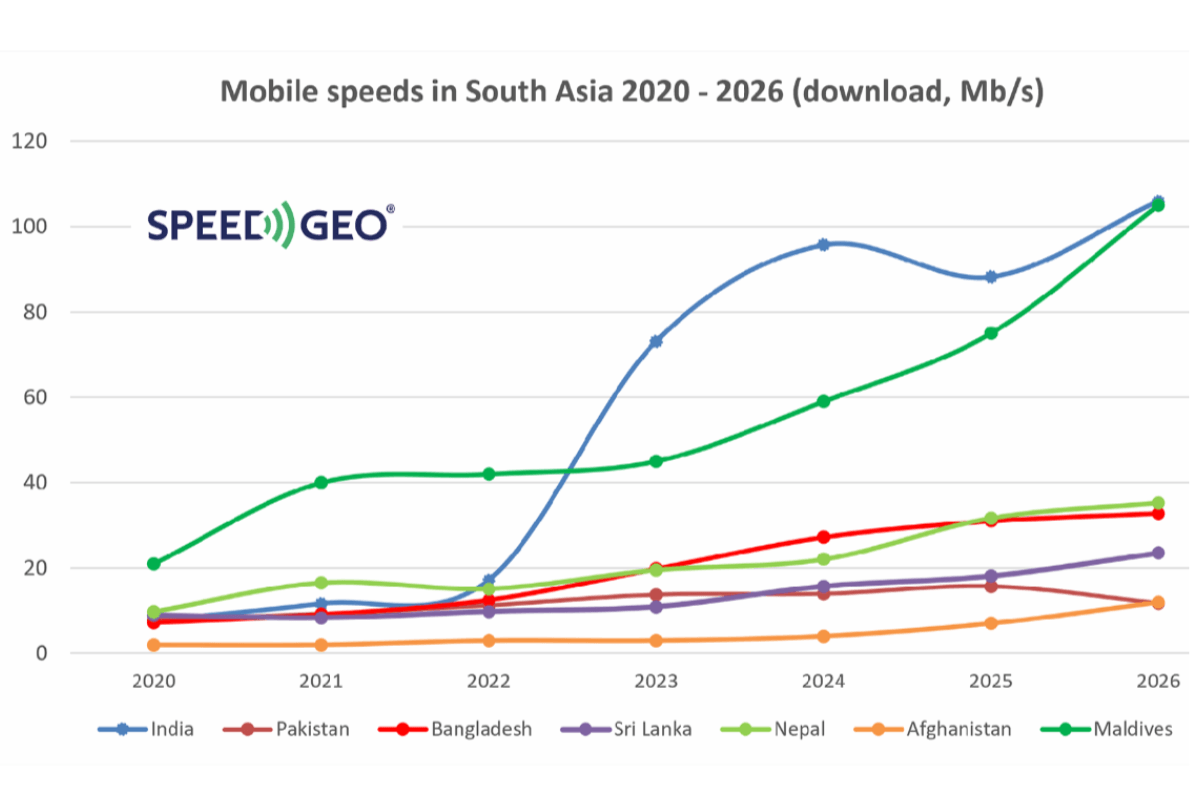
India recorded an average mobile download speed of 106 Mbps, narrowly ahead of the Maldives at 105 Mbps.
India’s mobile download speed rose sharply following the commercial launch of 5G in October 2022.
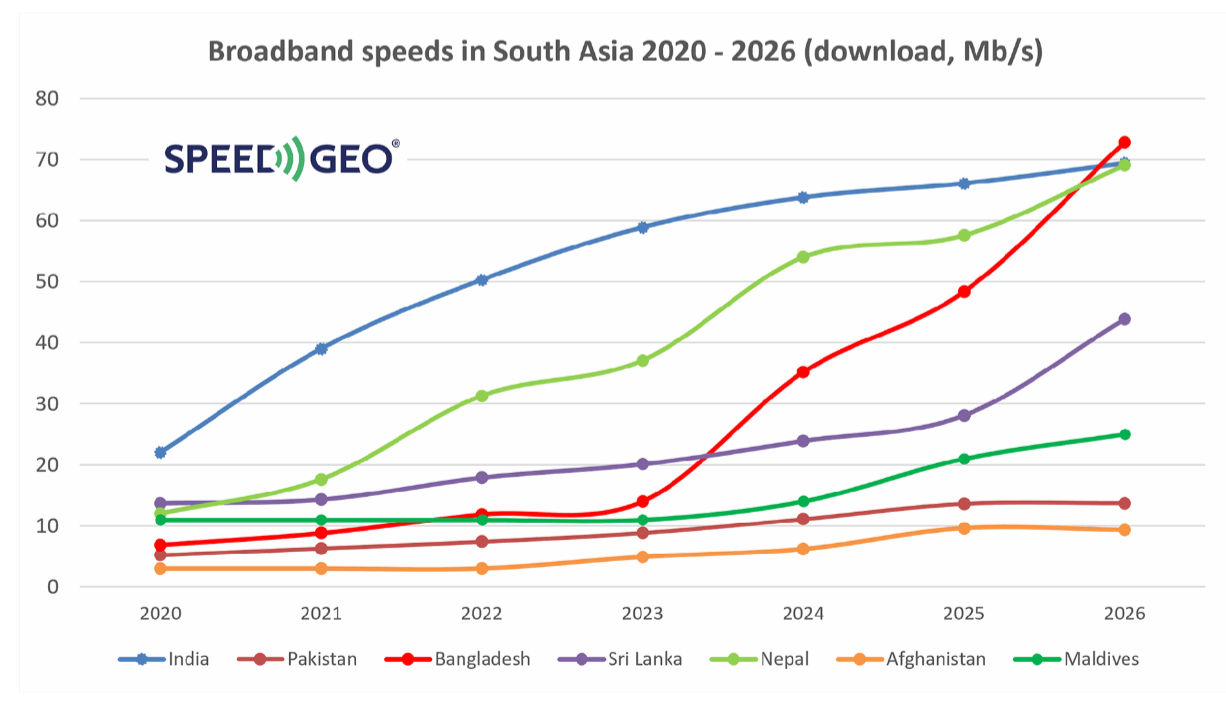
Fixed broadband download speed in India increased from 22 Mbps in 2020 to 69 Mbps in 2026.
Bangladesh led South Asia’s fixed broadband rankings with an average download speed of 73 Mbps.
The findings are based on more than 12 million speed tests conducted through V-Speed apps.
According to the report, network quality across South Asia depends not only on technological advancement but also on political, economic and regulatory factors.
India recorded an average mobile download speed of 106 Mbps in 2026, narrowly surpassing the Maldives at 105 Mbps. SpeedGeo identified India and the Maldives as South Asia’s mobile internet speed leaders. In both countries, the report attributed the results to broad 5G deployments rather than limited trials.
India’s mobile download speed increased from 17 Mbps in 2022 to 73 Mbps in 2023. The report said this sharp improvement was a direct result of the commercial launch of 5G on October 1, 2022, when Reliance Jio and Airtel began building out large 5G networks.
The country’s average mobile download speed increased further to 96 Mbps in 2024 before declining to 82 Mbps in 2025.
According to SpeedGeo, the exponential expansion of the user base likely contributed to this temporary decline. The report described it as a “victim of its own success” scenario, explaining that India had one of the fastest 5G rollouts in the world, but its networks were adding new users faster than operators could add capacity.
By 2026, India remained the regional leader the Maldives finished marginally behind India. It became the first country in South Asia to launch commercial 5G in 2019, with its mobile download speed increasing from 21 Mbps in 2020 to 105 Mbps in 2026.
The report said mobile internet speeds in Bangladesh, Nepal and Sri Lanka also increased, but considerably more slowly than in India and the Maldives, despite the formal launch of 5G in some of these markets. Bangladesh’s mobile download speed increased from 7 Mbps to 33 Mbps. According to the report, this improvement was driven by a maturing 4G network and better backhaul infrastructure, including fibre and submarine cables, rather than 5G.
Nepal’s speed increased from 9.7 Mbps to 35.3 Mbps despite the absence of a full-scale commercial 5G launch. The report attributed the improvement to early 4G deployment and systematic infrastructure expansion. Sri Lanka recorded more subdued growth, with its mobile download speed increasing from 8.9 Mbps to 23.5 Mbps amid the ongoing economic crisis.
Pakistan was the only country in the region where mobile internet performance deteriorated in 2026. Its download speed declined from 16 Mbps in 2025 to 12 Mbps in 2026 despite initial 5G launches in the second quarter of the year. Afghanistan’s mobile speed increased from 2 Mbps to 12 Mbps over the period covered by the study.
India’s Fixed Broadband Speed Rises From 22 Mbps to 69 Mbps
India also recorded steady growth in fixed broadband performance between 2020 and 2026. According to SpeedGeo, India’s fixed broadband download speed increased from 22 Mbps to 69 Mbps. The report said the improvement was driven mainly by services based on the 5G rollout deployed since 2022 and the increasing penetration of fibre-to-the-home services.
Through the BharatNet programme, the government is supporting the expansion of FTTH coverage in rural areas. India did not lead South Asia’s fixed broadband rankings in 2026. Bangladesh took the top position with an average download speed of 73 Mbps, overtaking the previous leader, India. Nepal matched India at 69 Mbps.
The report attributed Bangladesh’s performance to the expansion of its fibre-optic backbone, increased international bandwidth capacity through submarine cables, regulatory changes and competition among local providers relying on fibre-optic technologies such as GPON.
Nepal also recorded significant progress, with its fixed broadband download speed increasing from 12 Mbps to 69 Mbps over the period analysed. Its growth was supported by the expansion of the national fibre-optic backbone, the adoption of FTTH and GPON, and competition between private internet service providers and state-owned Nepal Telecom.
Every article you read here is the result of time, research, and effort. If you feel it adds value, you can support TelecomTalk.
FAQs
Which country had the fastest mobile internet in South Asia in 2026?
India recorded the fastest average mobile download speed in South Asia at 106 Mbps, narrowly surpassing the Maldives at 105 Mbps.
What was India’s average mobile internet speed in 2026?
India recorded an average mobile download speed of 106 Mbps in 2026, according to SpeedGeo.net.
How much did India’s fixed broadband speed increase between 2020 and 2026?
India’s average fixed broadband download speed increased from 22 Mbps in 2020 to 69 Mbps in 2026.
What contributed to India’s mobile internet speed growth?
The report primarily attributed the improvement to the large-scale commercial deployment of 5G networks following their launch in October 2022.
Which country led South Asia in fixed broadband speed in 2026?
Bangladesh led the region with an average fixed broadband download speed of 73 Mbps, ahead of India and Nepal at 69 Mbps each.
 Support Telecomtalk