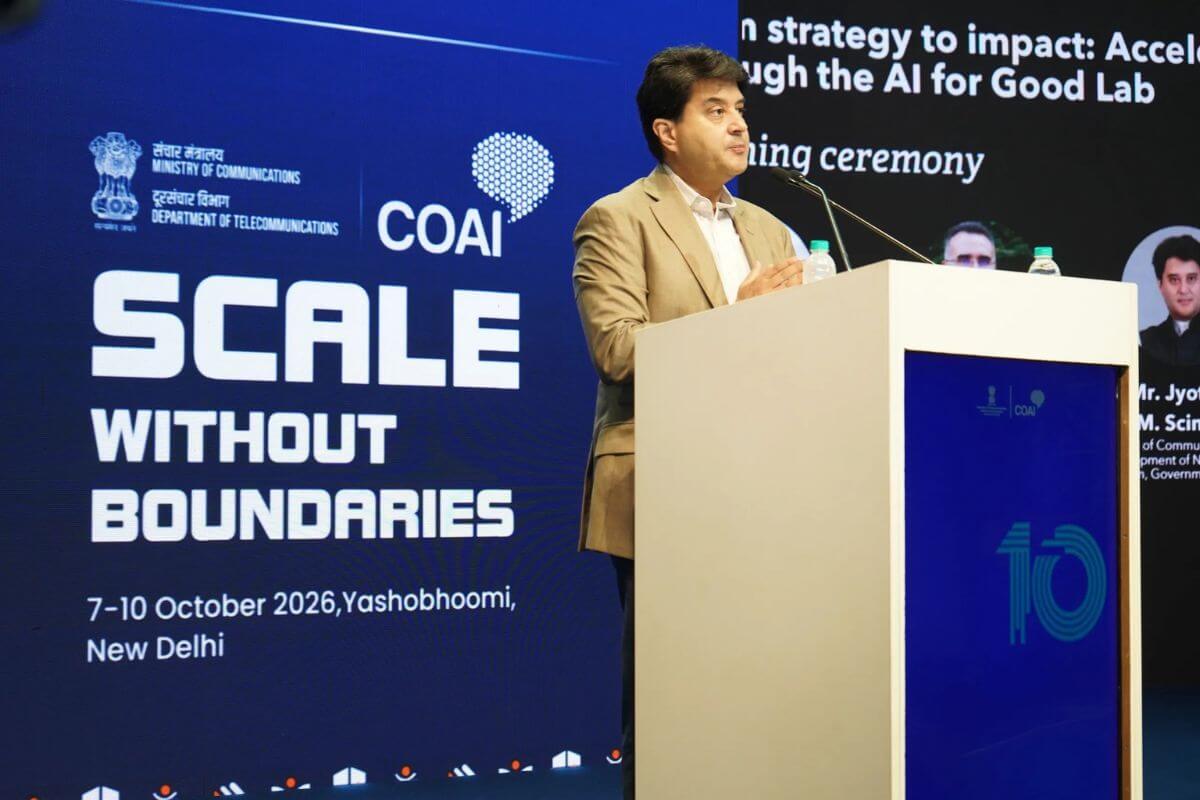
Scindia outlined India’s strategic transition from digital connectivity expansion to global technological leadership. He highlighted that the nation’s rapid rollout of 5G Standalone will serve as the foundational bridge to 6G, marking a historic shift where India actively shapes international communication standards rather than adopting them.
The third day of IMC 2026, held under the theme ‘Scale Without Boundaries’, focused on global 6G standardisation, artificial intelligence-driven telecom networks and deploying resilient cybersecurity frameworks to protect the next billion digital connections. Government leaders, international telecom alliances and technology innovators discussed strategies to strengthen secure network architectures and prepare for the next phase of digital connectivity.
The International 6G Symposium brought together global standardisation bodies and regional alliances to align efforts towards the IMT-2030 roadmap. A dedicated session, ‘Silicon to Sovereignty’, outlined strategies to scale indigenous semiconductor capacity, trusted chip design and deep-tech intellectual property.
AI, Cybersecurity and Subsea Connectivity in Focus
The AI for Good Summit, organised by the International Telecommunication Union (ITU), brought together global institutions, the Centre for Development of Telematics (C-DOT) and industry researchers to establish frameworks for research, policy and deployment of public-interest AI.
Other sessions examined AI-native network defence, telecom supply chain security and the resilience of subsea connectivity infrastructure. Discussions also covered the network API economy, trusted Internet of Things (IoT) systems and the growing energy requirements of telecom networks and AI data centres, highlighting the importance of securing and governing the digital infrastructure underpinning global connectivity.
IMC Emerges as a Global Standardisation Platform
Ramakrishna P., CEO of India Mobile Congress, said: “As we mark our 10th edition, the India Mobile Congress has evolved beyond a technology showcase to become a defining platform for global standardisation. Today’s sessions on the IMT-2030 roadmap and trusted digital architectures prove that India is no longer just a vast market for technology deployment but a critical hub for deep-tech innovation. By uniting international telecom alliances, government bodies and startups, we are ensuring that the frameworks governing the 6G and AI era are built collaboratively, securely and with a vision for true global impact.”
IMC 2026 Attracts Participants from Over 100 Countries
Organised by the Department of Telecommunications (DoT), Ministry of Communications, Government of India, and the Cellular Operators Association of India (COAI), the 10th edition of IMC 2026 welcomed attendees from over 100 countries. The four-day event features more than 600 partners and exhibitors, over 500 startups and 900 thought leaders, showcasing more than 2,000 technology use cases across over 120 sessions.
The event covers a broad range of sectors, including 5G and 6G, next-generation AI networks, semiconductors, non-terrestrial networks, cybersecurity, quantum communication, enterprise transformation, circular economy, environmental, social and governance (ESG) initiatives, and electronics manufacturing.
Quotes from industry Leaders on Inaugural day of India Mobile Congress 2026:
Lt. Gen. Dr. S.P. Kochhar, Director General, COAI “As networks reach every nook and corner of the country, subscriber expectations around bandwidth and network quality continue to rise. Building consumer trust and network resilience is therefore critical. We have started using AI to streamline operations and enhance consumer benefits, but this also brings challenges around skills, employment and infrastructure costs. While AI may disrupt certain jobs, it will also create new opportunities in data science, analysis and AI management. The resulting data demands require us to augment networks faster. Ultimately, the consumer matters most, and we must continue to build trust while addressing these challenges.”
Erik Ekudden, Chief Technology Officer, Ericsson: “In 5G, we are already working on differentiated performance, programmable networks through network APIs and bringing AI into the RAN. Those developments are creating the business conditions and learnings that will carry us into 6G. At the same time, AI is changing the way we think about devices and services, from smartphones and wearables to drones, autonomous vehicles and humanoids. These new use cases will create very different requirements for networks, including greater uplink capacity, more flexible connectivity and services that can support new patterns of data flows. The next step is to build differentiated performance and services around business models that allow this flexibility to translate into real value.”
Sanjeev Dhallam, VP, Core Network & Security, Bharti Airtel: “AI is helping strengthen both consumer protection and network security by improving the speed and visibility with which telecom operators can detect and respond to suspicious activity. However, AI-driven actions need to be supported by the right context and intelligence to ensure accurate decisions. While AI can help automate detection and containment, clear policy guardrails and human oversight remain critical, particularly when it comes to taking sensitive actions that could impact the network.”
Radhey Sarda, SVP & Head Advanced Technologies, Reliance Jio: “Network-as-a-Service is moving from a niche offering to a scalable reality, with 5G Standalone, network slicing and edge computing enabling connectivity tailored to specific needs. From ensuring reliable, priority access for first responders during mass gatherings to powering low-latency, high-bandwidth applications in smart manufacturing, NaaS is driving business agility while strengthening network resilience. These use cases demonstrate how programmable networks can deliver measurable value across industries and serve as scalable models for India and the world.”
Ankit Goel, Founder and Chairman, Space World Group: “Physical network security is a critical part of the digital infrastructure ecosystem. As an IP1 player, the focus is on building a secure physical network in line with government guidelines. Network design is planned with a long-term outlook of at least 25 years, with security measures incorporated at the deployment stage to address challenges such as fibre cuts and infrastructure requirements in remote locations. Engagement with local authorities, from the panchayat level to regulatory bodies, further supports network security. A robust Network Operations Centre (NOC), supported by IoT devices, enables network monitoring and helps maintain a secure and reliable infrastructure backbone, ensuring service continuity and a consistent user experience.”
Robert May, Executive Vice President of Technology and Product Management, Fortinet, “As organisations accelerate AI adoption to drive business growth and efficiency, they must balance innovation with robust data protection, regulatory compliance and digital sovereignty. The way forward lies in two complementary approaches, ‘Security for AI’ – to safeguard AI applications, infrastructure and sensitive data against emerging threats; and ‘AI for Security’ – to help security teams automate operations, accelerate threat detection and response, and manage growing complexity more effectively. Telecom and service providers will also play a vital role in extending these advanced security capabilities to businesses of all sizes, enabling them to adopt AI with greater confidence.”
Vibha Mehra, India Country Manager, Nokia, “As an industry, there has to be a very conscious effort to create a plan on how to move forward, not just as a telecom industry, but as a tech industry. This has to be done in partnership and at scale. If the right technologies are not adopted and brought into everything that is done, the industry will be left behind. Reskilling and upskilling are essential, and there has to be good collaboration between industry, government and universities. The ability to keep changing and adjusting to the changing environment is a critical skill.”
Jeanette Whyte, Head of Public Policy, APAC, GSMA, “As India accelerates its digital transformation, building a safer and more trusted online ecosystem is essential to sustaining consumer confidence and unlocking the full potential of the country’s digital economy. Addressing online scams, cyberbullying and other forms of digital harm requires moving beyond a compliance-led approach to one that embeds security, privacy and user protection into the design of digital services. Closer collaboration between technology platforms, telecom operators, policymakers and industry stakeholders, supported by a risk-based approach to security, will be critical to protecting users without compromising inclusion and ease of access. A collective commitment to digital trust will be fundamental to India’s ambition of becoming a global digital leader.”
Dr. Dilip Krishnaswamy, Executive Vice President – III, C-DOT, “The future of connectivity lies in making it ubiquitous, intelligent and sustainable. We are exploring how satellite-enabled networks, edge AI and 6G technologies can bring essential services to remote communities, strengthen disaster response and create new economic opportunities for rural India. By combining indigenous innovation with collaborative research, we can ensure that the benefits of digital transformation reach every community and advance the vision of Viksit Bharat.”
Also in the IMC 2026 Series:
Reference 1: Union Minister of Communications Jyotiraditya Scindia Reviews Final Preparations for IMC 2026
Reference 2: IMC 2026: PM Modi Discusses Digital Inclusion, 6G, AI With GSMA Board
Reference 3: IMC 2026: Bharti Airtel Announces Free International Roaming With All Its Postpaid Plans
Reference 4: IMC 2026: Vi to Showcase AI-Powered Innovations and Intelligent Connectivity Solutions
Reference 5: IMC 2026: Reliance Jio Showcases India-Built AI and Connectivity Innovations
Reference 6: IMC 2026: Ericsson Showcases 5G, AI and 6G Innovations
Reference 7: IMC 2026: Ericsson Scales Up AI-Ready Antenna Manufacturing in India
Reference 8: IMC 2026: Starlink Has Set Up Over 20 Gateway Sites in India, Says VP Lauren Dreyer
Reference 9: IMC 2026: Scindia Reviews Airtel’s Future-Ready Digital Infrastructure at Airtel Booth
Reference 10: IMC 2026: Jio Developing Indigenous Satellite Stack, Files Pre-6G Patents, Says Akash Ambani
Reference 11: IMC 2026: Jio Plans Satellite Network to Connect Over 600,000 Villages, Maritime and Border Areas
Reference 12: IMC 2026: Vi Business, Hindalco Partner to Deploy Private Network at Odisha Bauxite Mine
Reference Out of IMC: Average Revenue per GB of Wireless Data Drops 10.59 Percent to Rs 8.02 in FY26: TRAI
Reference 13: IMC 2026: Cost of 1 GB of Data Has Fallen from Rs 268 in 2014 to Rs 8 Now, Says Scindia
Reference 14: IMC 2026: India Moving Towards End-to-End Telecom Value Chain, Shaping the Rules, Equipment and Innovation: Scindia
Reference 15: IMC 2026: Viksit Tech 47 Report Sets Target of 50 Indian Tech Brands With Rs 1 Lakh Crore Revenue by 2047
Reference 16: IMC 2026: Jio Will Always Stand for Affordability, Says Akash Ambani
Reference 17: IMC 2026: India Targets 10 Percent of Global 6G Patents and Standards: MoS Communications
Reference 18: IMC 2026: MeitY Pavilion Showcases India’s Digital Innovation and Emerging Technology Capabilities
If this article saved you time or helped you decide better, consider supporting our work.
 Support Telecomtalk