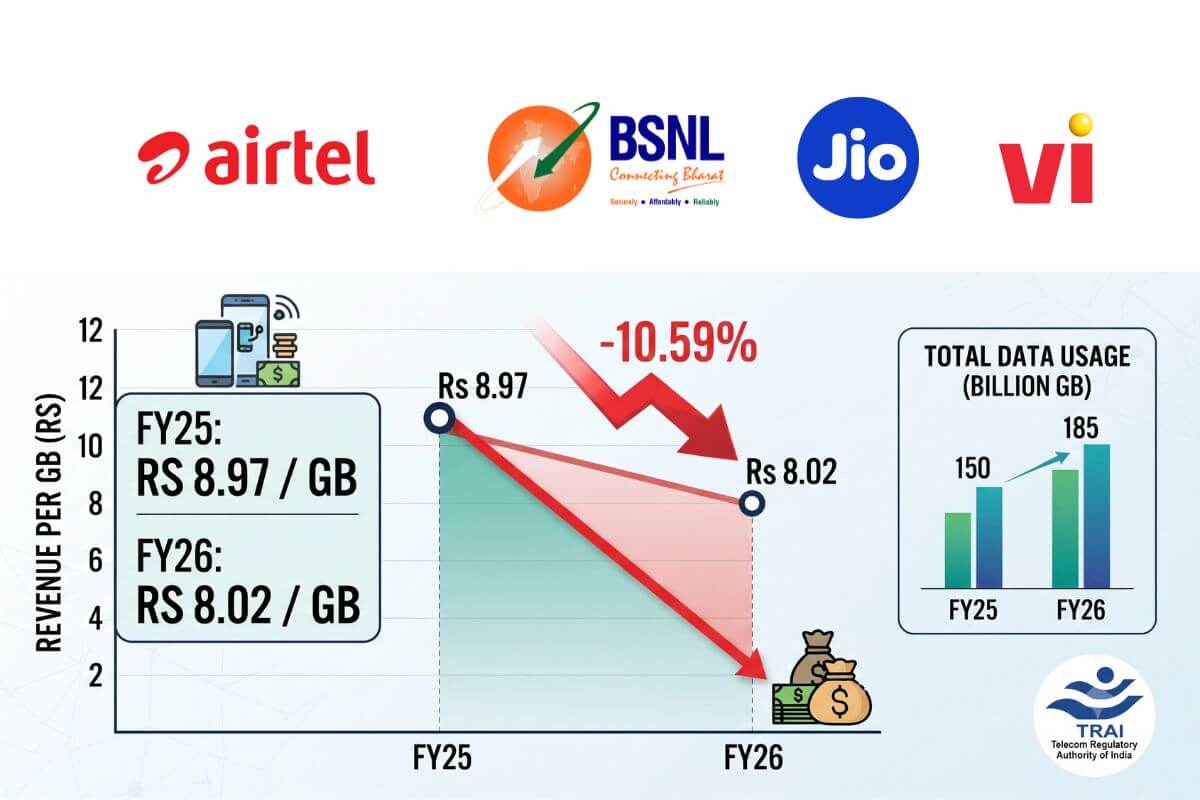
The average revenue realization per GB of wireless data declined 10.59 percent to Rs 8.02 in 2025-26 from Rs 8.97 in the previous financial year (2024-25), even as wireless data consumption continued to surge, according to the Telecom Regulatory Authority of India (TRAI).
The number of wireless data subscribers increased 9.29 percent to 1,026.75 million as of March 2026 from 939.51 million a year earlier. Average wireless data usage per wireless data subscriber per month rose 18.49 percent to 25.51 GB from 21.53 GB.
Overall internet subscriptions increased 12.76 percent to 1,092.79 million at the end of March 2026 from 969.10 million a year earlier. Broadband subscribers rose 12.90 percent to 1,065.88 million, while narrowband subscribers increased 7.72 percent to 26.91 million.
Wireless service ARPU rose 3.59 percent to Rs 180.73 per month in 2025-26 from Rs 174.46 in 2024-25. Prepaid ARPU stood at Rs 190.66 per month, while postpaid ARPU was Rs 119.76. Average monthly minutes of usage (MOUs) per subscriber stood at 950, with postpaid users recording 305 minutes and prepaid users 1,055 minutes.
Reference: India Has Evolved into a Data-First Telecom Market, with Voice as a Complementary Service: Private Telcos
Telephone Subscriber Base Grows 10.81 Percent
The total telephone subscriber base grew 10.81 percent to 1,330.58 million at the end of March 2026 from 1,200.80 million. Overall tele-density rose 9.66 percent to 93.26 percent from 85.04 percent.
Urban Telecom Growth Outpaces Rural
Urban telephone subscriptions increased 16.92 percent to 778.79 million, taking urban tele-density to 151.47 percent from 131.45 percent. Rural subscriptions grew 3.20 percent to 551.79 million, while rural tele-density increased to 60.46 percent from 59.06 percent. The rural share of total telephone subscriptions, however, declined to 41.47 percent from 44.53 percent.
Wireless Services Dominate Telephone Market
Of the total telephone subscriber base, wireless (mobile + fixed wireless access) subscribers accounted for 1,282.33 million and wireline subscribers for 48.25 million at the end of March 2026. Wireless subscribers increased 10.19 percent to 1,282.33 million, with a net addition of 118.58 million during the year.
Wireless Tele-Density Rises
Overall wireless (Mobile+FWA) tele-density rose to 89.88 percent from 82.42 percent. Rural wireless tele-density increased to 59.89 percent from 58.67 percent, while urban wireless tele-density climbed to 143.10 percent from 124.83 percent.
Mobile Subscriber Base Adds 108.74 Million
Wireless mobile subscribers increased 9.40 percent to 1,265.73 million from 1,156.99 million, with a net addition of 108.74 million during the year. Mobile tele-density rose to 88.71 percent from 81.94 percent. Rural mobile tele-density increased to 59.08 percent from 58.40 percent, while urban mobile tele-density rose to 141.30 percent from 123.99 percent.
Wireline Subscriber Base Jumps 30.25 Percent
Wireline subscriptions recorded a sharper growth of 30.25 percent, rising to 48.25 million from 37.04 million. Wireline tele-density increased to 3.38 percent from 2.62 percent, with rural tele-density rising to 0.57 percent from 0.39 percent and urban tele-density to 8.37 percent from 6.62 percent.
Telecom Sector Revenue Crosses Rs 4 Lakh Crore
The telecom sector’s gross revenue increased 8.59 percent to Rs 4,04,067 crore in 2025-26 from Rs 3,72,097 crore. Applicable Gross Revenue (ApGR) rose 7.12 percent to Rs 3,81,645 crore, while Adjusted Gross Revenue (AGR) increased 10.44 percent to Rs 3,34,659 crore from Rs 3,03,025 crore.
Pass-Through Charges Decline
Pass-through charges declined 13.63 percent to Rs 45,673 crore from Rs 52,879 crore, with their share of gross revenue falling to 11.30 percent from 14.21 percent. Spectrum Usage Charges (SUC) increased 6.12 percent to Rs 4,040 crore from Rs 3,807 crore in the year 2024-25, while licence fee collections rose 10.40 percent to Rs 26,763 crore from Rs 24,242 crore during the same period.
Access Services Drive AGR Growth
Access services accounted for 83.95 percent of the telecom sector’s total AGR. During 2025-26, gross revenue, ApGR, AGR, licence fee and spectrum usage charges in access services increased 7.32 percent, 6.77 percent, 10.85 percent, 10.84 percent and 6.26 percent, respectively, while pass-through charges declined 16.46 percent.
917 Private Satellite TV Channels Permitted
In the television sector, around 917 private satellite TV channels had been permitted by the Ministry of Information and Broadcasting as of March 31, 2026, for uplinking, downlinking or both. Of these, 908 were available for downlinking in India. TRAI said 342 were pay channels, comprising 238 standard-definition and 104 high-definition channels, while the remaining 566 permitted channels were considered free-to-air (FTA).
Pay DTH Subscriber Base Falls
The pay DTH segment continued to contract, with four pay DTH service providers reporting a net active subscriber base of around 49.05 million as of March 31, 2026, down from 56.92 million a year earlier. This is in addition to the subscribers of the free DTH services of Doordarshan, TRAI said.
Private FM Radio Expands Reach
Private FM radio expanded marginally, with 390 operational private FM channels across 120 cities as of March 31, 2026, compared with 388 channels across 113 cities a year earlier. The number of private FM radio operators stood at 31, compared with 33 in the previous year.
FM Radio Advertising Revenue Declines
However, advertising revenue reported by FM radio operators declined to Rs 1,616.42 crore in 2025-26 from Rs 1,818.71 crore in 2024-25. Community radio stations increased to 564 as of March 31, 2026, from 531 a year earlier.
TRAI Report Tracks Telecom and Broadcasting Trends
TRAI said the annual performance report provides a broad overview of India’s telecom services and key trends in cable TV, DTH and radio broadcasting for the period from April 1, 2025, to March 31, 2026. The report is compiled primarily from information furnished by service providers.
If this article saved you time or helped you decide better, consider supporting our work.
 Support Telecomtalk