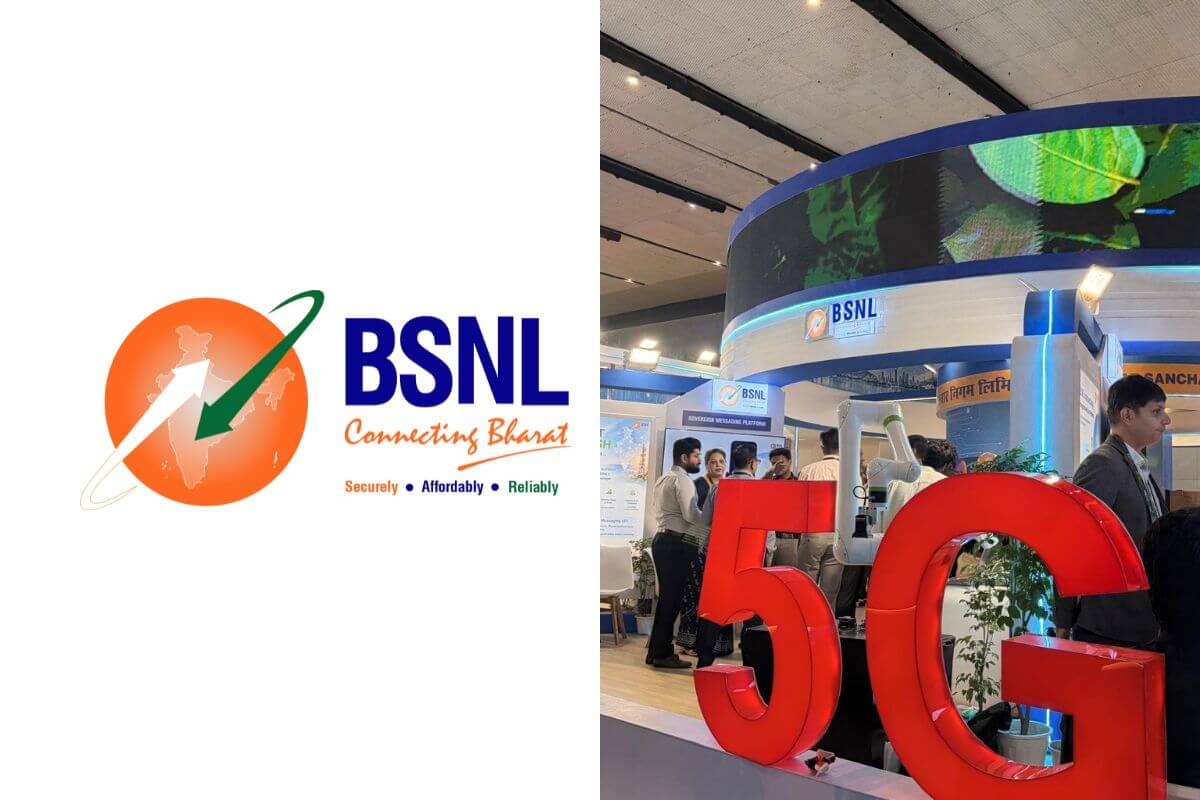
He said that the ground is prepared for the upcoming network transition to 5G and expects customers to take pride in using an indigenous network. “rest assured, we are all geared up for the growth of the 5G network again in the times to come, and customers definitely will have the pride of us being on the indigenous 5G network.”
At the event, BSNL also showcased upgrades to its automated customer interface, Vani, which has been integrated with the core network to help subscribers identify and resolve connectivity issues through regional languages.
“Foremost is our customer-centric initiative where my chatbot Vani has been further powered with the network brain and we have brought the customer now very close to what actual network health is, and in the native language, customer can interact with Vani,” Dua said.
“Get what the challenge the customer is facing is and, if required, a complaint also gets booked over the voice conversation, and rest assured, with the minimal possible time the customer will have the problem fixed,” he added.
Partnership to Strengthen Network Security
BSNL has also partnered with cybersecurity firm Saptang to deploy an indigenous data-filtering mechanism within its core network. The system is aimed at addressing security threats before potentially harmful traffic reaches end-user devices.
“We have partnered with Saptang to bring the best in technology for the filtering of data, for protecting the customer data, and a lot of challenges that customers face. We want to have those things attended to right in the heart of the network so that the end devices customer may have anything, but the data which flows in and out of the device is pure, clear data without any challenges to the customer,” Dua stated.
Bharat Sandesh to Enable Unified Digital Communication
The telecom operator also unveiled ‘Bharat Sandesh’, a two-way digital communication platform that will enable verified interactions between citizens, government agencies and private entities such as banks and utility providers through a single interface.
“On this platform, not only the government but the private enterprises also will be able to communicate. So if I’m a customer and I am a subscriber to, let us say, a bank, electricity company, a water company, and then of course the other agencies, all of them into one single screen, I can interact, I can select, I can chat. Again, this is all AI-powered, and a voice interaction is there,” Dua said.
Government Support Drives Indigenous Telecom Push
Dua also credited government support for the development of indigenous telecom infrastructure and the expansion of connectivity initiatives such as BharatNet across remote parts of the country.
“Our government has always been very, very supportive, has been doing phenomenal work in all financial and technical support, and as you understand, the 4G indigenous thing has come up only because of the government support, and that’s the first success,” he said.
“The Bharat Net project is also reaching every nook and corner of the country. This is a grand success for the digital inclusion of all masses across the country,” Dua added.
BSNL Plans 25,000 More Towers, Explores Roaming Arrangement With Vi
In another development, speaking about BSNL’s further network expansion plans, Minister of State for Communications Chandra Sekhar Pemmasani said, “We are getting another 25,000 towers, orders have already been placed. And we are also working on getting another 25 to 50,000 towers depending on our cash flow and other stuff. So over the next one year, I think we will have a lot of capacity expansion in BSNL. And there is also an effective… some people may say, you know, BSNL or Vodafone [Vi] doesn’t have an adequate coverage. If you look at it, Vodafone [Vi] and BSNL have been working together in terms of creating intra-circle roaming. There are a couple circles that we have experimented, and people are able to latch either to the network. And we want to see if that can be taken further before, you know, individually these companies expand the network coverage.”
Asked about the circles in which an inter-circle roaming agreement could be implemented between them [BSNL and Vi], he said, “… this is a pilot we are testing in a couple circles right now. It’s going very well. And, you know, obviously this has to be discussed and there are some revenue adjustments. And as soon as we know, we will let you know. It has not been finalized.”
Submer India, BTCL Sign MoU to Explore AI-Ready Data Centre Infrastructure
Submer India Private Limited (Submer) and BSNL Tower Corporation Limited (BTCL), a wholly owned subsidiary of Bharat Sanchar Nigam Limited (BSNL), have signed a Memorandum of Understanding at the India Mobile Congress 2026 to explore the development of sovereign, AI-ready data center infrastructure across India.
The collaboration will focus on infrastructure to meet the growing requirements of artificial intelligence (AI) and high-performance computing. The companies will jointly assess opportunities in GPU-as-a-Service, sovereign AI cloud infrastructure, edge and micro-edge data centres, and large-scale data centre projects of up to 20 MW.
According to an official release dated October 10, 2026, the parties will also evaluate the suitability of BSNL premises and data centre facilities for transformation into distributed edge infrastructure. The assessments will consider technical and commercial feasibility, connectivity, scalability, energy efficiency, and the requirements of government departments, public sector undertakings (PSUs), enterprise, research, and institutional workloads.
BSNL Sees Opportunity to Support Sovereign AI Capabilities
“AI will play an increasingly important role in India’s digital transformation, creating demand for secure, high-performance computing infrastructure that can serve the country at scale,” said Robert Jerard Ravi, Chairman and Managing Director, BSNL. “This MoU marks an important step in evaluating how BSNL’s nationwide infrastructure and connectivity footprint can support sovereign AI capabilities. Our collaboration with Submer will help us explore an infrastructure model designed around India’s long-term digital priorities.”
“Government bodies and enterprises need a practical path to adopt AI without compromising performance, security, or data sovereignty,” said Sudhakar Rao Papa, Director, Enterprise Business, BSNL. “By assessing GPU-as-a-Service, sovereign cloud and distributed edge infrastructure, this collaboration aims to bring AI computing capacity closer to organizations across India and support a broader range of public-sector and enterprise applications.”
“India’s next phase of digital growth will depend on secure, scalable, and locally available computing infrastructure,” said Jitendra Garg, ITS, PGM (BTCL) BSNL Corporate Office. “This collaboration combines BSNL’s extensive nationwide network and strategic facilities with Submer’s expertise in advanced data center systems. It gives us a strong foundation from which to evaluate new AI infrastructure opportunities for public-sector and enterprise customers.”
“India has the talent, demand, and digital reach to become a global AI infrastructure leader. The next step is to build the physical capacity that turns that ambition into deployable compute,” said Anupam Shrivastava, Submer India Head. “Together with BTCL, we are bringing infrastructure, network reach, and engineering expertise into one model. Our goal is clear: make sovereign AI capacity available where it is needed, from strategic edge locations to large-scale AI data centers.”
Submer to Bring Data Centre and Liquid-Cooling Expertise
Under the MoU, Submer said it will apply its expertise in integrated data center architecture, liquid cooling, thermal management, and high-density computing. Cooling, power, facilities, and IT infrastructure will be considered as one system from the outset, helping the parties assess infrastructure designed for the density and efficiency requirements of modern AI.
BTCL will coordinate access to relevant BSNL premises and data center facilities for technical and commercial feasibility studies. It will also support connectivity, regulatory alignment, and engagement with government and enterprise stakeholders.
Sovereign AI Cloud and GPU-as-a-Service Among Key Focus Areas
A key area of assessment will be a sovereign AI cloud model that draws on BSNL’s network footprint and indigenous 4G and 5G core to support scalable, low-latency GPU-as-a-Service. The proposed model is intended to give government bodies and enterprises access to AI computing capacity while keeping infrastructure and data processing aligned with national requirements.
The collaboration will also include coordinated opportunity development, stakeholder engagement, technical workshops, and enablement programmes to support the adoption of AI infrastructure across India.
“The MoU reflects a shared ambition to build the infrastructure behind India’s AI economy: sovereign by design, distributed where required, and engineered for the density and efficiency of modern computing,” the joint statement said.
Also in the IMC 2026 Series:
Reference 1: Union Minister of Communications Jyotiraditya Scindia Reviews Final Preparations for IMC 2026
Reference 2: IMC 2026: PM Modi Discusses Digital Inclusion, 6G, AI With GSMA Board
Reference 3: IMC 2026: Bharti Airtel Announces Free International Roaming With All Its Postpaid Plans
Reference 4: IMC 2026: Vi to Showcase AI-Powered Innovations and Intelligent Connectivity Solutions
Reference 5: IMC 2026: Reliance Jio Showcases India-Built AI and Connectivity Innovations
Reference 6: IMC 2026: Ericsson Showcases 5G, AI and 6G Innovations
Reference 7: IMC 2026: Ericsson Scales Up AI-Ready Antenna Manufacturing in India
Reference 8: IMC 2026: Starlink Has Set Up Over 20 Gateway Sites in India, Says VP Lauren Dreyer
Reference 9: IMC 2026: Scindia Reviews Airtel’s Future-Ready Digital Infrastructure at Airtel Booth
Reference 10: IMC 2026: Jio Developing Indigenous Satellite Stack, Files Pre-6G Patents, Says Akash Ambani
Reference 11: IMC 2026: Jio Plans Satellite Network to Connect Over 600,000 Villages, Maritime and Border Areas
Reference 12: IMC 2026: Vi Business, Hindalco Partner to Deploy Private Network at Odisha Bauxite Mine
Reference Out of IMC: Average Revenue per GB of Wireless Data Drops 10.59 Percent to Rs 8.02 in FY26: TRAI
Reference 13: IMC 2026: Cost of 1 GB of Data Has Fallen from Rs 268 in 2014 to Rs 8 Now, Says Scindia
Reference 14: IMC 2026: India Moving Towards End-to-End Telecom Value Chain, Shaping the Rules, Equipment and Innovation: Scindia
Reference 15: IMC 2026: Viksit Tech 47 Report Sets Target of 50 Indian Tech Brands With Rs 1 Lakh Crore Revenue by 2047
Reference 16: IMC 2026: Jio Will Always Stand for Affordability, Says Akash Ambani
Reference 17: IMC 2026: India Targets 10 Percent of Global 6G Patents and Standards: MoS Communications
Reference 18: IMC 2026: MeitY Pavilion Showcases India’s Digital Innovation and Emerging Technology Capabilities
Reference 19: IMC 2026: India Has Already Built Its Own 4G Stack and Deployed It Across the Country: Scindia
Reference 20: IMC 2026 Concludes With Focus on Agri-Food AI, Autonomous 5G AI Agents, and Last-Mile Digital Delivery
Reference 21: IMC 2026: Airtel CEO Says Entry-Level, Inclusive Plans Have to Stay Where They Are
Found this useful? You can support us.
 Support Telecomtalk