The 10th edition of the India Mobile Congress (IMC) 2026 concluded on Saturday, October 10, 2026, after four days of discussions, multilateral collaboration and technology showcases, highlighting India’s growing role in global digital innovation. Held under the theme ‘Scale Without Boundaries,’ the concluding day focused on practical applications of artificial intelligence (AI) in agriculture, youth-led robotics, autonomous 5G AI agents and last-mile digital connectivity.
Inaugurated by Prime Minister Narendra Modi, the decadal edition emphasised indigenous intellectual property (IP), sovereign semiconductor capabilities and India’s ambitions in next-generation telecommunications. Communications Minister Jyotiraditya M. Scindia outlined the country’s target of securing 10 percent of global 6G patents, underscoring its efforts to contribute to international telecom standards.
Ramakrishna P., CEO of India Mobile Congress, said, “The 10th edition of India Mobile Congress has set a decisive benchmark for how digital forums drive actionable transformation. Over the past four days, IMC 2026 demonstrated that India’s digital narrative is no longer confined to rollouts and scale; it is about setting international benchmarks, incubating sovereign technologies and driving purposeful innovation. From International 6G Symposium to our concluding focus on agricultural AI and youth robotics, this edition has shown the world that India is building an inclusive, resilient and self-reliant technological ecosystem that scales without boundaries.”
The final day (Day 4) placed particular emphasis on sector-specific AI applications, led by the Global Initiative on AI for Agri-Food Systems Meeting, organised in collaboration with the International Telecommunication Union (ITU). The discussions focused on leveraging AI to strengthen agricultural and food systems. The event also featured the Robotics for Good Youth Challenge India, organised by the ITU and IIT Delhi’s I-Hub Foundation for Cobotics (IHFC), with support from the Department of Telecommunications (DoT), to promote grassroots innovation and develop future-ready talent.
Build-A-Thon Explores Autonomous 5G AI Agents
Developer capabilities and network automation were also in focus at the ITU Build-A-Thon, where engineers worked on autonomous AI agents designed for 5G network orchestration. Participants also engaged in interactive cybersecurity challenges at the Digital Defence Games.
Last-Mile Connectivity in Focus
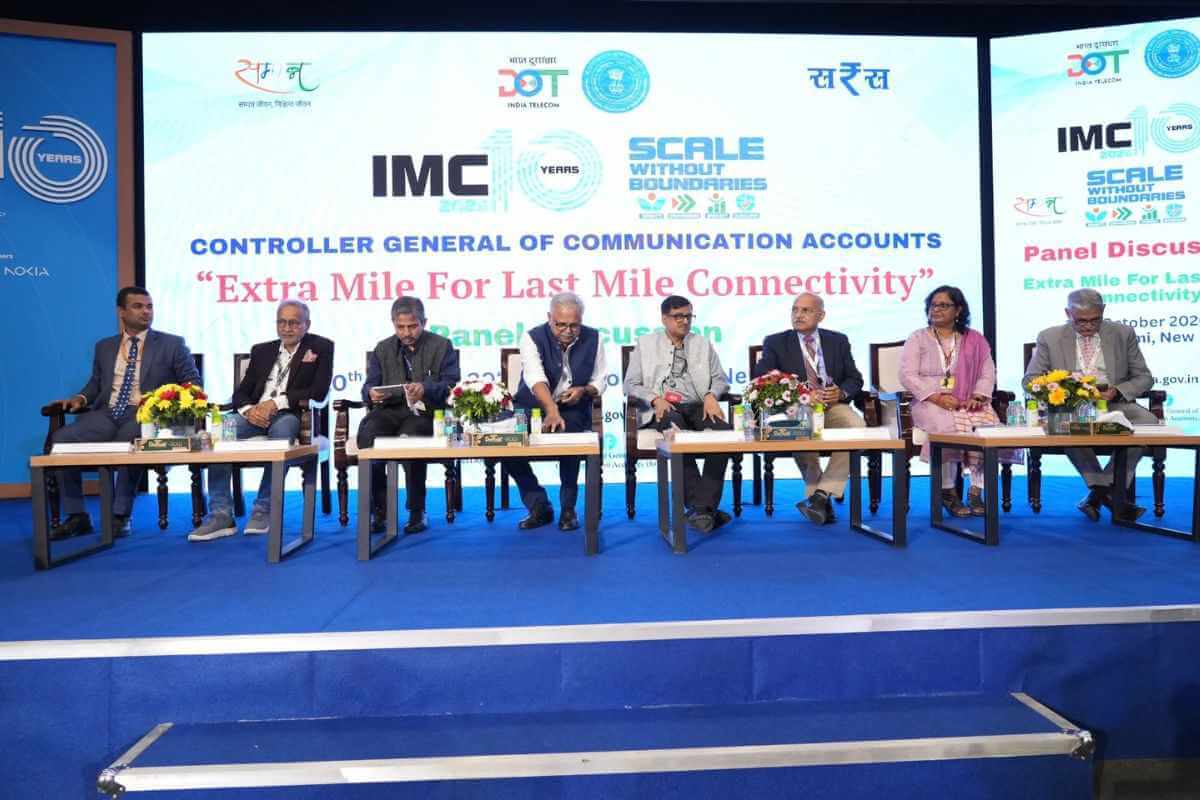
The session titled ‘Extra Mile for the Last Mile’ examined sustainable financing models, rural broadband deployment and infrastructure safeguards needed to expand digital access. Discussions centred on ensuring that high-speed connectivity translates into economic opportunities at the gram panchayat level.
The four-day event brought together policy priorities, telecommunications standards and emerging technologies, with its concluding sessions highlighting the role of AI, robotics and digital infrastructure in advancing inclusive connectivity and India’s participation in the global technology ecosystem.
Quotes from industry leaders on the day 4 of India Mobile Congress 2026:
Dr. Bilel Jamoussi, Deputy Director, Telecommunication Standardization Bureau (TSB), Chief of the Study Groups and Policy Department, International Telecommunication Union (ITU) said, “Agriculture and food touch every person, every community and every country, and AI is now moving from laboratories into the real economy to help address their biggest pressures. But the true measure of an AI solution is not how sophisticated its algorithm is; it is whether it solves a real problem for a smallholder farmer. That is why AI must be developed with farmers, not just for them. International standards are central to this, because they do not slow innovation; they make it work at scale, helping prevent fragmentation so that solutions do not remain trapped in isolated pilots. Through cooperation across governments, international organizations, researchers, industry and investors, we can move from vision to actualization, and build a sustainable, resilient and secure food future for all.”
Syed Tausif Abbas, Sr. DDG & Head, TEC, Department of Telecommunications (DoT) said, “Connectivity links our farms, interoperability links our systems, and artificial intelligence links innovation with impact. But the success of this Global Initiative will be measured not only by technological advances, but by tangible improvements in farmers’ livelihoods, agricultural productivity, supply chain efficiency and food security. For that, AI solutions must be transparent, inclusive and accessible, with due attention to data quality, privacy and the needs of small and marginal farmers, and supported by international standards that let solutions built in different countries work together effectively.”
Devendra Singh, Deputy Director General, Telecommunication Engineering Centre (TEC), Department of Telecommunications (DoT) said, “Evaluating AI systems requires moving beyond traditional computing standards toward structured frameworks for fairness, transparency, and robustness. Bias in AI originates across multiple stages from uncurated training data and outliers to model selection and deployment environments. To address this, we assess risk across multiple tiers, combining domain specific metric evaluations with empirical testing across protected attributes and adverse conditions. A truly robust AI system must perform reliably in hostile or edge environments, maintain safety and security governance, and provide measurable, transparent outputs across every level of integration.”
Debasish Mahalik, Deputy Director, Food and Agriculture Department, Bureau of Indian Standards (BIS) said, “AI-driven agriculture can deliver meaningful impact only when technology is supported by robust standards for data quality, privacy, security and interoperability. At the Bureau of Indian Standards, our focus is on developing a system-wide framework for digital agriculture that reflects India’s diverse farming ecosystems and includes small and marginal farmers. By bringing stakeholders together to build common standards, we can enable trusted, scalable and sustainable agricultural solutions that translate innovation into tangible benefits on the ground.”
Jan Redlich, CTO, Bonn Systems said, “AI in agriculture can only deliver on its promise when data can be shared across systems while ensuring farmers retain control over their data. Today, fragmented digital ecosystems create silos that limit interoperability, access and trust. The reference architecture developed by the Focus Group on AI for Agriculture addresses this through shared semantics, open interfaces and sovereignty by design. By building on existing standards for data models, identity and access, it enables applications and services to work across platforms. This allows new use cases to emerge without creating new silos, helping build a more connected, trusted and interoperable agricultural ecosystem.”
Also in the IMC 2026 Series:
Reference 1: Union Minister of Communications Jyotiraditya Scindia Reviews Final Preparations for IMC 2026
Reference 2: IMC 2026: PM Modi Discusses Digital Inclusion, 6G, AI With GSMA Board
Reference 3: IMC 2026: Bharti Airtel Announces Free International Roaming With All Its Postpaid Plans
Reference 4: IMC 2026: Vi to Showcase AI-Powered Innovations and Intelligent Connectivity Solutions
Reference 5: IMC 2026: Reliance Jio Showcases India-Built AI and Connectivity Innovations
Reference 6: IMC 2026: Ericsson Showcases 5G, AI and 6G Innovations
Reference 7: IMC 2026: Ericsson Scales Up AI-Ready Antenna Manufacturing in India
Reference 8: IMC 2026: Starlink Has Set Up Over 20 Gateway Sites in India, Says VP Lauren Dreyer
Reference 9: IMC 2026: Scindia Reviews Airtel’s Future-Ready Digital Infrastructure at Airtel Booth
Reference 10: IMC 2026: Jio Developing Indigenous Satellite Stack, Files Pre-6G Patents, Says Akash Ambani
Reference 11: IMC 2026: Jio Plans Satellite Network to Connect Over 600,000 Villages, Maritime and Border Areas
Reference 12: IMC 2026: Vi Business, Hindalco Partner to Deploy Private Network at Odisha Bauxite Mine
Reference Out of IMC: Average Revenue per GB of Wireless Data Drops 10.59 Percent to Rs 8.02 in FY26: TRAI
Reference 13: IMC 2026: Cost of 1 GB of Data Has Fallen from Rs 268 in 2014 to Rs 8 Now, Says Scindia
Reference 14: IMC 2026: India Moving Towards End-to-End Telecom Value Chain, Shaping the Rules, Equipment and Innovation: Scindia
Reference 15: IMC 2026: Viksit Tech 47 Report Sets Target of 50 Indian Tech Brands With Rs 1 Lakh Crore Revenue by 2047
Reference 16: IMC 2026: Jio Will Always Stand for Affordability, Says Akash Ambani
Reference 17: IMC 2026: India Targets 10 Percent of Global 6G Patents and Standards: MoS Communications
Reference 18: IMC 2026: MeitY Pavilion Showcases India’s Digital Innovation and Emerging Technology Capabilities
Reference 19: IMC 2026: India Has Already Built Its Own 4G Stack and Deployed It Across the Country: Scindia
Some people read for free. A few choose to support. If you found TelecomTalk useful, you can help keep us running.
 Support Telecomtalk