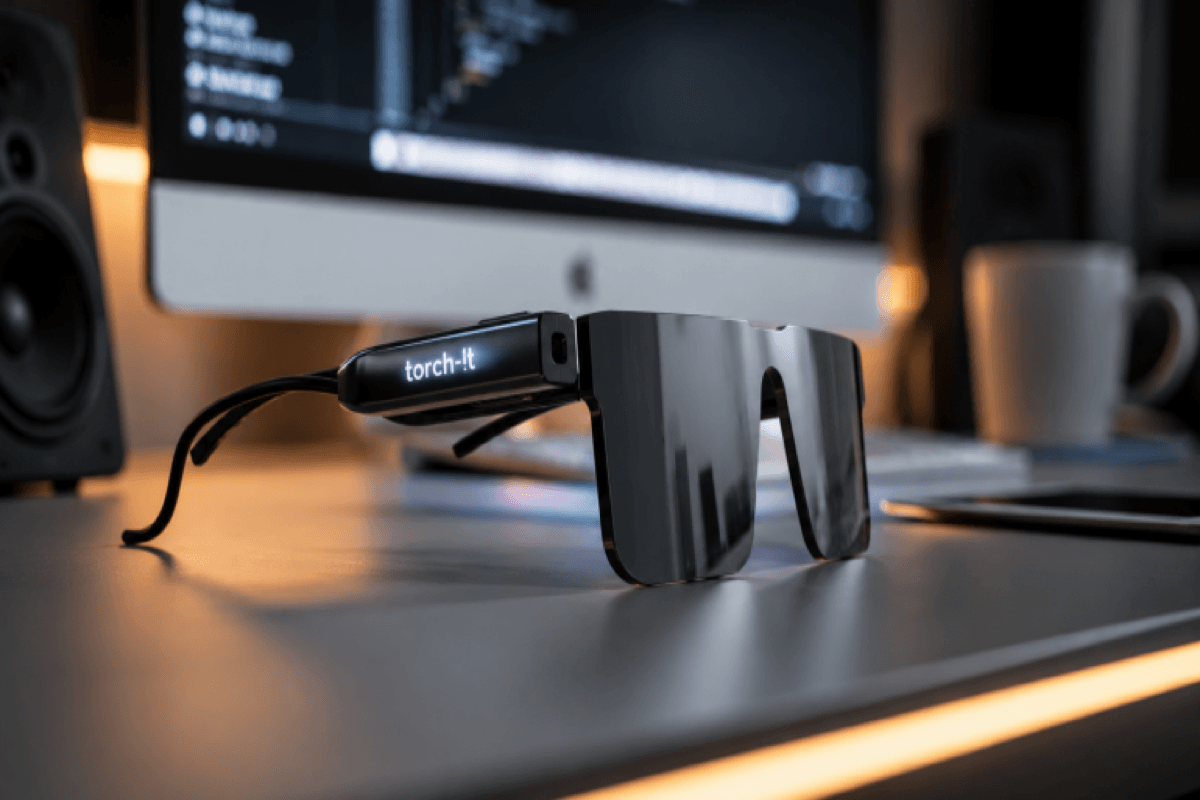
An Indian assistive-technology startup is using AI to help visually impaired people read text, recognise everyday objects, and access information more independently. Based in Ahmedabad, Torchit is building its Jyoti AI smart-glasses ecosystem with features focused on real-life challenges rather than entertainment.
The company launched its latest wireless glasses in July 2026. Torchit showcased its accessibility technology during India Mobile Congress 2026, where Indian firms highlighted AI wearables.
Torchit’s Jyoti AI glasses help blind and low-vision users access information that would normally require sight or another person’s help.
These glasses use a camera and artificial intelligence to understand what is in front of the user. Then share the details through sound. Depending on the model and features, users can get help reading text, identifying objects, recognising colours, and detecting currency notes. The goal is to make daily routines easier, from reading a sign to grocery shopping.
Instead of looking at a screen, the glasses deliver information through audio. This makes them useful when someone is moving, holding something, or doing a task that requires hands-free attention.
Six Modes Focus On Everyday Tasks
The Jyoti ecosystem includes six modes shown during the demo: Explore, Read, Medicine, Colour, Currency and Food and Grocery. Users switch between these modes using buttons on the glasses.
Explore mode describes what the camera captures. Read mode helps with printed text. Medicine mode identifies medicine bottles and their labels. Colour and Currency modes support activities like picking the right clothes or checking a banknote. Food and Grocery mode helps identify items in the store.
These functions target situations that usually need help, like reading a label, checking a note, or choosing a product.
AI is not perfect. Users should still check important information, especially medicine names, dosages and safety instructions. The glasses should not be the source of confirmation.
The New Wireless Model Removes A Major Constraint
Torchit’s latest wireless Jyoti AI Vision Glasses mark a shift from its earlier wired versions.
According to a Business Standard report from October 9, the new model came out in July 2026. Torchit says it has already reached more than 40,000 users across India. The company is also working on an AI assistant for the glasses.
The wireless version has the camera, speaker, battery and AI-processing hardware built into the eyewear. Product details say it supports reading, scene understanding and multilingual help.
Removing the need for devices makes the glasses easier to use in everyday life. Still, battery life, comfort, speed, and information accuracy remain user concerns.
What Is The Price Of Jyoti AI Glasses?
The price varies by model.
Business Standard reported that Torchit’s glasses were priced between ₹20,000 and ₹25,000, based on details the company shared at IMC 2026. The company’s official website lists the Jyoti AI Pro at ₹29,900. So prices vary across models.
For buyers, the exact model matters. Features, hardware setup and how independent the device is from gear can change between products.
Torchit also offers assistive tools. Mobility aids, reading tools and more. To improve accessibility.
Why This Matters For India’s AI Industry
Torchit’s work shows a side of India’s growing AI scene. While big tech companies race to build AI assistants, smart-glasses startups like Torchit use AI to solve specific daily-life problems.
For impaired students, being able to read educational materials without help could make a big difference. For adults, recognising objects, reading labels, and understanding surroundings could mean independence.
The real impact will depend on price, language support, reliability and whether people can try the tools before buying or get help after the purchase. AI glasses also cannot replace mobility training, a cane or a guide dog. These tools are still important.
Torchit’s effort should be seen as an option, not a complete fix for all challenges faced by people with visual impairments.
Can AI Glasses Make Accessibility More Affordable?
The bigger question is whether AI-powered assistive devices can become affordable.
At ₹20,000 to ₹30,000, these glasses are out of reach for many Indian families. Their usefulness depends on how they work in real life. On busy streets, in classrooms, on public transport, or in shops.
Also Read: Google and Unity Let AI Build Games
Torchit’s new wireless glasses. Its plans for an AI assistant show this field is changing. If the technology gets more accurate and easier to access, AI glasses could become a tool for people with visual impairments.
For now, the real test isn’t how powerful the AI sounds; it’s whether users can depend on it to do everyday tasks on their own.
For now, the most important measure of success will not be how advanced the AI sounds, but whether users can rely on it to complete everyday tasks more independently.
Image Credits: mytorchit
If this article saved you time or helped you decide better, consider supporting our work.
FAQs
What are Torchit’s Jyoti AI glasses?
They are AI-powered assistive glasses designed to help blind and low-vision users access visual information through audio feedback.
What can Jyoti AI glasses recognise?
Depending on the model and feature, they support text reading, object identification, colour recognition, currency identification and descriptions of surroundings.
What is the price of Torchit AI glasses in India?
Business Standard reported a price range of approximately ₹20,000–₹25,000 for the glasses discussed at IMC 2026. Torchit separately lists the Jyoti AI Pro at ₹29,900.
Are Torchit’s AI glasses wireless?
Yes. Torchit introduced a wireless Jyoti AI Vision Glasses model in July 2026, alongside its earlier wired offering.
Can these glasses completely replace a white cane?
No. They are an additional assistive technology, not a complete replacement for mobility aids, orientation and mobility training, or other established accessibility support.
 Support Telecomtalk