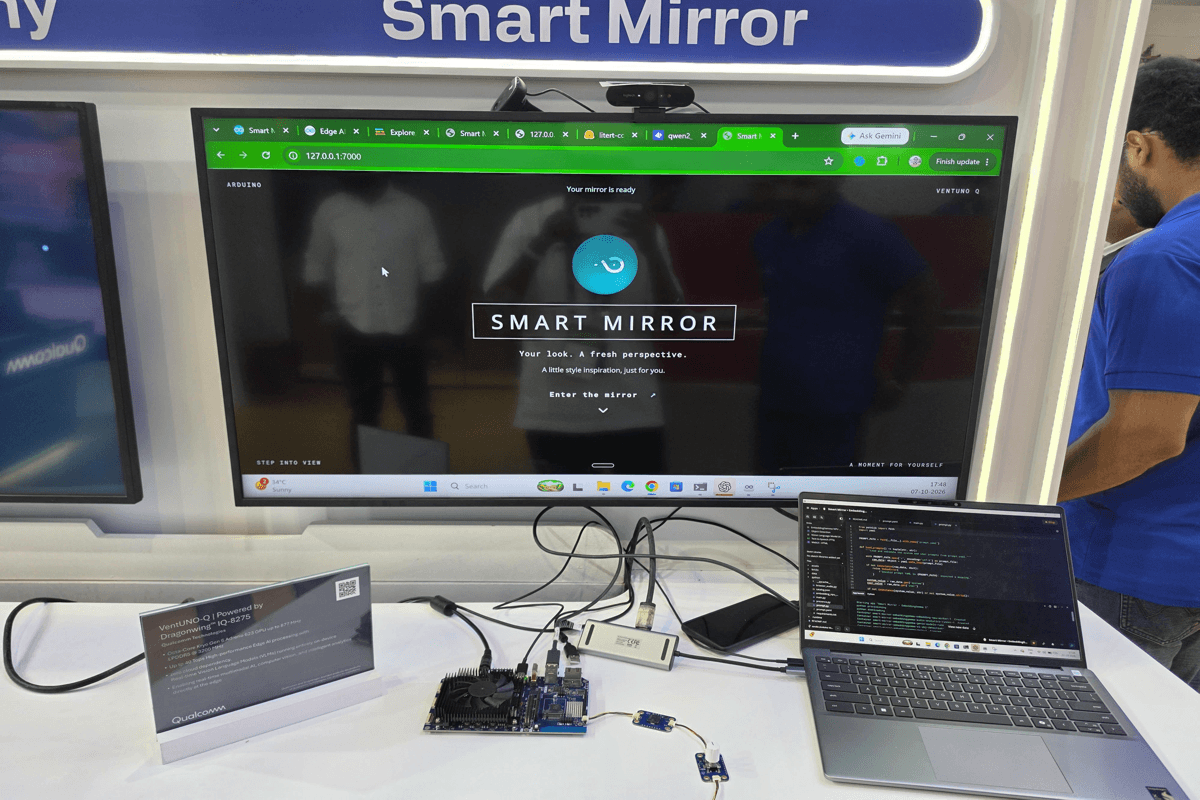
Imagine standing in front of a mirror that does more than show your reflection. It could describe what you are wearing, suggest ways to improve your style, and offer recommendations without sending every image to a cloud server. An AI-powered smart mirror shown at India Mobile Congress 2026 in New Delhi offers a look at how this technology could change shopping, retail and other daily experiences.
The display showed an AI-powered mirror built around the Ventuno Q computing platform. People could stand in front of the screen while an AI model looked at their appearance, described their clothing, and suggested ways to improve their style.
This idea could help in clothing stores, where people often try on outfits or ask for help with colours, combinations, and styles. An AI mirror could provide a different kind of feedback directly in a room or store display.
According to a Business Standard report published on October 9, the display was meant to show how AI could go beyond chatbots and phone apps and into physical spaces. The mirror was one of the technologies shown at India Mobile Congress 2026.
The key isn’t the mirror itself, but the computing platform that makes it work.
According to the person who explained the demonstration, Ventuno Q uses Qualcomm’s Snapdragon IQ-8275+ processor, along with 16GB of RAM and 64GB of storage. The platform can run a seven-billion-parameter vision-language model on its own, so the AI shown at the event works without needing the internet.
This is called edge AI. Instead of sending every request to a distant data centre, the device runs the AI on its own hardware.
Also Read: Jio AI Glasses Could Bring UPI Payments
This difference matters for applications that use cameras and personal information. Local processing can reduce reliance on cloud services. It might make things faster, but privacy still depends on how the whole system collects, saves, and uses data.
Working offline does not mean every part will work without internet. Some functions that need information or online services may still require a connection.
Qualcomm Hardware Powers The Experience
Ventuno Q is made as a computing platform, not a mirror with a screen.
The setup includes Qualcomm’s Snapdragon IQ-8275+ chip, 16GB RAM and 64GB storage. It is meant to run AI models on the device, making it good for tasks that need seeing and responding.
The platform can also run AI models in languages, including models from Indian AI company Sarvam, according to the person at the display. That ability could be important in India, where stores have customers who speak different languages.
However, the display does not show that every language or feature is ready in a product. The exact abilities will depend on the software, model, and how each business uses it.
Smart Mirrors Could Change Retail
For stores, the benefit is more than just giving customers a new thing to try.
A smart mirror could help people try on clothing, get style tips, and find product details without searching the store or waiting for help. Stores could also explore how these systems fit into the shopping experience.
The same technology could also power interactive displays, education, and some industrial applications.
Business Standard said the Ventuno Q platform was shown as a computing solution with possible uses beyond smart mirrors. Its ability to run AI locally could interest groups that want to use AI without depending on cloud-based processing.
For businesses, the real question is whether these systems can give good results at a price that makes business sense.
What Is The Price Of Ventuno Q?
A person at the event said the Ventuno Q platform costs about $300, or around ₹30,000, according to Business Standard. The report also said the platform was available for order.
This number should not be taken as the cost of a full smart mirror for regular people. The total cost may depend on the screen, mirror hardware, installation, software and the exact use built around the platform.
There is also no confirmed plan to sell AI mirrors as a product in India. The display is better seen as an example of what the technology can do, not proof that AI mirrors are already common in homes.
Privacy And Accuracy Will Matter
A mirror with a camera that watches a person’s appearance raises privacy and data-handling concerns.
Businesses using these systems need to say when cameras are on, whether they keep pictures, how they keep customer info safe, and whether people can choose not to use it. Processing AI locally can help with some cloud concerns. That doesn’t guarantee privacy.
Suggestions also need to be helpful and correct. An AI system may misunderstand clothes, lighting, or colours, so treat its style tips as help, not the final answer.
Is This The Future Of Smart Mirrors?
The Ventuno Q display shows a shift toward AI devices that can see, understand, and react to their surroundings.
Also Read: Apple, Fitbit, Whoop, Pebble: Fitness Trackers Compared
Instead of making people open an app and upload a photo, a smart mirror could bring visual AI where it is needed. Whether this becomes a common shopping experience will depend on cost, reliability, and privacy measures. It also depends on whether shoppers find the tips useful.
For now, the story about mirrors in India isn’t about a new product coming out soon, but about new kinds of AI devices that work locally, moving from shows to real use.
Image Credits: (X-@HowDevelop)
Found this useful? You can support us.
FAQs
What is an AI smart mirror?
An AI smart mirror combines a display or mirror surface with artificial intelligence that can analyse visual information and provide interactive responses, such as outfit descriptions or styling suggestions.
What is Ventuno Q?
Ventuno Q is the computing platform demonstrated powering the AI mirror. The reported configuration uses Qualcomm’s Dragonwing IQ-8275+ processor, 16GB RAM and 64GB storage.
Can the AI mirror work without the internet?
The platform can run a seven-billion-parameter vision-language model locally for the AI processing demonstrated at IMC 2026. Some other functions may still require connectivity.
How much does Ventuno Q cost?
A representative quoted approximately $300, or around ₹30,000, for the platform. This should not be treated as the confirmed retail price of a complete smart mirror.
Are AI smart mirrors available across India?
There is no confirmed nationwide consumer rollout established by the demonstration. Ventuno Q was reported to be available for preorder, but finished products and their availability may vary.
 Support Telecomtalk