Airtel Prepaid vs Postpaid: How Did Data Speeds Compare in September 2026?
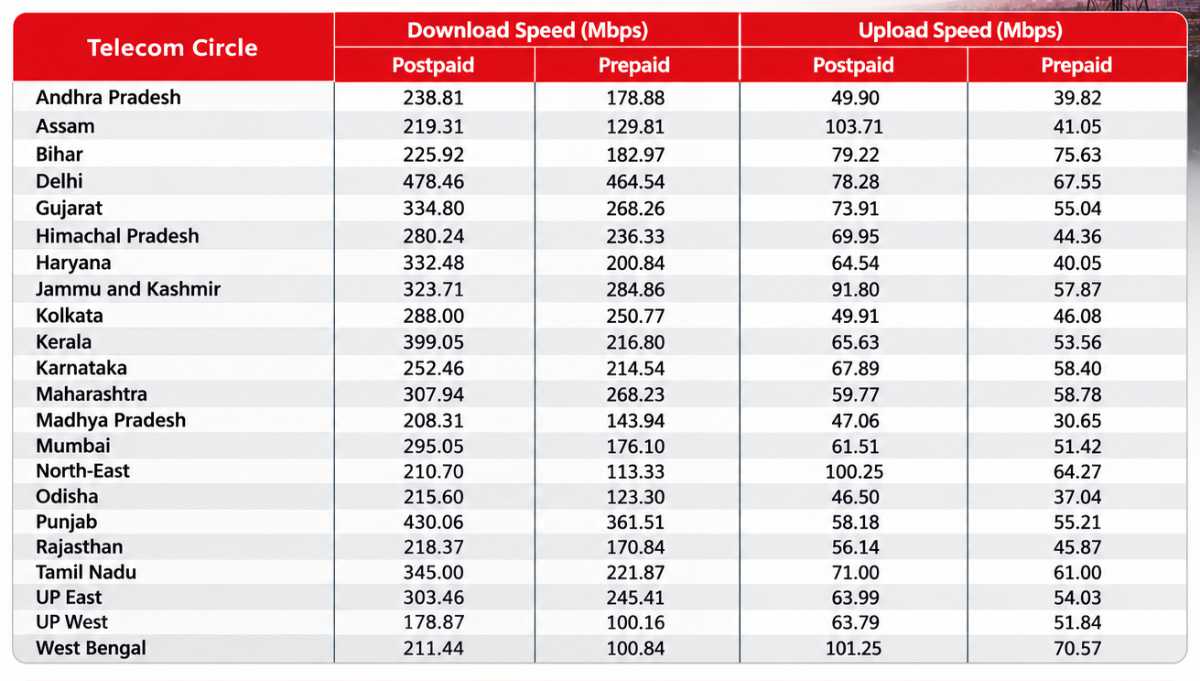
Airtel's September 2026 QoS report shows postpaid plans outperforming prepaid connections in measured download and upload speeds across all telecom service areas, with Delhi leading download speeds.
India’s leading telecom operator, Bharti Airtel, recorded higher mobile data download and upload speeds on its postpaid tariff plans than on its prepaid tariff plans across all telecom service areas in September 2026, according to the operator’s Quality of Service (QoS) performance report for Wireless Access Services. The report, which provides details of offered typical speeds and the 80th percentile of measured speeds, shows that Airtel’s postpaid plans had an offered typicaldownload speed of 23 Mbps, compared with 18 Mbps for prepaid plans. Similarly, the offered typicalupload speed stood at 10 Mbps for postpaid customers, against 8 Mbps for prepaid users.
Airtel Download Speeds
In terms of measured download speeds, postpaid tariff plans recorded higher 80th percentile speeds in all 22 service areas covered in the report. Delhi recorded the highest download speed for postpaid users at 478.46 Mbps, followed by Punjab at 430.06 Mbps and Kerala at 399.05 Mbps. Among prepaid users, Delhi topped the list with 464.54 Mbps, followed by Punjab at 361.51 Mbps and Gujarat at 268.26 Mbps.
The gap between the two categories was particularly notable in Assam, where postpaid tariff plans recorded an 80th percentile download speed of 219.31 Mbps, compared with 129.81 Mbps for prepaid users. West Bengal also reported a significant difference, with postpaid speeds at 211.44 Mbps against 100.84 Mbps for prepaid connections. In Andhra Pradesh, the corresponding figures stood at 238.81 Mbps for postpaid and 178.88 Mbps for prepaid users.
Airtel Upload Speeds
Upload speeds also largely favoured postpaid customers across all service areas. The highest 80th percentile upload speed measured for postpaid users was recorded in Assam at 103.71 Mbps, followed by West Bengal at 101.25 Mbps and the North-East service area at 100.25 Mbps. For prepaid tariff plans, Bihar recorded the highest 80th percentile upload speed at 75.63 Mbps, followed by West Bengal at 70.57 Mbps and the North-East service area at 64.27 Mbps.
80th Percentile Speed Measured Across Test Samples (in Mbps)
The 80th-percentile value indicates that at least 80 percent of the measured test samples recorded download and upload speeds equal to or greater than the “offered typical download and upload speeds” stated in the service tariff.
Customer Service Related QoS Parameters
Meanwhile, Airtel reported strong performance across customer service-related QoS parameters. Billing and charging complaints stood at 0.01 percent across all service areas, comfortably within the prescribed benchmark of 0.1 percent. The company also achieved 100 percent performance in resolving billing and charging complaints within four weeks and applying account adjustments within the stipulated period.
Airtel Call Centre Accessibility Remains Above TRAI Benchmarks
Call centre accessibility remained above the 95 percent benchmark across all service areas, ranging from 98.61 percent in Rajasthan to 99.81 percent in West Bengal. The percentage of calls answered by operators within 90 seconds also exceeded the prescribed 95 percent benchmark in every circle.
Airtel recorded 100 percent compliance in service termination within seven working days of receiving a customer’s request and refund of deposits within 45 days of service closure or non-provisioning of service across all reported service areas.
Airtel’s 5G Fast Lane Technology: Why Postpaid Users Get Higher Speeds
Bharti Airtel announced the launch of Priority Postpaid in May 2026, which was later rebranded as Fast Lane technology. The new service leverages 5G network slicing technology to deliver a superior and more consistent experience to postpaid customers.
For this service, Airtel said it had upgraded its 5G network with advanced capabilities of slicing technology. This makes the network more efficient, creates more capacity, and provides the capability to use this capacity in a targeted manner for delivery of a superior experience for Postpaid customers.
Fast Lane technology, powered by 5G slicing, is available to customers across all Airtel postpaid plans. This could explain the difference in download and upload speeds between postpaid and prepaid users reflected in Airtel’s September 2026 Quality of Service (QoS) report. Airtel began reporting separate speed measurements for postpaid and prepaid plans in June 2026.
Conclusion
Overall, the September 2026 data indicates that Airtel postpaid plans recorded higher offered typical download and upload speeds than prepaid plans. The measured 80th percentile speeds also favoured postpaid subscribers across all service areas, highlighting the difference in reported network performance between the two tariff categories. At the same time, the operator maintained compliance with the prescribed customer service quality benchmarks across its wireless service areas.
 Support Telecomtalk