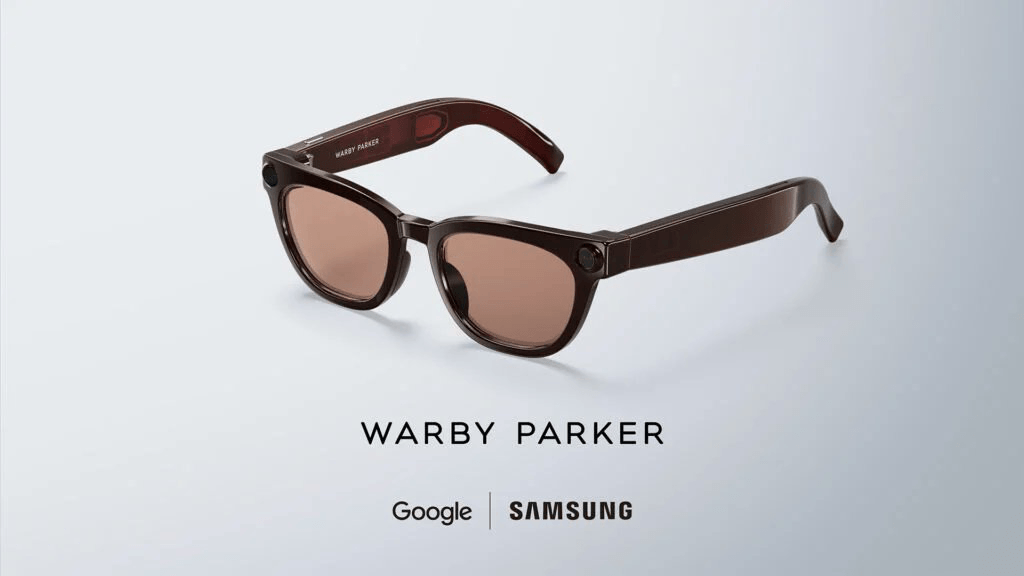
Samsung is reportedly preparing to release its AI‑powered smart glasses in November. Unlike an AR headset, these glasses are designed to look and feel like glasses while placing Gemini AI, cameras, microphones, and speakers around the wearer’s face. That places Samsung against Meta in one of the fastest‑growing categories of wearable devices.
Samsung could release its AI‑powered smart glasses as early as November 2026, marking its biggest effort yet to compete with Meta in the fast‑growing smart‑glasses market. A Samsung executive has reportedly confirmed the November schedule, although Samsung has not yet announced a launch date or price.
Samsung and Google officially presented the glasses this year, and Samsung is developing them as part of the Android XR ecosystem. Unlike Samsung’s Galaxy XR headset, these first‑generation glasses do not place a display in front of the wearer’s eyes. Instead, they concentrate on cameras, microphones, speakers and AI help from Google’s Gemini.
Meta has already become the company to beat in AI glasses with its Ray‑Ban Meta range. Samsung is now entering the category with a similar philosophy: make the hardware look like ordinary glasses and let AI provide the intelligence.
Samsung developed the glasses with eyewear companies Gentle Monster and Warby Parker providing design direction, rather than treating smart glasses as only a tech product. Samsung has positioned the device as a wearable rather than futuristic hardware.
That could be crucial for adoption, I think.
Gemini is the selling point
The biggest difference is what happens when people actually wear Samsung glasses.
Samsung says Gemini can understand what the wearer sees and hears, letting the wearer interact with AI through natural voice conversations. Samsung glasses can provide navigation help, answer questions about surroundings, translate languages, summarise notifications, and assist with tasks without requiring the wearer to pull out a smartphone.
Imagine walking through a city and asking Gemini for directions while still looking ahead.
Pointing Samsung glasses at a sign and asking for a translation.
Looking at a building and asking what it is.
The concept is not fundamentally new.
Also Read: Apple, Fitbit, Whoop, Pebble: Fitness Trackers Compared
Meta’s AI glasses already offer similar experiences. Samsung’s opportunity is to link those capabilities more deeply with the Galaxy ecosystem.
Your phone still does the lifting
These are not intended to replace smartphones completely.
Samsung’s first‑generation glasses are designed to work as a companion device. Demanding AI processing can rely on a connected Galaxy smartphone while Samsung glasses handle the camera, microphones, speakers and interaction layer.
That approach makes sense from a hardware perspective.
Samsung says its intelligent eyewear can deliver up to nine hours of use on a single charge, including demanding activities such as Gemini interactions and video recording. The charging case can supply seven additional full charges.
The hardware is built around a camera
Reports indicate that Samsung glasses use a 12‑megapixel camera, microphones and integrated speakers, with Qualcomm’s Snapdragon AR1 Gen 1 platform powering the device. The first generation does not include a display.
That means wearers don’t get holograms or floating notifications in front of their eyes.
That may actually be the smarter strategy.
Display‑equipped glasses remain technically difficult because of battery consumption, weight, heat and optics. Samsung seems to believe consumers may adopt audio‑and‑camera AI glasses first, then eventually move toward more advanced augmented‑reality products.
Privacy could become the problem
However, Samsung cannot ignore one major issue: privacy.
A camera attached to the wearer’s face can record people, surroundings and conversations without everyone nearby knowing. Samsung has addressed this by using indicators to show when recording is active. Reports say the camera is designed to stop recording if the external recording indicator is deliberately blocked.
The concern is spreading beyond Samsung. Governments and regulators are starting to look at how AI glasses should be used in spaces, especially concerning recording and privacy.
That could become a barrier to mass adoption.
India could be a market.
Samsung has a Galaxy user base in India, which makes the country an obvious market for an ecosystem-driven wearable.
However, Samsung has not yet confirmed availability or pricing for the new glasses. The current November launch report talks about a launch, but the exact markets are still unclear.
The timing is still significant.
Also Read: India’s 4G Phones Are Making a Comeback
AI glasses shipments are growing rapidly. Display-less models are now the main part of the category. Android Authority, citing Counterpoint Research, reports that global AI-glasses shipments increased 263% year over year in the first half of 2026, while display-less glasses made up 96% of shipments. Meta reportedly held 94% of that segment.
Samsung is therefore entering the market as AI glasses start to move beyond novelty.
The real question is no longer whether smart glasses can become useful.
The real question is which company can make people comfortable wearing an AI assistant on their face every day.
Samsung now wants that answer to be Gemini.
Image Credits: (X- techibee)
Found this useful? You can support us.
FAQs
When will Samsung Galaxy Glasses launch?
Samsung’s first AI glasses are reportedly scheduled for November 2026, although an exact date has not yet been announced.
Will Samsung Galaxy Glasses have a display?
No. The first-generation model is designed without an integrated display and instead focuses on cameras, speakers, microphones and AI.
What AI will Samsung Galaxy Glasses use?
Google Gemini will provide the primary AI experience, integrated with Samsung’s Galaxy ecosystem.
Can the glasses work without a Samsung phone?
The glasses are designed as a companion device and rely on a connected smartphone for some of the heavier AI processing.
Will Samsung Galaxy Glasses launch in India?
Samsung has not yet confirmed Indian availability or pricing. The reported November launch is for select global markets.
 Support Telecomtalk