The Ministry of Communications on Thursday, October 8, 2026, reiterated that India’s regulatory framework for satellite communication services is fair and non-discriminatory, rejecting claims by SpaceX CEO Elon Musk that “certain oligarchs” in India were blocking the launch of Starlink satellite internet services in the country.
Make Telecom Talk My Trusted Source
Musk Alleges Roadblocks to Starlink Launch
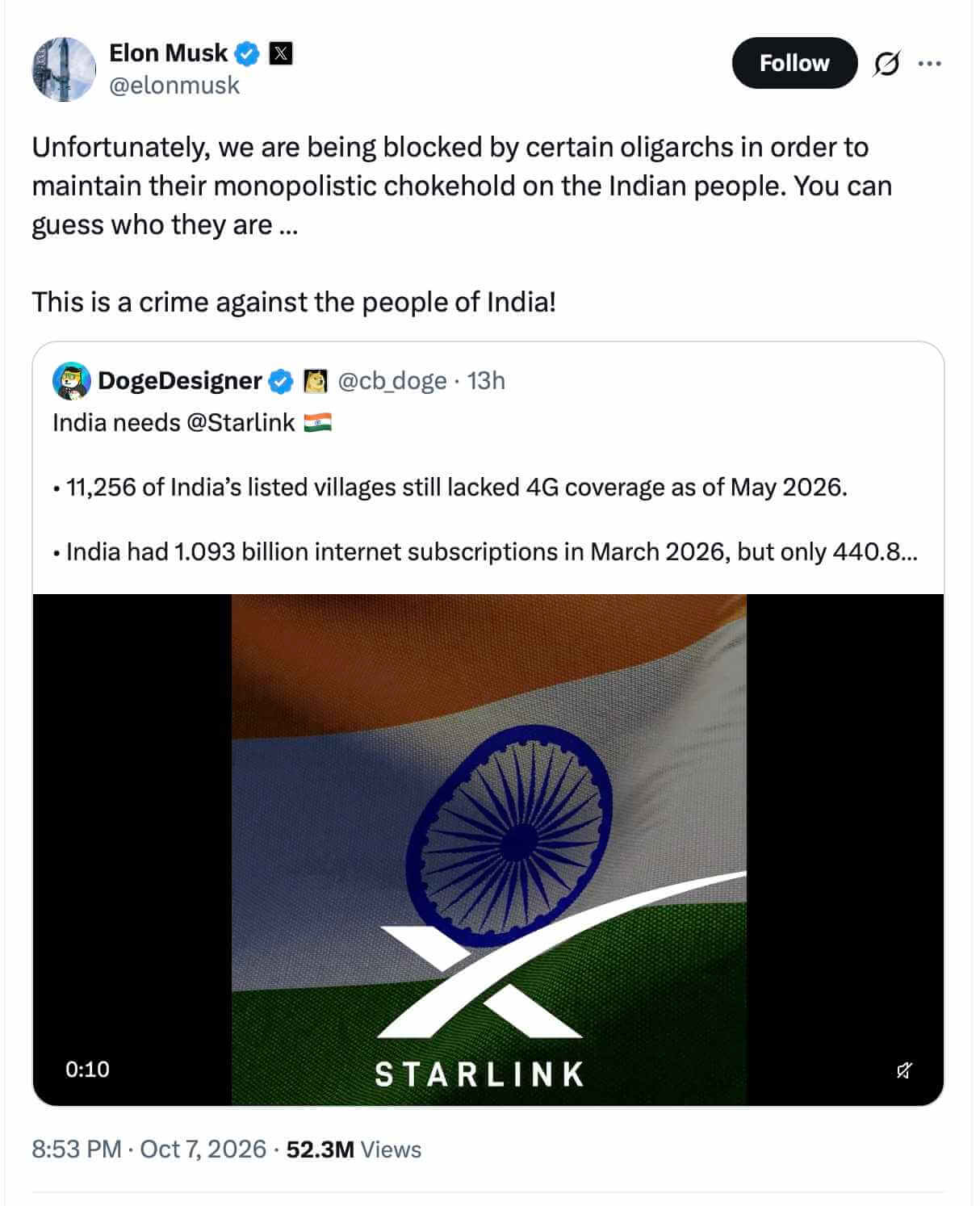
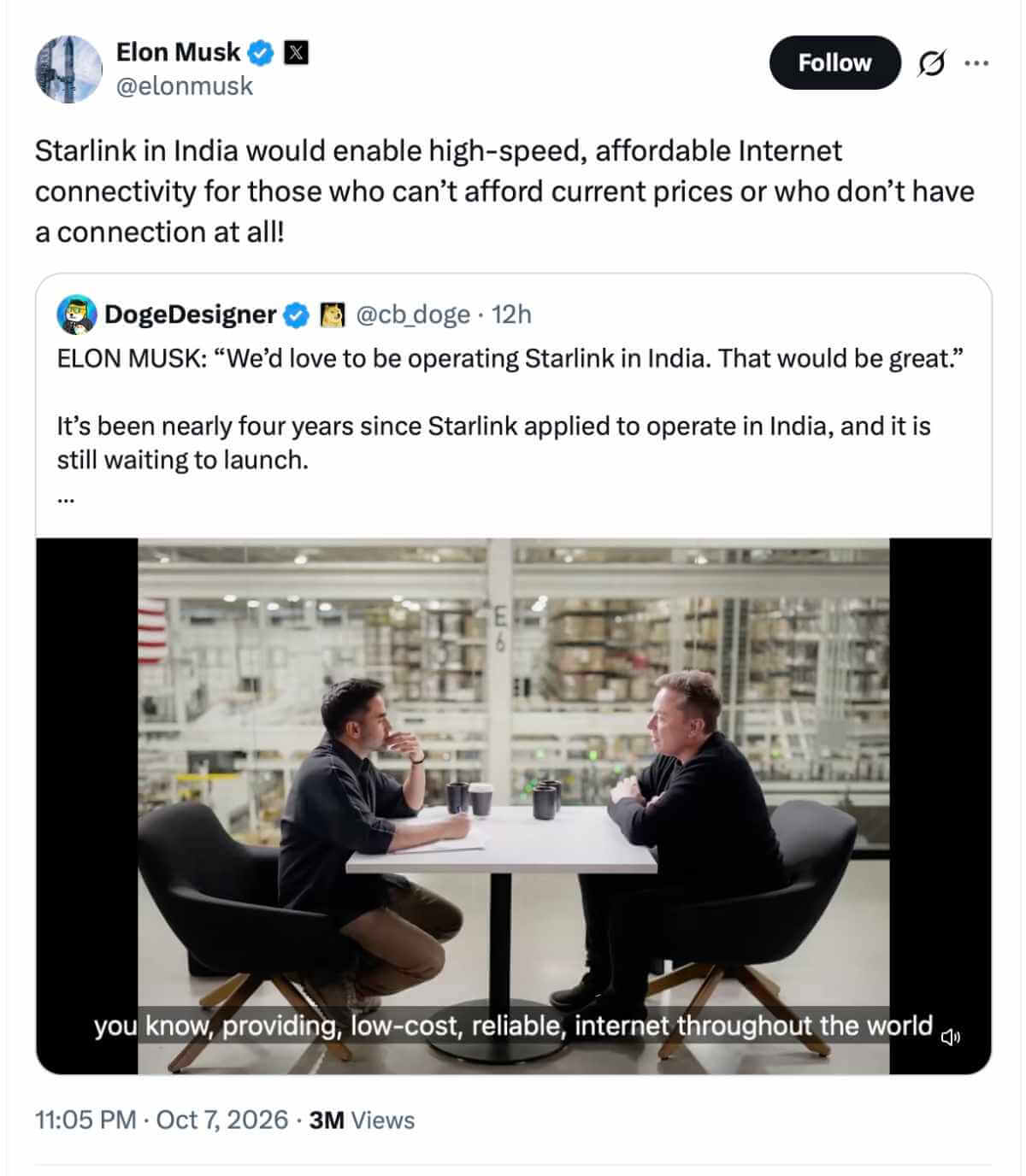
In a post on the microblogging platform X on October 7, 2026, Musk responded to a post by Doge Designer stating, “India needs @Starlink…” Musk said: “Unfortunately, we are being blocked by certain oligarchs in order to maintain their monopolistic chokehold on the Indian people. You can guess who they are …
• 11,256 of India’s listed villages still lacked 4G coverage as of May 2026.
• India had 1.093 billion internet subscriptions in March 2026, but only 440.87 million were rural. Rural subscription density was 48.31 per 100 people, compared with 126.80 in urban India.
• BharatNet had laid over 850,000 route-km of fibre and made about 221,000 Gram Panchayats service-ready. However, its Points of Presence were reported operational at only 80,472 Gram Panchayats in June 2026.
• Only 4.26% of India’s internet subscriptions were wired connections in March 2026. Starlink could give underserved communities another route to high-speed broadband.
• Starlink has already built 20 gateway sites in India, according to SpaceX Vice President of Starlink Business Operations Lauren Dreyer, speaking at India Mobile Congress today.
• Starlink says it has developed India-specific security controls designed to keep Indian user data within India.
• Its satellite network could bring high-speed internet to remote villages, mountains and islands where extending fibre or mobile networks is difficult.
• Better connectivity could help rural schools access online learning, clinics offer remote consultations and small businesses reach more customers. Starlink already supports education and healthcare in remote communities internationally.
• Portable Starlink terminals have supported disaster response around the world. They could give Indian emergency teams backup connectivity when floods, earthquakes or storms damage ground networks.
• Direct to Cell could also help ordinary 4G phones connect beyond tower coverage, subject to Indian approvals and mobile operator partnerships.
• The government itself identifies difficult terrain, low commercial viability and infrastructure constraints as reasons for remaining coverage gaps. This is exactly where Starlink could help India reach more people.
• India should complete the remaining clearances and spectrum allocation so Starlink can begin commercial service.
• SpaceX’s Vice President of Starlink Business Operations, Lauren Dreyer, said that Starlink is ready to help achieve Prime Minister Modi’s vision of 100% connectivity across India. She highlighted its potential to connect remote classrooms, support telemedicine and restore connectivity after disasters, adding, “With Starlink, people can get connected within minutes, not years.”
India’s hardest-to-reach communities deserve reliable internet too,” the post of cd_doge said on October 7, 2026.
Centre Defends Satellite Regulatory Framework
The Ministry of Communications’ statement came shortly after Musk’s post on X.
“A post is being circulated in social media regarding the fairness of India’s regulatory framework for satellite communication services and suggesting that it is being applied in a discriminatory manner,” the Ministry of Communications said in an official statement.
The ministry added that “The Government has put in place a fair and non-discriminatory authorisation framework for all telecommunication services, including satellite communication services. Under this, telecom licences have been granted to three Global Mobile Personal Communication by Satellite services based on non-geosynchronous satellite orbit-based satellite communications, as part of its commitment to enable provision of satellite communication services in India.”
Security Clearances Underway for Three Satellite Operators
“Under the terms and conditions of license, every such licensee is required to demonstrate compliance with security conditions. This is aimed at ensuring that services provided meet various security requirements to ensure safety of all users and their data. Security assessment as part of this process is currently under way in respect of all the three licensees. As and when this process is completed for a licensed entity, it may proceed to the next step of seeking assignment of spectrum.
At present, all the three entities are at broadly the same regulatory stage. As such, the suggestion that the framework or its application is unfair or discriminatory is baseless and misconceived.”
Satellite operators are required to obtain authorisation from IN-SPACe before commencing services in India. However, commercial satellite services by non-geostationary satellite operators have yet to begin, with security clearances and spectrum allocation among the key regulatory steps involved.
 Support Telecomtalk