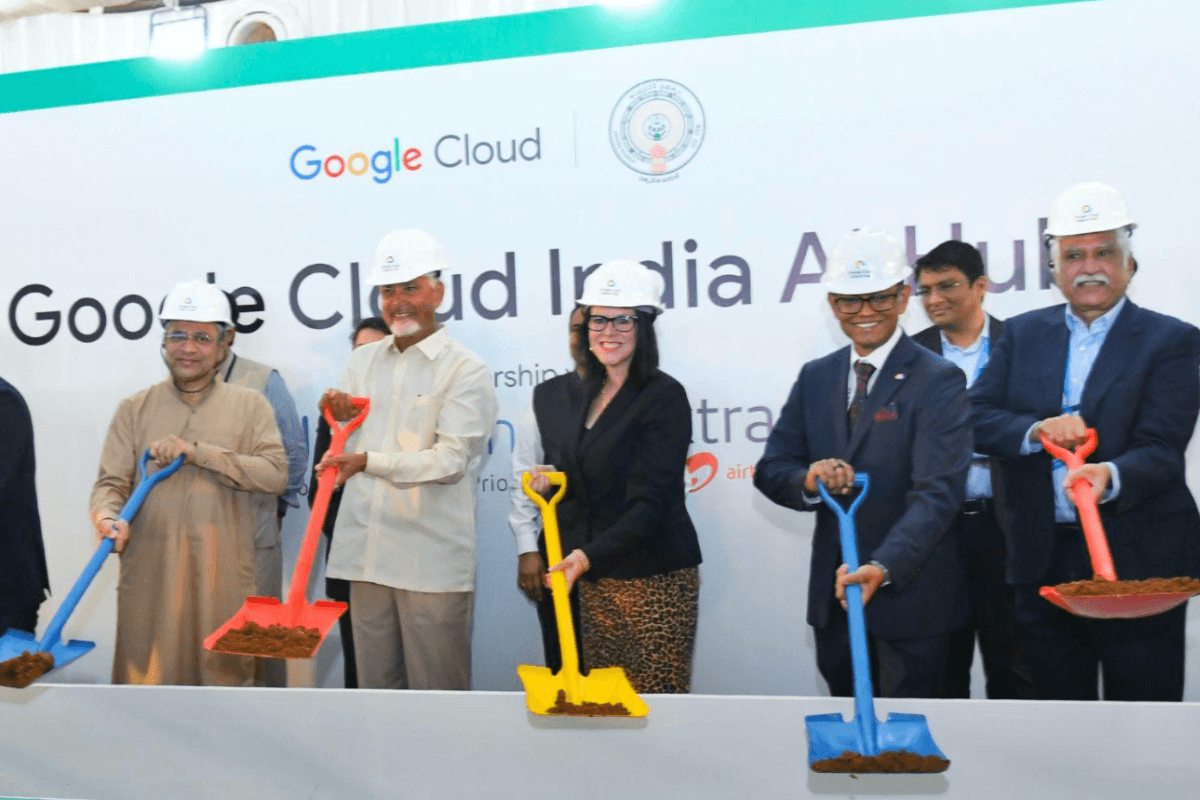
India’s push to become a global artificial intelligence powerhouse received a major boost as Google officially broke ground on its largest AI infrastructure project in the country. The new AI hub, coming up in Visakhapatnam (Vizag), Andhra Pradesh, will be supported by Airtel’s data centre arm, Nxtra, alongside AdaniConneX, marking a significant milestone in India’s digital infrastructure journey.
At the heart of this project is not just technology, but infrastructure at scale. Airtel Nxtra will play a key role in building the backbone of the AI ecosystem, bringing together data centres, ultra-low latency fibre networks, green energy integration, and next-generation cable landing capabilities. The project is being positioned as one of the largest AI infrastructure deployments globally, with a scale that could reshape how digital services are delivered across India.
The Vizag AI hub is part of Google’s broader $15 billion investment plan in India over the next five years, aimed at accelerating the country’s transition into an AI-driven economy . This includes the development of a gigawatt-scale data centre ecosystem, making it one of the first such large-scale AI infrastructure clusters in the region.
For Airtel, this partnership signals a deeper strategic shift. Traditionally known as a telecom operator, the company has been steadily expanding its presence in the digital infrastructure space through Nxtra. By aligning with global hyperscalers like Google, Airtel is positioning itself not just as a connectivity provider, but as a key enabler of next-generation digital services.
The infrastructure requirements for AI are fundamentally different from traditional cloud workloads. AI models demand high-performance computing, massive storage capabilities, and ultra-fast data movement across networks. This is where Airtel Nxtra’s integrated approach becomes critical. Its pan-India fibre footprint, combined with advanced data centre capabilities, is expected to provide the low-latency environment needed to support AI applications at scale.
Thomas Kurian, CEO, Google Cloud, said, This AI hub represents a key moment for India’s AI-native future and will open new doors for economic opportunity across the country.
The choice of Visakhapatnam is also strategic. The city is emerging as an important digital and industrial hub, supported by strong government backing and improving connectivity infrastructure. With subsea cable landing stations and expanding fibre networks, Vizag offers the kind of connectivity advantage that large-scale AI and cloud infrastructure projects require.
Government officials and industry leaders present at the groundbreaking ceremony highlighted the importance of this initiative in strengthening India’s position in the global technology landscape.
Ashwini Vaishnaw, Union Minister for Electronics and IT, said, The AI hub and subsea cable infrastructure in Visakhapatnam will be critical for India’s journey to becoming a global technology leader.
From a broader perspective, this development reflects a shift in how digital ecosystems are being built. The focus is moving from consumer-facing applications to foundational infrastructure. Data centres, energy supply, and network capacity are becoming critical building blocks for future growth, especially as AI adoption accelerates across industries.
A key aspect of the Vizag AI hub is its emphasis on sustainability. The project includes plans for integrating clean energy sources to power the data centres, aligning with India’s long-term renewable energy goals. As data centres become more energy-intensive, the ability to operate on green power will be an important differentiator for infrastructure providers.
Another important component is the expansion of fibre connectivity and subsea cable infrastructure. These elements are crucial for ensuring seamless data flow between India and global markets. The AI hub is expected to strengthen India’s connectivity with international networks, improving performance for businesses and consumers alike.
Beyond infrastructure, the project also has a strong focus on ecosystem development. Initiatives around skill development, digital literacy, and community engagement are expected to play a role in ensuring that the benefits of this investment reach a wider audience. Training programs aimed at preparing the workforce for roles in construction, operations, and AI-related fields are already part of the broader plan .
For Airtel Nxtra, this is an opportunity to scale its capabilities and establish itself as a key player in India’s data centre and AI infrastructure market. As competition intensifies with players like Reliance Jio and global cloud providers expanding their footprint, partnerships like these could prove crucial in shaping the future landscape.
At the same time, the project highlights a larger trend: the convergence of telecom, cloud, and energy infrastructure. Companies that can integrate these elements effectively are likely to emerge as leaders in the next phase of digital growth.
The Vizag AI hub is still in its early stages, but its impact could be far-reaching. From enabling advanced AI applications to strengthening India’s digital backbone, the project represents a step forward in building a resilient and future-ready infrastructure ecosystem.
As India continues its journey towards becoming a digitally empowered economy, investments of this scale underline the importance of strong partnerships between technology companies, infrastructure providers, and government bodies. Airtel Nxtra’s role in this initiative positions it at the centre of this transformation, where the real value lies not just in connectivity, but in enabling the next generation of digital innovation.
If this article saved you time or helped you decide better, consider supporting our work.
 Support Telecomtalk