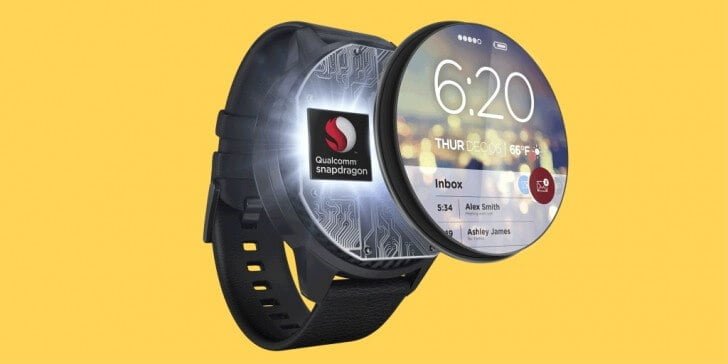
In an unexpected mode, Qualcomm has announced four new processing chipsets today – Snapdragon 625, Snapdragon 435, Snapdragon 425, and Snapdragon Wear 2110 – with the first three chipsets being designed to be used in smartphones and tablets, and the latter developed specifically for wearable devices like smartwatches and fitness trackers.
The Qualcomm Snapdragon 625 is a mid-range smartphone processor, and the most important point to be noted is that it is manufactured using a 14nm FinFET process. The company claims that the power usage is 35 percent lower than the Snapdragon 617, which is being quoted as its predecessor.
It consists of a 64-bit octa-core Cortex-A53 CPU that can be clocked as high as 2.0GHz. It is accompanied by Adreno 506 GPU with 4K video playback support and Qualcomm’s X9 LTE modem that can reach download speeds of upto 300Mbps.
In the imaging department, the Snapdragon 625 supports rear-facing cameras with resolution upto 24 megapixels and front-facing cameras with resolution upto 13 megapixels. Moreover, the chipset can help capture 4K videos as well.
Qualcomm Snapdragon 435
The Snapdragon 435 will be positioned as one of the company’s entry-level chipsets. Due to the presence of a 64-bit octa-core Cortex-A53 CPU, it might appear similar to the Snapdragon 625, but this entry-level chipset is made using an older 28nm process, and can be clocked to just 1.4GHz.
The chipset, which is successor to the Snapdragon 410 and Snapdragon 412, has an integrated 4G LTE Cat. 7 X8 modem that can support download speeds of upto 300Mbps but upload speeds are upto 150Mbps with the use of 2x20MHz carrier aggregation.
In terms of imaging, it comes with dual image signal processors, and it can support cameras wit resolutions upto 21 megapixels. In terms of graphical processing, the Snapdragon 435 comes with Adreno 505, and is designed to work flawlessly in smartphones with 1,920 x 1,080 pixels displays.
The third smartphone chipset announced today by the company, the Qualcomm Snapdragon 425, comes with a 64-bit 1.4GHz quad-core ARM Cortex-A53 CPU that is built using 28nm processor and it can be clocked at 1.4GHz.
There’s Adreno 308 GPU in the chipset with support for OpenGL 3.0 libraries, and it can support upto 16-megapixel cameras with 1080p video capture. In terms of connectivity, the Snapdragon 425 comes with an integrated 4G LTE Cat. 4 X6 modem with upto 150Mbps download speed and upto 75Mbps upload speed.
It can support 16-megapixel cameras and 1080p video recording abilities, and it comes with dual image signal processors. The Snapdragon 425 comes with LP-DDR3 667MHz RAM compatibility and eMMC 5.1 storage support.
Qualcomm Snapdragon Wear 2100
Now coming to the chipset designed specifically for wearable devices like smartwatches and fitness trackers, the Qualcomm Snapdragon 2100, is 30 percent smaller and 25 percent more power efficient when compared to the Qualcomm Snapdragon 400.
It packs a quad-core 32-bit Cortex-A7 CPU clocked at 1.2GHz, an Adreno 304 GPU, and can support display resolutions upto 640 x 480 pixels at 60Hz. It will be available in two variants – Bluetooth + Wi-Fi as well as Bluetooth + Wi-Fi + Cellular – and also supports NFC, GPS, and Quick Charge 2.0.
It is being reported that LG is already working on the successor to the LG Watch Urbane that uses Qualcomm’s new Snapdragon Wear 2100 chipset for better performance and better battery life as well as connectivity. This yet unnamed smartwatch will be launched later this year.
 Support Telecomtalk