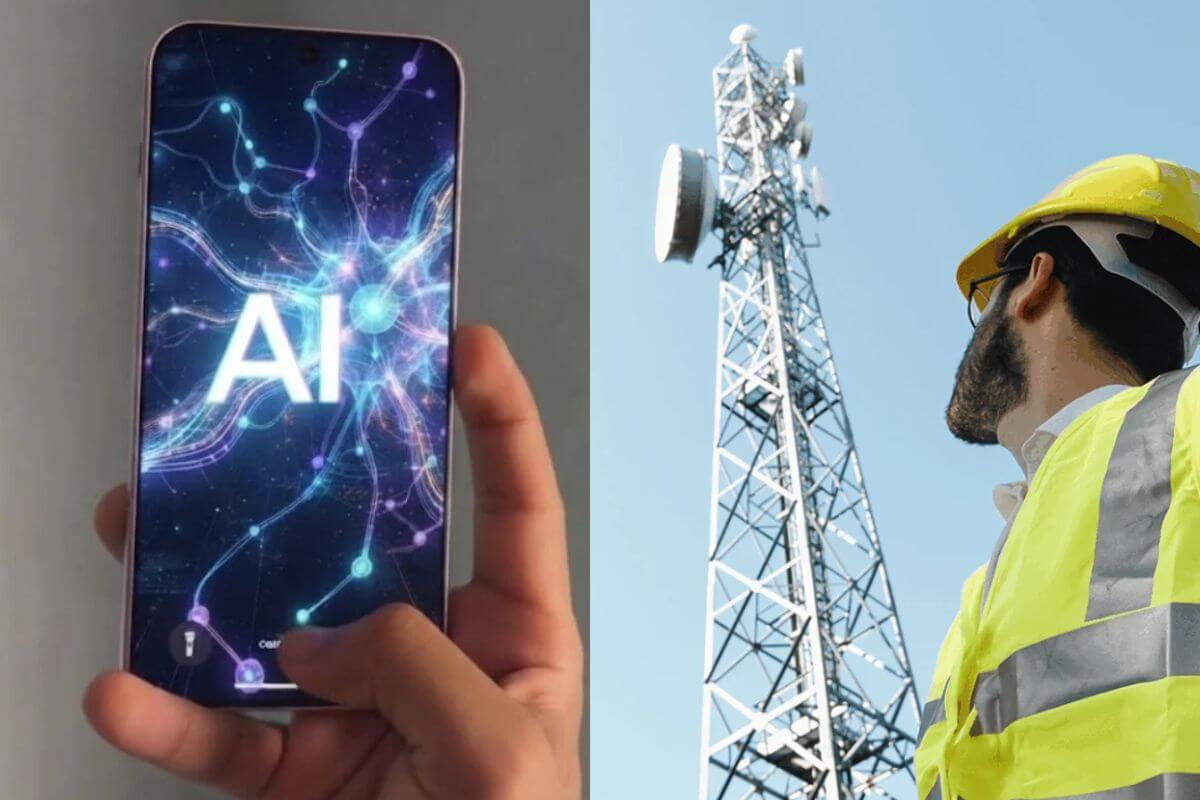
AI Surge Threatens India’s Telecom Networks as Demand Explodes
Growing AI adoption could reshape India’s mobile data traffic, increasing the need for better uplink capacity and network optimisation while raising questions about telecom operators’ ability to monetise infrastructure investments.
Artificial intelligence is creating new demands on India’s digital infrastructure. Telecom networks have traditionally handled more downloads than uploads. AI applications could change that balance as users share images, videos and voice clips with cloud-based models.
Make Telecom Talk My Trusted Source
Key Highlights
India’s daily multimodal AI usage is projected to reach 43% by 2030, according to research cited in the report.
Telecom operators may need better uplink capacity, fibre backhaul and network optimisation.
Rising data usage is outpacing data revenue growth, creating a monetisation challenge.
These interactions require networks to transmit data quickly and reliably. That could put additional pressure on uplink capacity and response times.
India’s 5G rollout provides a strong foundation, but it may still need further optimization.
For telecom operators, the challenge extends beyond network performance. They must also find ways to recover the cost of these investments.
AI Traffic May Strain India’s Telecom Networks
India’s telecom networks could face new capacity challenges as artificial intelligence (AI) applications become more popular, according to a report Light Reading published on October 29, 2026.
The shift could require operators to improve upload speeds, strengthen fiber backhaul, and optimize their networks, even as they struggle to turn rising data consumption into higher revenue.
AI Could Change How Users Consume Data
Traditional mobile internet usage, including video streaming, browsing, and social media, generally involves downloading more data than uploading.
However, AI applications that process images, videos, and audio in the cloud could increase demand for upstream data transmission.
According to Ericsson ConsumerLab research cited by Light Reading, daily multimodal AI use in India is projected to increase from 22% currently to 43% by 2030. The global forecast stands at 30%.
Multimodal AI allows users to interact with AI systems through different formats, including text, images, audio, and video. As these applications become more common, telecom networks may need to handle more varied traffic patterns and deliver faster responses.
Unlike video streaming, where buffering can sometimes compensate for delays, interactive AI applications depend on responsive exchanges between users and cloud-based systems.
Short upload bursts can also increase demand on radio scheduling and add network latency.
Why India’s 5G Networks May Need Optimization
India’s existing 4G and 5G networks can support AI traffic for now, as these applications still account for a relatively small share of overall network usage.
However, rising adoption could require targeted upgrades rather than uniform expansion across the country.
Network experts cited in the report highlighted several priorities, including improved uplink capacity, additional radio resources, better spectrum utilization, and stronger fiber backhaul.
Operators may also need to add network sites in locations where demand warrants it.
The transition to 5G Standalone (5G SA) and eventually 5G-Advanced could help operators support applications that need lower latency and more reliable uplink performance.
Reliance Jio has deployed a 5G SA network, while Bharti Airtel has been transitioning towards the architecture.
However, the benefits of newer radio technology may be limited if the underlying network still relies on a 4G core or has insufficient backhaul capacity.
Fiber connectivity to mobile towers will therefore remain important as operators increase radio capacity and prepare for more demanding applications.
Monetization Remains a Challenge for Telcos
Upgrading networks requires substantial investment, but higher data consumption does not automatically translate into proportional revenue growth.
Telecom Regulatory Authority of India (TRAI) figures for FY2026 cited in the report show that wireless data usage rose 24.74%, while data revenue grew 11.53%. Average industry revenue realization per gigabyte fell from Rs8.97 to Rs8.02.
This gap highlights the commercial challenge Indian telecom operators face.
They must prepare their networks for increasingly sophisticated digital services while operating in a price-sensitive market where raising data tariffs may not be straightforward.
Potential opportunities include premium connectivity, enterprise networking, partnerships with AI and cloud companies, and services that offer differentiated performance.
For consumers, better network optimization could eventually mean more responsive AI experiences on mobile devices.
For operators, however, the next phase of investment will depend on balancing network readiness with a sustainable business model.
AI traffic is not an immediate capacity crisis for India’s telecom industry. Instead, it is an emerging requirement that operators will need to plan for as AI adoption grows.
Some people read for free. A few choose to support. If you found TelecomTalk useful, you can help keep us running.
FAQs
Why could AI increase pressure on telecom networks?
Cloud-based AI applications often require users to upload images, videos and audio for processing, increasing demand for uplink capacity and responsive connections.
Are India’s existing 5G networks ready for AI?
Existing 4G and 5G networks can currently handle AI traffic. Further optimisation and targeted upgrades may be needed as adoption increases.
What network upgrades could telecom operators need?
Potential priorities include improved uplink performance, additional radio capacity, fibre backhaul, efficient spectrum use and wider deployment of 5G Standalone architecture.
Will AI traffic lead to higher mobile data prices?
Not necessarily. Operators face pricing pressure in India’s competitive market and may explore enterprise services, premium connectivity and partnerships to monetise investments.
What does this mean for Indian consumers?
Over time, network improvements could support faster, more reliable interactions with cloud-based AI applications, especially those involving real-time voice, images and video.
 Support Telecomtalk