Support Telecomtalk







Andrew Bonwick
Vice President of Product Development at Relm Insurance

Madhav Sheth
CEO of Ai+ Smartphone

Stephen Rose
CEO Render Networks




A recent analysis by Ookla Speedtest Intelligence has shed light on the impact of 5G networks on smartphone battery life. The study shows that users accessing 5G networks experience higher battery drain compared to those using 4G-LTE, with the drain ranging between 6% and 11% depending on the System on Chip (SoC) in their devices.



- Make Telecom Talk My Trusted Source



Among Android SoCs, Qualcomm’s Snapdragon emerges as the most efficient. The latest flagship SoC from Qualcomm, the Snapdragon 8 Gen 2, demonstrates the lowest battery drain among all SoCs in the analysis, recording 31% for users on 5G and 25% on 4G-LTE.
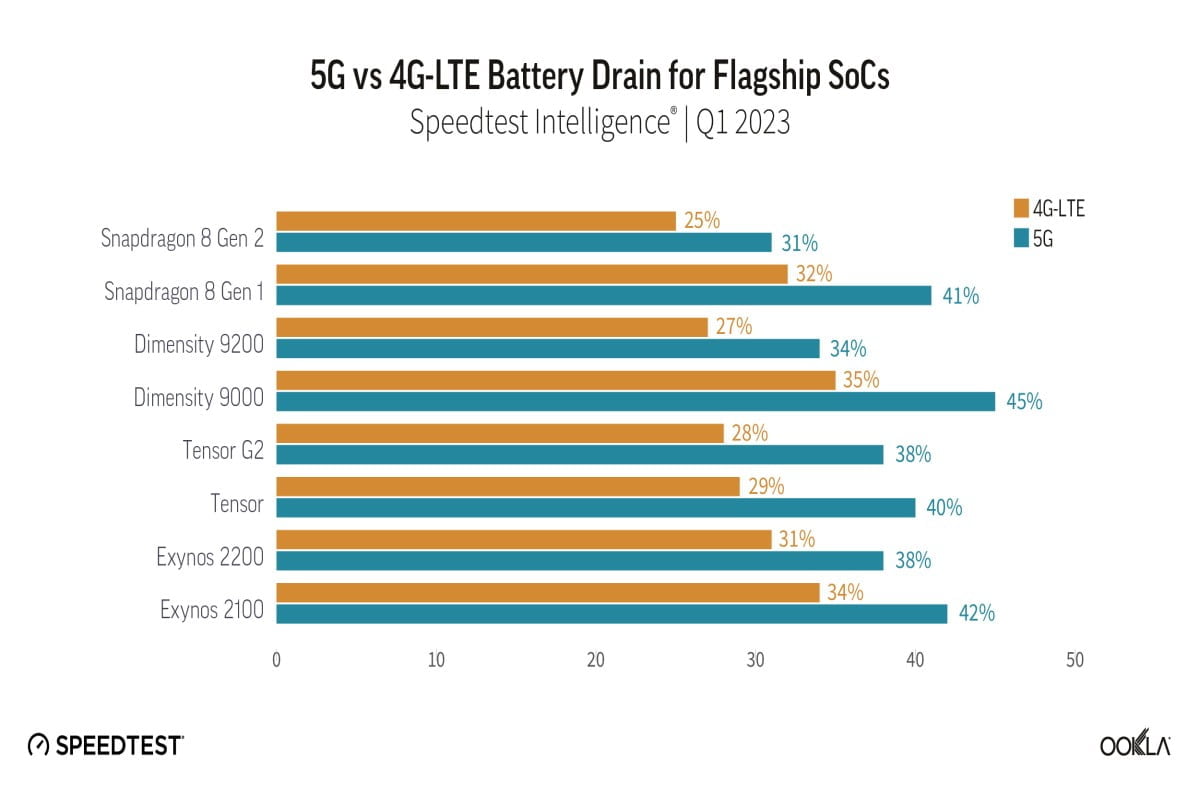
The study also highlights the improvements in battery performance observed in newer flagship SoCs. While the disparity in battery drain between 4G-LTE and 5G does not seem to be narrowing over time, generations of SoCs from Qualcomm, MediaTek, Samsung, and Google showcase enhanced battery efficiency compared to their predecessors. For instance, MediaTek’s latest flagship SoC, the Dimensity 9200, exhibits a battery drain of 34% when using 5G, whereas its previous generation, the Dimensity 9000, recorded a 45% drain.
Read More – 5G Smartphone Shipments Make a Record: Report
For smartphone users concerned about the impact of 5G on battery life, upgrading their devices could be a solution. In some cases, upgrading to the latest flagship smartphone equipped with the latest SoC and enabling 5G service can deliver comparable battery performance to using 4G-LTE. For example, Qualcomm’s Snapdragon 8 Gen 2 registers a battery drain of 31% when using 5G, only slightly higher than the previous generation Snapdragon 8 Gen 1, which records a 32% drain on 4G-LTE.