IN-SPACe had rejected an earlier application by the company for a constellation of around 30,000 satellites, citing non-conformity with certain features and spectrum bands.
“The company has recently applied to get authorisation for its Gen 2 constellation… at an altitude of 340-615 km in low Earth orbit (LEO),” the report quoted a person as saying.
SpaceX, which operates the world’s largest LEO satellite network, remains bullish on India’s nascent but potentially large satcom market. The company had originally sought approval for both Gen 1 and Gen 2 constellations to launch services in the country.
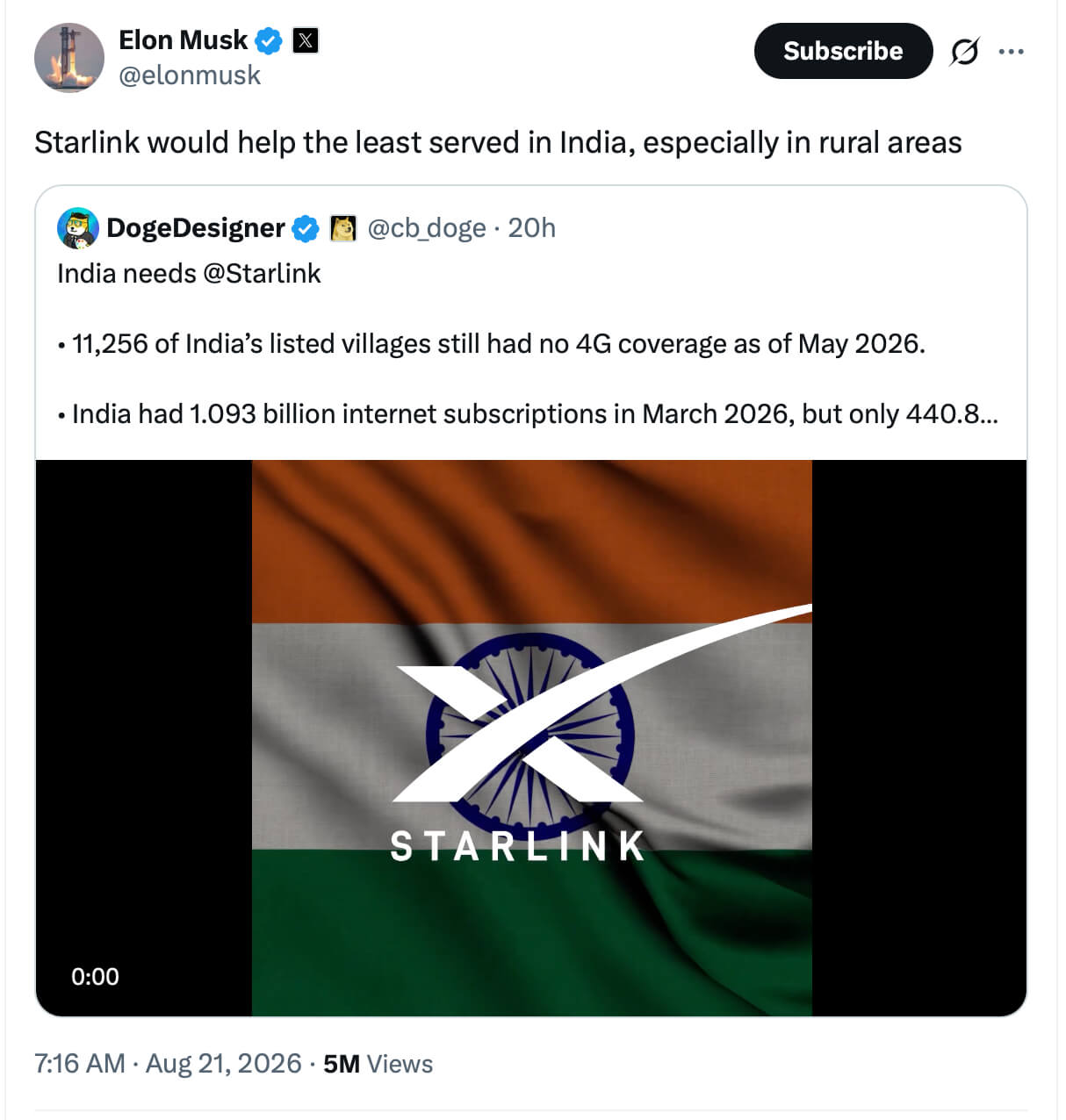
SpaceX founder Elon Musk has positioned Starlink’s satellite internet service as a potential solution to improve connectivity in underserved parts of India, particularly rural areas. “Starlink would help the least served in India, especially in rural areas,” Musk said in a post on social media on August 21, 2026, responding to a post by X account DogeDesigner that called for Starlink services to be extended to remote villages across India.
The post to which Musk responded drew attention to the persistent connectivity gap between rural and urban India. Figures cited in the post showed that 11,256 listed villages lacked 4G coverage as of May 2026. India had 1.093 billion internet subscriptions in March 2026, of which 440.87 million were in rural areas. Internet subscription density stood at 48.31 per 100 people in rural India, compared with 126.80 per 100 people in urban areas.
“BharatNet has laid more than 850,000 route-km of fibre and made about 221,000 Gram Panchayats service-ready. Yet its Points of Presence were reported operational at only 80,472 GPs as of June 2026.
The government itself says the remaining mobile gaps are caused by difficult terrain, low commercial viability and infrastructure constraints. This is exactly where Starlink can help by reaching remote villages, mountains, islands and disaster-hit areas. Direct-to-device connectivity could also help phones stay connected beyond tower coverage.
The Indian government should complete the remaining clearances, allocate spectrum and clear Starlink for commercial launch ASAP. India has already waited far too long,” the DogeDesigner post said.
IN-SPACe, however, approved only the Gen 1 constellation in July 2025. The constellation provides traditional broadband services through 4,408 LEO satellites.
Direct-to-Device technology
India may soon permit features such as D2D connectivity while opening additional spectrum bands for satellite communication services, prompting Starlink to reapply for Gen 2 authorisation. If approved, the move could strengthen Starlink’s coverage and capacity advantage over competitors such as Reliance Jio’s proposed 1,600-satellite LEO constellation, Amazon Leo and Eutelsat OneWeb, the report said.
While SpaceX plans to deploy around 42,000 satellites under its Gen 2 constellation, it has sought IN-SPACe authorisation for nearly 30,000 satellites. The company could seek approval for additional satellites at a later stage.
Satellite operators require IN-SPACe authorisation before commencing services. So far, non-geostationary satellite operators, including Starlink, Eutelsat OneWeb and Jio’s joint venture with Luxembourg-based SES, have not launched commercial services in India, largely because of pending security clearances and spectrum allocation.
The Telecom Regulatory Authority of India (TRAI) has recommended a framework for pricing satellite spectrum, but the government is yet to take a final decision. On D2D connectivity, the regulator is conducting consultations and is expected to issue recommendations in the coming months.
Telecom Operators Raise Concerns Over D2D Competition
Telecom operators have long viewed D2D services as a potential threat to their businesses. They have argued that satellite operators should be subject to rules similar to those governing telecom companies if satellite firms are permitted to provide mobile connectivity directly to consumers.
The US, Canada and Australia have adopted frameworks allowing satellite services to supplement mobile phone coverage. While satellite communication could significantly expand connectivity, it also presents national security challenges, prompting the Indian government to emphasise regulatory compliance and safeguards against misuse of space infrastructure.
A small group of TelecomTalk readers helps keep this platform running. Support us if you find our work valuable.
 Support Telecomtalk