Support Telecomtalk







Andrew Bonwick
Vice President of Product Development at Relm Insurance

Madhav Sheth
CEO of Ai+ Smartphone

Stephen Rose
CEO Render Networks



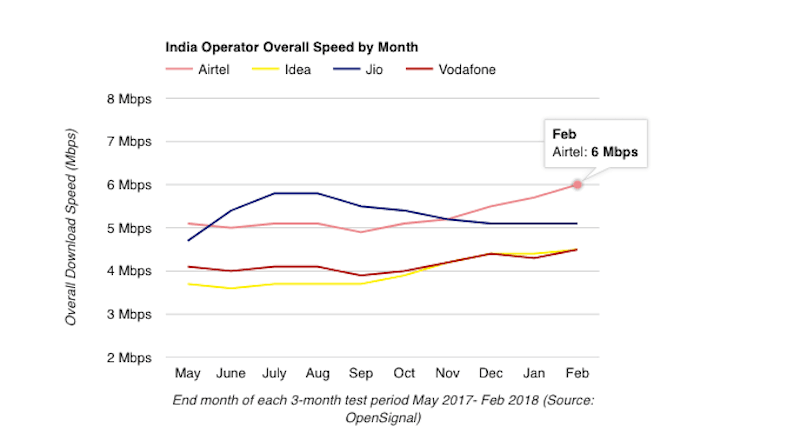
4G in India has always been marred with various issues such as availability, download and upload speeds and so on. However, in recent times, things have changed a lot with increased download speeds and a whopping 96% of LTE coverage by a new entrant. OpenSignal, the network measuring firm recently released its report on 4G speeds offered by the country’s top four telecom operators- Bharti Airtel, Reliance Jio, Vodafone India and Idea Cellular during a ten-month period between May 2017 and February 2018. As expected, Bharti Airtel beats Jio and rest of the telcos in OpenSignal’s tests with an average download speed of 6 Mbps. Airtel is followed by Jio with 5.1 Mbps download speed and Vodafone, Idea secured 4.5 Mbps and 4.4 Mbps average download speed.
- Make Telecom Talk My Trusted Source






OpenSignal, in its report, stated that throughout the summer of 2017, the overall speeds for Airtel, Idea and Vodafone were steady, but in September 2017, the overall download speeds staring rising on the three networks. The three operators began expanding the reach of their LTE networks, which in turn resulted in overall speed increase in Airtel and Idea networks. Both Airtel and Idea registered almost a megabit increase of overall speed between May 2017 and February 2018. As a result, Airtel climbed into the lead in the overall speed metric in December, passing Jio, while Idea pulled itself even with Vodafone in the same timeframe.
Moving onto the Jio’s trend line, it’s quite the opposite to three telcos. As a 4G-only operator, Jio’s overall speed score depends solely on the download speeds of its 4G connections, but there’s no lack of such connections in India, as Jio registered a whopping 96% of LTE availability on its network. OpenSignal cited that Jio’s 4G speeds suffered due to capacity problems. In Jio’s case, the chart shows a big spike in overall download speeds in May, June and July of last year, pushing it past Airtel. “That speed boost most likely represents network upgrades that boosted capacity on Jio’s LTE network. Once that new capacity was in place, Jio’s overall speeds began to level off in our measurements and then gradually drop throughout the rest of the year as customers began consuming that new bandwidth,” said OpenSignal.