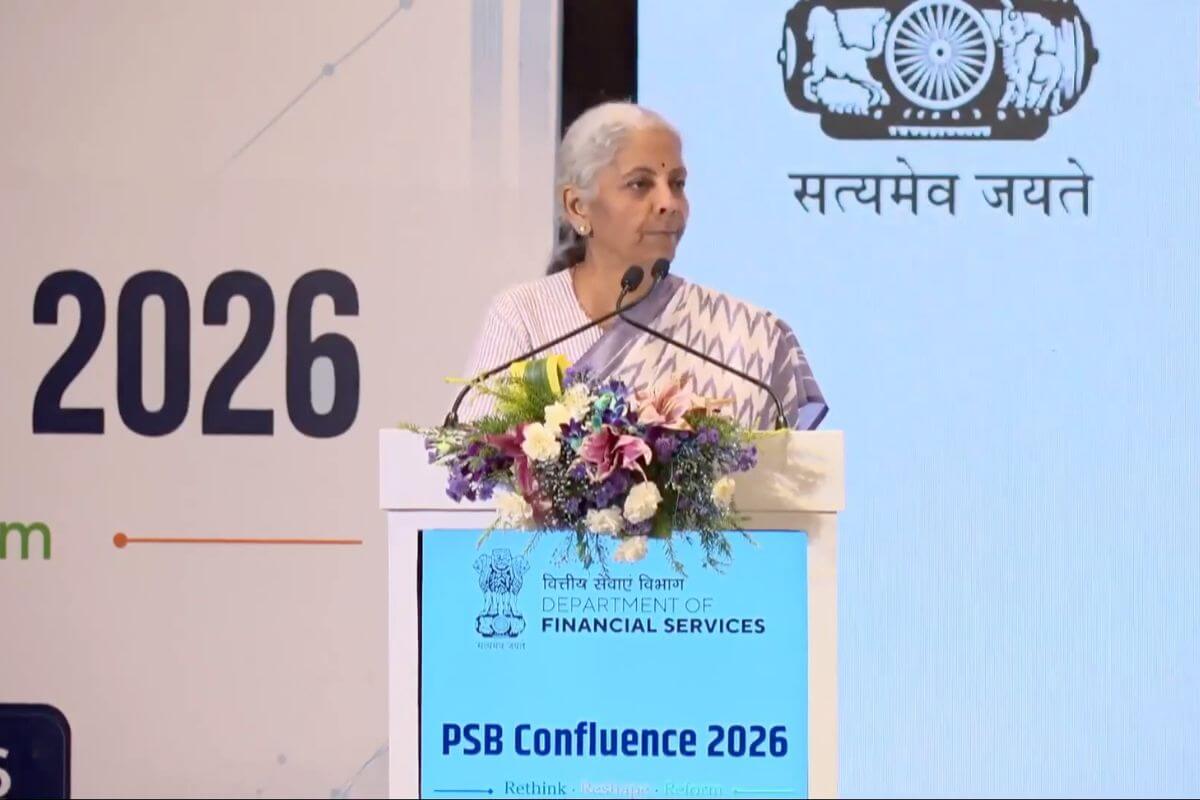
Union Finance Minister Nirmala Sitharaman said the Indian banking sector is in a strong position to undertake the next phase of reforms, with non-performing assets (NPAs) at their lowest-ever level. Speaking at the PSB Confluence in New Delhi on Monday, August 17, 2026, Sitharaman said public sector banks (PSBs) and financial institutions had undergone a difficult period of balance-sheet repair and reforms, emerging stronger from the process.
The first day of the two-day PSB Confluence 2026, organised by the Department of Financial Services (DFS), Ministry of Finance, brought together senior leadership of Public Sector Banks (PSBs) and Public Financial Institutions (PFIs), senior officials from the Government and domain experts to deliberate on emerging opportunities and strategic priorities for the banking and financial sector.
The Union Finance Minister highlighted the critical importance of the seven themes identified for deliberations during the two-day Confluence in taking forward the banking sector, financial inclusion and credit. She emphasised that the historically low level of Non-Performing Assets (NPAs) places the banking sector in a position of strength to take forward the next phase of reforms.
With the banking sector’s asset quality significantly improved, the Finance Minister said there could not be a better time to focus on reforms aimed at supporting India’s growth ambitions under the Viksit Bharat 2047 vision.
She said the improved health of banks provides a position of strength from which the sector can take forward reforms and play a larger role in financing India’s long-term economic development.
According to an official release by the Ministry of Finance on August 17, 2026, four of the seven themes were taken up for detailed deliberations on Day 1: Deposit Mobilisation, Banking for Youth, Supporting the Investment Cycle and Global Capability Centres (GCCs).
The discussions highlighted approaches to strengthen the deposit base through deeper customer engagement; develop banking propositions responsive to the aspirations and financial needs of India’s youth; enhance institutional capabilities and financing solutions to support the evolving investment cycle; and position PSBs and PFIs to capture emerging opportunities across the expanding GCC ecosystem.
As part of the discussions on Banking for Youth, the potential of leveraging Mera Yuva Bharat (MY Bharat), a national platform of the Department of Youth Affairs, Ministry of Youth Affairs and Sports, for wider youth engagement was explored.
On Day 2, discussions will cover the remaining three themes: Agriculture and Horticulture Value Chain Infrastructure, Priority Sector Lending and Reimagining the Credit Card Business, followed by presentations on actionable strategies and innovative solutions emerging from all seven thematic groups.
The Confluence reflects the collective endeavour of the Government, PSBs and PFIs to build on the progress achieved by the banking sector and prepare for emerging opportunities. The deliberations seek to strengthen institutional capabilities and competitiveness and position PSBs and PFIs to effectively support India’s evolving growth aspirations and its journey towards Viksit Bharat 2047.
Addressing the gathering, the Finance Minister spoke about the reforms undertaken in the banking sector, the improvement in asset quality and the road ahead. Her remarks are reproduced below: Edited transcript
“Secretary, Department of Financial Services, Joint Secretary, CMD of State Bank of India (SBI), and Shri Laxmikanth Rao from the RBI, CMDs of all the public sector banks, and also the financial institutions which have come here to join in this conclave.
And as I was seated there, the Chairman of the State Bank of India reminded me that this probably would be one of the biggest conclave of bank heads. So, the importance in terms of presence itself underlines the importance of this gathering.
Big it is, I agree, but I must credit the Department of Financial Services for having worked on the seven different topics which are very critical for us to discuss, and discuss among yourselves, generate some kind of a consensus so that that shall be the template on which all of us can take the banking sector forward, financial inclusion forward, credit forward, and so on.
Yes, at some point in time, there was a discussion among all of us about what could be the content and the topics on which thinking heads from the banking leadership can speak. But, briefly, as I was seated there, I have seen the materials—the seven different topics on which you are likely to speak among yourselves. But for each one of it—and that is why I repeat this point—for the first time, I would think, DFS, at least as long as I have been here, the DFS has actually spent time looking into the details of what each of the seven topics should be focusing on.
So, the content material for each of them is well-researched, bringing in the best practices from around the globe, and also highlighting the need that we have to recognize and discuss and take things forward. Particularly the one document which I was looking into was on the youth. It classifies our youth nicely into different categories, both from the college experiences, age groups which are going to be in college, and otherwise the youth in different age, highlighting the fact 29 percent of India’s population is between 15 and 29 years.
So, if you see the nuggets which come out of these documents, and I understand all these seven documents have been in advance shared with all of you, with the expectation that you would spend some time on each one of them before you attend this meet, and therefore be able to contribute from your point of view the critical thoughts for each one of them, so that this two-day meet would conclude giving us a clear set of workable ideas. Workable because you have given the ideas, you’re the ones who are going to take it forward later on.
But this comes at a time when the intensive discussions of today and tomorrow comes at a time we expect the announcement on the high-powered committee to look into banking for Viksit Bharat. Sooner the committee will be announced. And the material that you are producing from two days’ discussion, on the basis of a well-researched set of documents which have been shared with you in advance, will hopefully provide that substantive meat for the committee to also look at.
So, the committee would probably have that material before them, and even as they deliberate to give us their thoughts and also the recommendations which will help us to clearly understand where the committee wants India to go towards Viksit Bharat and in that, the role of banks.
So, I think two days, absolutely valuable. No one is going to have any FOMO; everyone is here. So, it is your output that I am keenly looking forward to because once the committee gives its input, it’s for us to rapidly move in that direction understanding that the Viksit Bharat 2047 is actually not too far away. We are in 2026. So, less than or short of 20 years is what we have before us.
There couldn’t have been a better time to talk about banking for Viksit Bharat, especially for the grind that all of you all have gone through, come out of it with all the recognition of difficulties, and coming out towards the root of reform. Your NPAs are at the lowest ever Indian banking has seen, and therefore there cannot be a better position of strength with which you can take on reforms.
You’re actually having these two-day confluence, the ideas are going to be from the field, from the executioners as it were. And once the committee, as I said, goes through all this and forms its view and recommendations, we’ll be just ready to press the button or pedal to rev up the Indian economy.
So, since you’re going to have to have me come tomorrow also, post your discussions, with a complete brief that I’ll hear in front of you, before you, about each of the seven topics on which you’ve deliberated, I will stop my opening statement at this stage instead of repeating all the seven categories on which you are going to be discussing. You’ve got the documents, you’ve done your work, so I will be keen to hear what comes out of it tomorrow.
So, thank you very much, and I think this will be one of the best meets where you’re looking for your future action. All the top leadership is here; you have to set the tone for India’s Viksit Bharat,” Sitharaman said.
If this article saved you time or helped you decide better, consider supporting our work.
 Support Telecomtalk