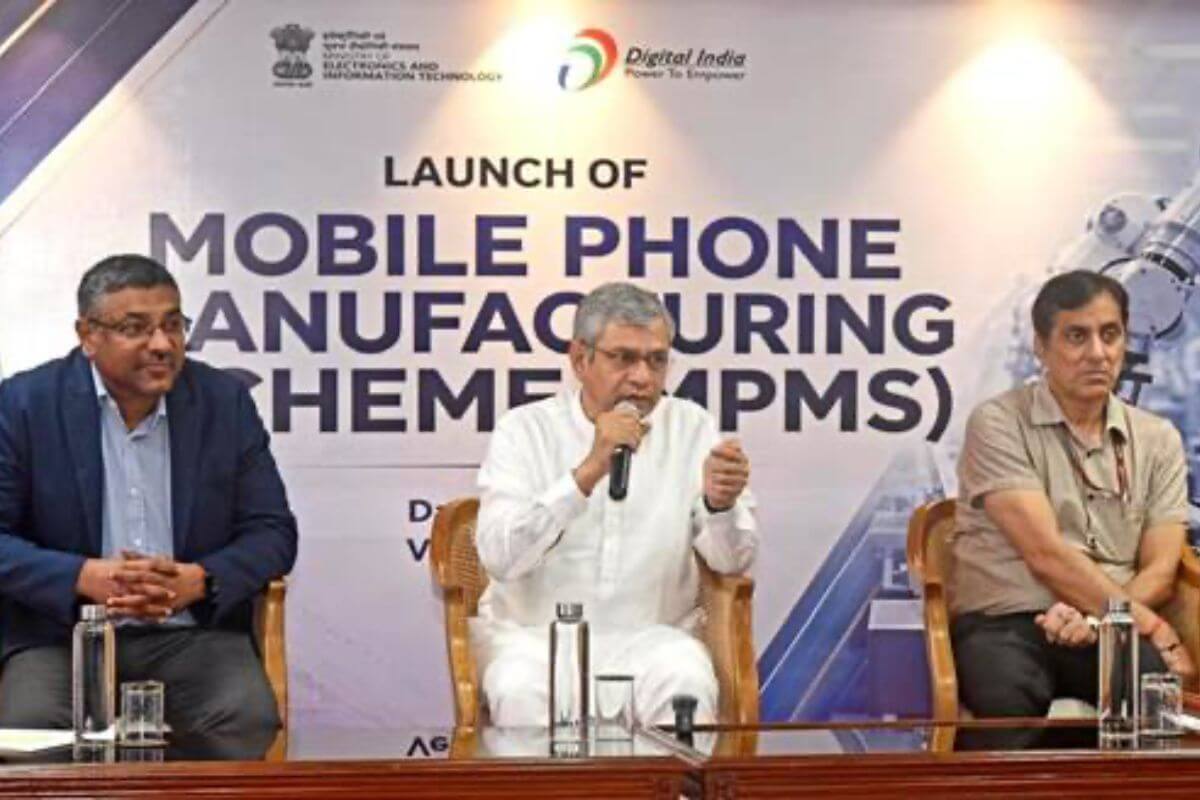
The Ministry of Electronics and Information Technology (MeitY) under the Government has notified the Mobile Phone Manufacturing Scheme (MPMS) with a budgetary outlay of Rs 62,500 crore to boost India’s global competitiveness, deepen the domestic mobile phone supply chain and strengthen manufacturing capabilities. The scheme is expected to generate around 60,000 direct jobs during its five-year tenure, according to an official release issued by the Ministry of Electronics and IT on August 21, 2026.
Make Telecom Talk My Trusted Source
Vaishnaw Pushes for Stronger Indian Ownership of Brands and IP
Union Minister for Electronics and Information Technology Ashwini Vaishnaw said that the Mobile Phone Manufacturing Scheme will provide a significant impetus to the development of Indian-owned mobile brands, intellectual property and design. Emphasising the importance of genuine Indian ownership, the Union Minister said that the design, intellectual property and brand must be Indian-owned and capable of competing with the best products in the respective market segment.
Vaishnaw further stated that the Government will undertake a meticulous evaluation to ensure that the intellectual property is genuinely Indian-owned, while non-fiscal and other support measures will be developed in consultation with the industry.
India’s Electronics Manufacturing Sector Expands Under Make in India
According to the Ministry, the electronics manufacturing sector has expanded significantly under the Prime Minister’s Make in India initiative, with production growing seven-fold and exports increasing eleven-fold since 2014-15.
“The electronics manufacturing sector has emerged as a major employer, especially for young men and women from far-flung villages, with several manufacturing plants employing more than 5,000 people at a single location, and employment at some facilities reaching 20,000. This growth has been primarily driven by mobile phone manufacturing, with mobile phones now constituting a major share of India’s electronics production and exports and playing a critical role in strengthening India’s position in global value chains,” the Ministry said.
Mobile phone manufacturing has been a key driver of this growth, with India emerging as the world’s second-largest mobile phone manufacturer by volume. Nearly 99.2 percent of mobile phones used in the country are now made in India.
Smartphones also emerged as India’s largest exported product category in 2025, surpassing traditional major export items such as diesel fuel and cut diamonds.
Production Linked Incentive (PLI) Scheme
The Production Linked Incentive Scheme for Large Scale Electronics Manufacturing (PLI-LSEM), whose tenure ended on March 31, 2026, played a key role in establishing India as a global hub for mobile phone manufacturing and exports. The MPMS has been introduced to maintain this momentum and further expand domestic production.
Salient Features of MPMS
The scheme has two target segments. Target Segment 1 (TS1) will incentivise mobile phone manufacturing, while Target Segment 2 (TS2) will support Indian mobile phone brands. The scheme will operate for five years from 2026-27 to 2030-31, with a possible one-year gestation period for applicants under TS2.
Under TS1, incentives will range from 2.25 percent to 5 percent. TS2 applicants will receive a 5 percent incentive for Indian brands, along with an additional 3 percent incentive for Indian design and research and development. Non-fiscal support will also be extended to Indian brands.
An additional incentive of up to 1.5 percent will be available to manufacturers in both segments for domestic sourcing of key components and sub-assemblies, provided such components are localised for at least 25 percent of the total mobile phone units manufactured in a financial year.
For TS1, eligible applicants must be mobile phone manufacturers or Electronics Manufacturing Services (EMS) companies registered in India, with a minimum turnover of Rs 10,000 crore in 2025-26. Existing brands will have to meet an annual sales threshold of Rs 5,000 crore over and above their 2025-26 sales. New brands will become eligible after achieving annual sales of Rs 10,000 crore in India and will subsequently have to meet the Rs 5,000-crore annual threshold.
Under TS2, applicants must have a minimum turnover of Rs 1,000 crore in 2025-26 and meet the government’s definition of an Indian brand. This includes registration or incorporation in India, Indian ownership of intellectual property and trademarks, management control by Indian citizens, more than 51 percent Indian shareholding, and in-house design and R&D capabilities in the country.
Expected Outcomes
The government expects cumulative mobile phone production under the scheme to reach approximately Rs 39 lakh crore during its tenure, accompanied by a substantial increase in exports. “MPMS is also expected to generate around 60,000 direct jobs, contributing to economic growth, employment generation, and strengthening India’s position as a global electronics manufacturing hub,” the Government said.
A small group of TelecomTalk readers helps keep this platform running. Support us if you find our work valuable.
 Support Telecomtalk