Airtel’s Air-Gapped Cloud Lets Organisations Run AI Without Internet Connectivity
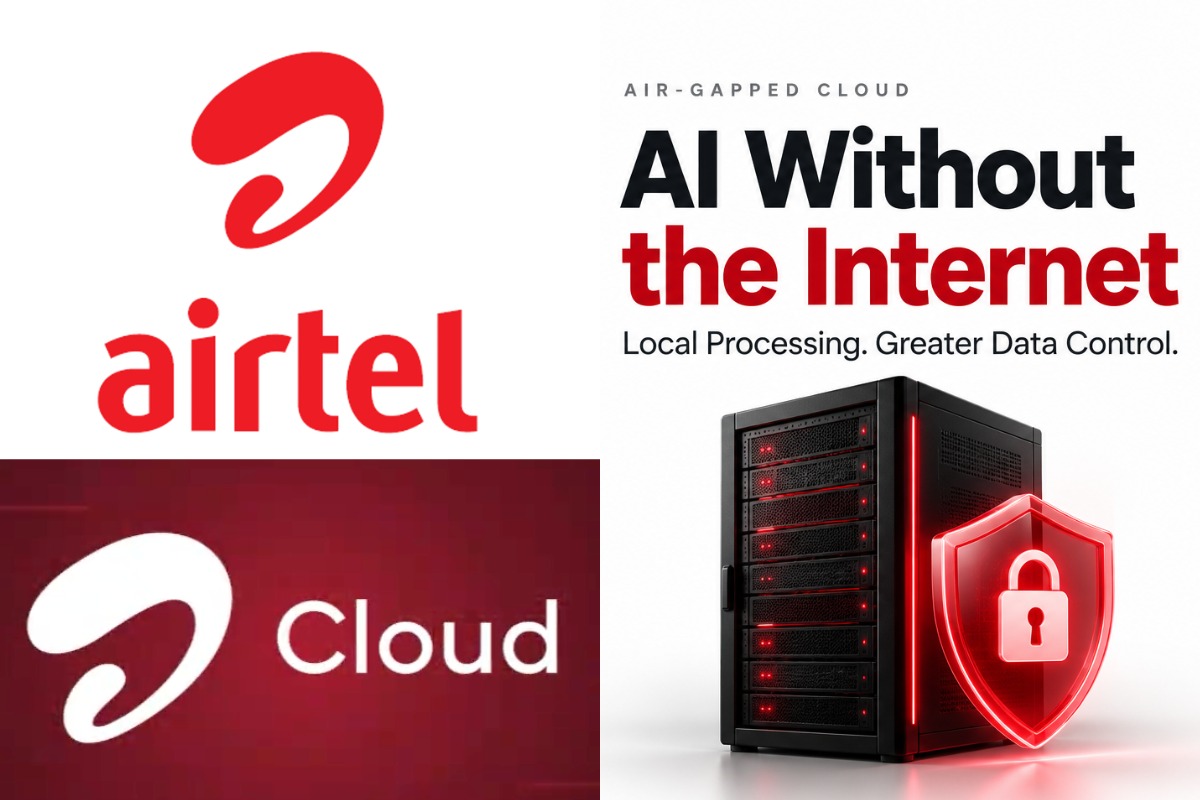
Airtel’s Air-Gapped Cloud, powered by Google Cloud, enables organisations to run AI tools without internet connectivity. The offering combines offline analytics, integrated hardware and software, and local operational control for sensitive workloads.
Bharti Airtel’s Air-Gapped Cloud offering enables organizations to run artificial intelligence tools in environments disconnected from the public internet. Powered by Google Cloud, the platform is positioned for defense and government organizations that require sensitive information to remain within controlled infrastructure. Airtel says its teams manage deployments on site, supporting data residency and sovereignty within India.
Make Telecom Talk My Trusted Source
Key Highlights
Airtel Air-Gapped Cloud is powered by Google Cloud.
The deployed platform operates without internet or Google Cloud connectivity.
Supported AI capabilities include document, audio and video analysis.
Airtel describes controls covering data, operational and software sovereignty.
The offering combines integrated hardware and software with Airtel management.
The offering combines offline AI capabilities, local data processing and an integrated cloud platform.
Its applications include analyzing documents, processing audio and video, translating information and supporting operations in locations where external connectivity is unavailable or restricted.
An air-gapped environment operates in isolation from external networks. Airtel says its deployed platform can operate without connectivity to Google Cloud or the public internet, allowing organizations to run supported services within a controlled environment.
Processing happens inside the isolated infrastructure, letting sensitive workloads run without a live connection to a remote public cloud. Organizations can therefore use supported cloud and AI capabilities while keeping their operating environment disconnected.
The underlying Google Distributed Cloud air-gapped platform supports computing, storage, data management and AI services. Google’s documentation also lists support for virtual machines and Kubernetes-based workloads, allowing different applications to operate within the local cloud environment.
Airtel highlights document intelligence as one of its applications. The platform supports optical character recognition, translation and structured information extraction.
It also lists large language model analysis using techniques such as chunking, embeddings, entity identification and relationship mapping. These capabilities can help organizations process unstructured documents and organize information for further analysis. Airtel also lists support for multimodal inputs and structured call detail record datasets.
For audio, the platform offers transcription, translation, noise reduction, and the extraction of entities and topics. Video analytics capabilities include detecting objects, faces, text, and actions within frames. The platform can store embeddings and metadata within the environment to support search and investigations.
Bharti Airtel additionally highlights on-premises translation of material such as images, audio files, and PDFs, with an option to download results.
Designed for Disconnected Field Environments
Alongside on-premises deployments, Airtel lists an air-gapped cloud appliance for tactical and challenging operating conditions. The appliance combines hardware and software to support deployment in environments with limited or unavailable connectivity.
Google describes its air-gapped appliance as a platform designed for use outside conventional data centers. It supports virtual machines, container workloads and AI services, including optical character recognition, speech-to-text and translation.
The field deployment option extends local processing to locations where organizations need to analyze information without relying on an internet uplink.
Airtel describes three layers of sovereignty for the platform. Data sovereignty means information remains on premises within the isolated environment, with no data transferred outside it, according to the company.
Operational sovereignty involves running the platform independently of Google Cloud and global networks, using dedicated networks and a local control plane.
The underlying platform supports local operational control, while Airtel says its offering will be fully managed by the company.
Software sovereignty focuses on delivering cloud capabilities locally. Airtel says Google Cloud’s open core and open APIs help reduce vendor risk and support operational and software continuity.
The offering is supplied as an integrated hardware and software solution. Airtel’s FAQ clarifies that customers cannot simply install the software on their existing hardware. Under the support model described by Airtel, Google supports its operating partners, which provide support to end users.
Airtel’s management role brings the integrated infrastructure and supported services together for organizations seeking to run sensitive workloads within an isolated environment.
Some people read for free. A few choose to support. If you found TelecomTalk useful, you can help keep us running.
FAQs
What is Airtel Air-Gapped Cloud?
Airtel Air-Gapped Cloud is a Google Cloud-powered offering that enables organisations to run supported cloud services and AI tools within an isolated environment.
Does Airtel Air-Gapped Cloud require internet connectivity?
The deployed platform can operate without connectivity to Google Cloud or the public internet.
What AI capabilities does the platform offer?
Airtel lists document processing, optical character recognition, translation, LLM analysis, audio transcription and video analytics among its capabilities.
Who is Airtel Air-Gapped Cloud designed for?
Airtel positions the offering for defence and government organisations that need local processing and control over sensitive information.
Can organisations install the software on their existing hardware?
No. According to Airtel, the offering is supplied as an integrated hardware and software solution, fully managed by the company.
 Support Telecomtalk