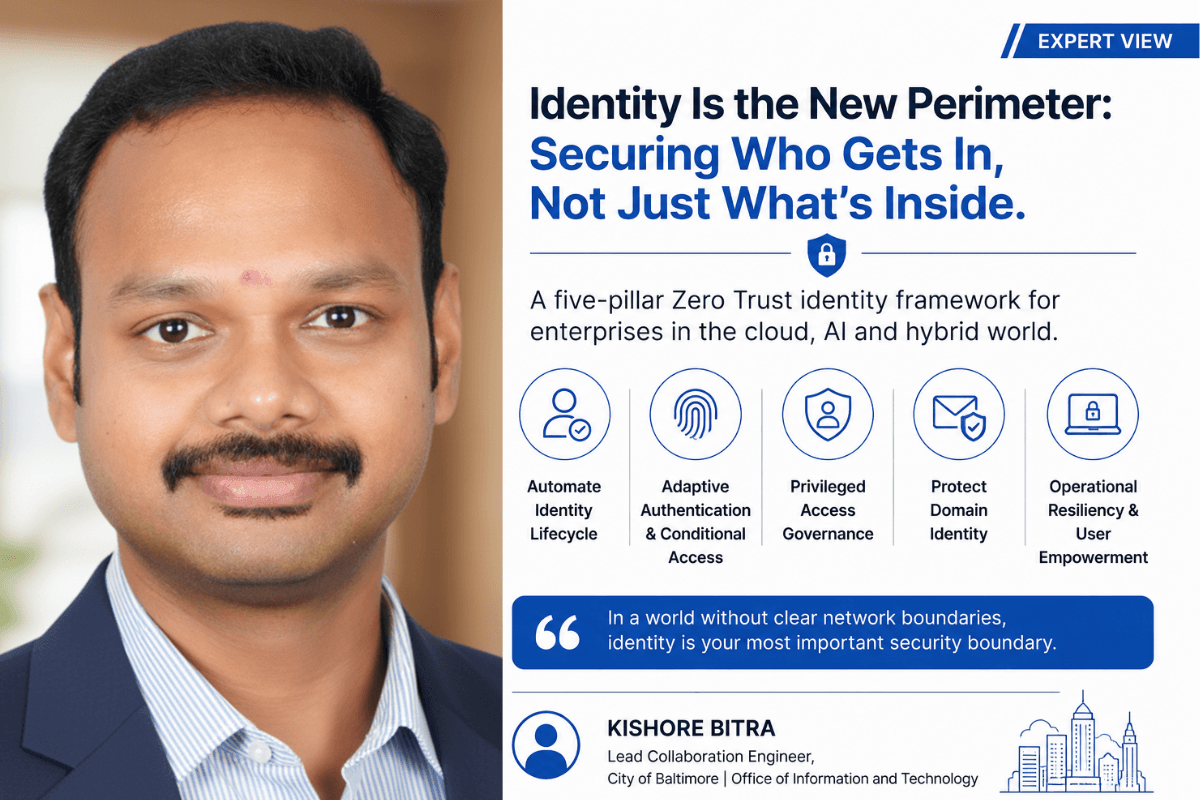
For decades, enterprise cybersecurity strategies were built around a simple assumption: protect the network and everything inside it remains secure. Organizations invested heavily in firewalls, intrusion detection systems, VPNs and network segmentation to create strong defensive perimeters.
That approach worked when employees operated primarily from corporate offices and applications lived inside company-owned data centers.
Applications run across public clouds, employees work from multiple locations, contractors access systems remotely, and business operations increasingly depend on third-party integrations. The traditional network perimeter has become difficult to define, making identity the most important security boundary for modern enterprises.
Every interaction with a business application, cloud service or collaboration platform begins with authentication. Whether it is a user account, service account, API key or security token, identity is now where trust is established and where many security incidents originate.
Many organizations accumulate what can be described as “identity debt” over time.
Employees join departments, change roles, receive access to additional applications and eventually leave the company. Yet access privileges often remain behind. Service accounts created for temporary projects continue operating long after their original purpose has ended. Legacy permissions accumulate without regular review.
These dormant accounts and unnecessary privileges can create opportunities for attackers.
Addressing this challenge requires a structured identity security strategy rather than isolated security controls.
Pillar 1: Centralized Identity Lifecycle Management
The foundation of identity security begins with ensuring that access rights accurately reflect employment status and job responsibilities.
A modern approach treats the HR system as the authoritative source of employee information. When an employee joins, changes roles or leaves the organization, identity systems automatically update access rights across connected applications.
This reduces reliance on manual processes and helps eliminate orphaned accounts that often remain active after employees depart.
Single Sign-On (SSO) further strengthens security by reducing the number of credentials employees must manage, lowering the risk of password reuse across applications.
Automated account hygiene processes can also identify stale accounts and disable credentials that remain unused or unmanaged for extended periods.
Pillar 2: Adaptive Authentication and Conditional Access
Passwords alone are no longer sufficient to protect enterprise systems.
Modern identity security increasingly relies on phishing-resistant authentication methods such as authenticator applications and FIDO2 security keys. These technologies significantly reduce the effectiveness of credential theft attacks.
Conditional Access introduces another layer of protection by evaluating contextual signals before granting access.
Factors such as device compliance, geographic location, user behavior and risk scores can be assessed in real time. A login attempt from an unmanaged device or an unusual location can be blocked even when valid credentials are presented.
For many organizations, these controls can help prevent large numbers of credential-based attacks each year.
Pillar 3: Privileged Access Governance
Administrative accounts represent some of the highest-value targets for cybercriminals.
A compromised administrator account can provide access to email systems, cloud services, security configurations and critical business applications.
Many organizations continue to rely on permanent administrative privileges because they simplify operational tasks. However, standing privileged access significantly increases security risk.
A Just-In-Time (JIT) access model provides an alternative approach. Administrative privileges are granted only when required and automatically removed once the task is completed.
This minimizes the exposure window and reduces the likelihood of privileged credentials being exploited by attackers.
Continuous monitoring of service accounts, application credentials and privileged identities further strengthens security posture.
Pillar 4: Protecting Domain Identity
Identity security extends beyond employee accounts.
Corporate domains themselves possess digital identities that can be abused through impersonation and email spoofing attacks.
Technologies such as SPF, DKIM and DMARC help verify the legitimacy of email communications and reduce the likelihood of attackers successfully impersonating trusted organizations.
As supply chains become increasingly interconnected, enterprises are also beginning to evaluate the identity security practices of third-party vendors and partners.
Ensuring that external organizations follow similar authentication standards can help reduce broader ecosystem risks.
Pillar 5: Operational Resiliency and User Empowerment
Security controls must balance protection with usability.
If security processes create excessive friction, users often seek workarounds that weaken overall security.
Secure Self-Service Password Reset capabilities allow employees to recover access without helpdesk intervention while maintaining strong verification requirements.
Similarly, restricting access to corporate data from managed and compliant devices helps ensure that sensitive information remains protected regardless of where employees work.
By linking user identities to trusted devices, organizations can strengthen both security and operational efficiency.
Why Identity Security Matters More Than Ever
The rapid adoption of cloud computing, AI-powered applications, remote work models and digital collaboration platforms has fundamentally changed enterprise security requirements.
Attackers increasingly target identities because identities provide direct access to valuable systems and data.
As organizations continue modernizing their digital infrastructure, identity security is becoming a foundational component of Zero Trust architectures and broader cybersecurity strategies.
While identity controls alone do not replace endpoint security, network protection or incident response capabilities, they provide a critical first line of defense against many of today’s most common attack methods.
Conclusion
The future of enterprise security is increasingly centered on identity rather than traditional network boundaries.
Organizations that invest in automated identity lifecycle management, phishing-resistant authentication, privileged access governance and domain protection can significantly reduce their attack surface while supporting modern ways of working.
In a world where employees, applications and data operate far beyond the confines of a traditional corporate network, identity has become the new perimeter.
Every article you read here is the result of time, research, and effort. If you feel it adds value, you can support TelecomTalk.
 Support Telecomtalk