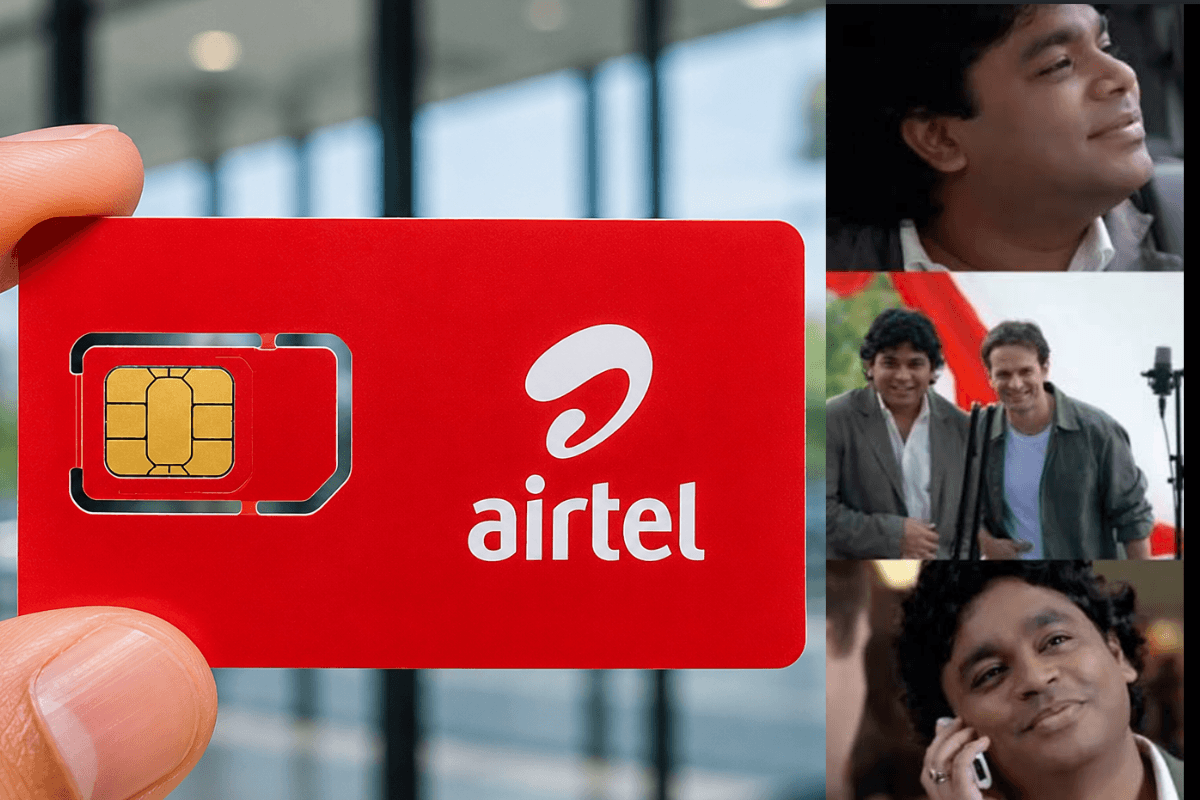
Airtel’s Five Notes Have Outlived 2G, 3G, 4G and Even Entered the AI Era
Twenty-five years after A.R. Rahman composed Airtel's iconic five-note signature, the melody remains one of India's most recognisable brand assets. While telecom has evolved from voice calls and SMS to 5G, fibre broadband and AI-powered services, the familiar tune has continued to represent the Airtel brand across every phase of that journey.
Airtel's five-note signature has remained relevant through every major telecom transition in India, from the early GSM era to today's AI-powered digital services.
Instead of replacing its sonic identity, Airtel has modernised the melody through new arrangements while preserving the original five-note structure for over two decades.
The signature has outlasted multiple advertising campaigns and technology generations, making it one of the few brand assets to consistently bridge different generations of mobile users.
Highlights
Airtel's five-note signature has remained relevant through every major telecom transition in India, from the early GSM era to today's AI-powered digital services.
Instead of replacing its sonic identity, Airtel has modernised the melody through new arrangements while preserving the original five-note structure for over two decades.
The signature has outlasted multiple advertising campaigns and technology generations, making it one of the few brand assets to consistently bridge different generations of mobile users.
There are very few advertising campaigns that survive for decades. Even fewer leave behind a brand asset that people can recognise within seconds Airtel’s five-note signature belongs to that rare category.
Make Telecom Talk My Trusted Source
Key Highlights
Airtel's iconic five-note signature, composed by A.R. Rahman in 2001, has completed 25 years.
The melody has remained a consistent brand identity through India's transition from 2G to the AI era.
Airtel has retained the recognisable five-note structure while refreshing its musical arrangements over time.
The signature has accompanied Airtel's evolution from a mobile operator to a digital communications company offering mobile, fibre broadband and enterprise services.
The longevity of the melody highlights how a strong sonic identity can outlast multiple technology and marketing cycles.
Composed by A.R. Rahman in 2001, the melody has now completed 25 years and continues to enjoy a level of recall that few Indian brands have achieved. While advertising trends, consumer behaviour and telecom technologies have changed dramatically, the familiar five notes have remained closely associated with Airtel.
For the company, the tune has become far more than background music. It has evolved into a sonic identity that customers recognise instantly, whether they encounter the brand through television commercials, digital campaigns or mobile services.
Introduced When India’s Mobile Market Was Taking Shape
When Airtel launched the signature in 2001, India’s telecom industry was still in its early growth phase. Voice calls and SMS dominated mobile usage, feature phones were the norm and internet access on handsets remained limited. Owning a mobile phone was becoming increasingly common, but data-driven services were still years away.
Over the next quarter century, the industry underwent one of the fastest technology transitions seen anywhere in the world. India moved from 2G to 3G, 4G and now 5G. Smartphones replaced feature phones, mobile internet became central to daily life and networks began supporting services ranging from video streaming and digital payments to online education, cloud applications and AI-powered experiences throughout these changes, Airtel’s five-note signature remained one of the few constants associated with the brand.
Airtel itself has changed significantly over the last 25 years what began primarily as a mobile operator has expanded into a broader digital communications company with businesses spanning wireless services, fibre broadband, enterprise connectivity and digital services.
The company’s advertising has evolved alongside these changes, but the core musical identity has remained intact. Different arrangements and creative interpretations have refreshed the melody over the years without altering the recognisable five-note structure that customers associate with Airtel.
That consistency has helped strengthen the brand across multiple generations of consumers. Someone who first heard the tune while purchasing a prepaid SIM card in the early 2000s can still recognise it today while watching a 5G campaign or using Airtel’s digital services unlike slogans or visual identities that are frequently redesigned, Airtel’s sonic branding has remained remarkably stable.
Why the Melody Continues to Work
Part of the signature’s longevity lies in its simplicity. Five notes are easy to remember, adaptable across different formats and instantly recognisable even when presented through different musical styles.
Over the years, Airtel has incorporated the melody across television, radio, digital advertising and various customer touchpoints. While creative execution has changed with evolving media platforms, the underlying musical identity has stayed familiar.
That continuity is unusual in one of the world’s most competitive telecom markets, where marketing campaigns often change rapidly to reflect new products or technologies.
From Telecom to the AI Era
The telecom industry has changed beyond recognition since the melody first appeared consumers have moved from making voice calls and sending SMS to streaming high-definition video, using cloud-based applications, making digital payments and relying on always-on connectivity. Fibre broadband has become an important part of household connectivity, while operators continue investing heavily in 5G infrastructure and network modernisation.
The industry is now entering another transition as artificial intelligence becomes increasingly integrated into telecom operations and customer services. Airtel itself has introduced AI-powered capabilities, including its spam detection solution and other customer-focused initiatives aimed at improving the customer experience.
Against this backdrop, the five-note signature continues to fit naturally because it represents the Airtel brand rather than any single technology generation.
The Sound That Stayed While Technology Changed
Most advertising campaigns have a limited lifespan. Technology evolves even faster the fact that Airtel’s signature has remained relevant through the eras of 2G, 3G, 4G, 5G and now AI reflects the value of maintaining a consistent brand identity while allowing it to evolve creatively over time.
From the early years of GSM voice services to today’s digital-first communications landscape, the melody has accompanied both Airtel’s own growth and the broader transformation of India’s telecom sector.
For many consumers, it evokes memories of their first mobile connection. For younger users, it is simply the sound they associate with the Airtel brand. Despite the difference in experiences, the same five notes continue to bridge generations.
As India’s telecom industry moves towards AI-driven networks, smarter digital services and deeper fibre connectivity, the underlying technology will continue to change. Yet Airtel’s familiar five-note signature remains a reminder that while platforms, devices and networks evolve, a strong brand identity can endure across decades.
Some people read for free. A few choose to support. If you found TelecomTalk useful, you can help keep us running.
FAQs
Who composed Airtel's famous five-note signature?
The iconic five-note Airtel signature was composed by A.R. Rahman in 2001.
How old is Airtel's signature tune?
The melody has completed 25 years and remains one of India's most recognisable brand sounds.
Why has Airtel continued using the same five-note melody?
The company has preserved it as a consistent sonic identity while adapting its arrangements for changing media platforms and technologies.
How has India's telecom industry changed since Airtel introduced the tune?
The industry has evolved from voice calls and SMS on 2G networks to 3G, 4G, 5G, fibre broadband and AI-powered digital services.
Does Airtel still use the five-note signature today?
Yes. The melody continues to appear across Airtel's advertising and customer touchpoints, representing the brand across the AI era.
 Support Telecomtalk