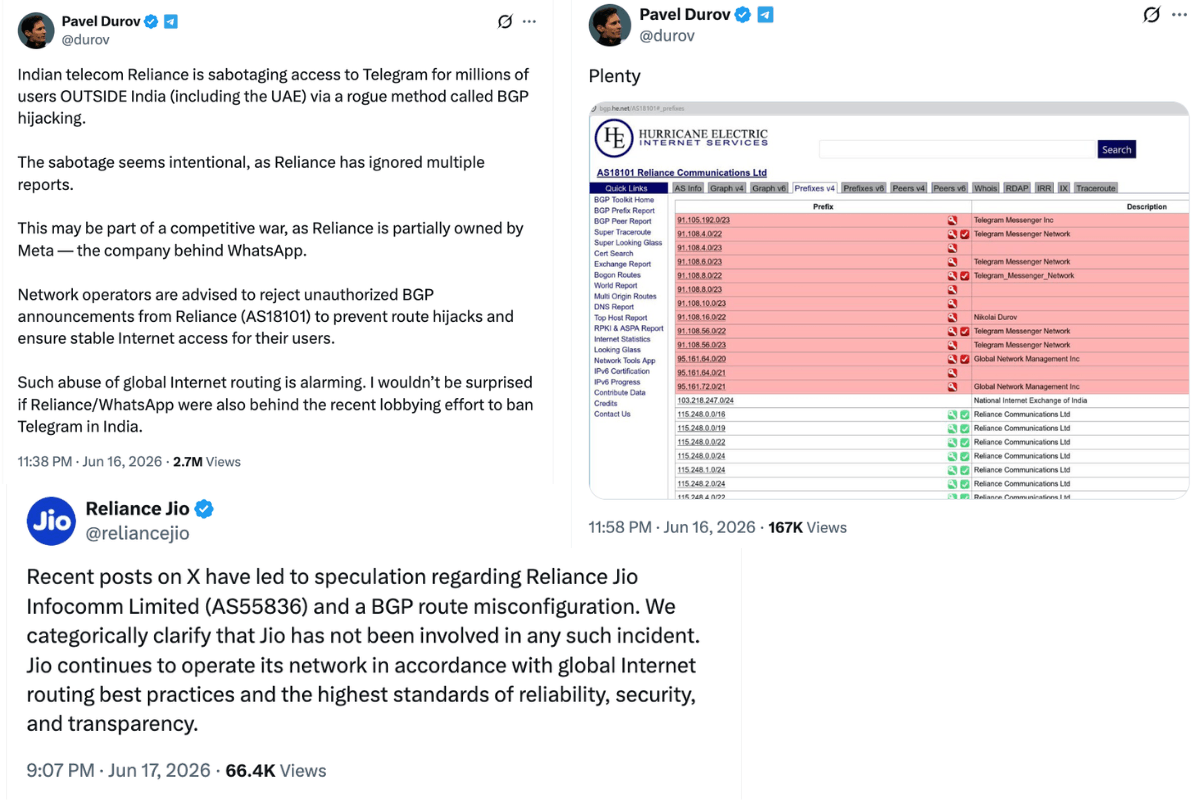
Reliance Jio has responded to speculation circulating on social media that attempted to connect the operator’s network with an alleged internet routing incident involving Telegram in a statement posted on X, Jio said recent posts had led to speculation regarding Reliance Jio Infocomm Limited (AS55836) and a BGP route misconfiguration the company categorically denied any involvement in the incident.
Make Telecom Talk My Trusted Source
Key Highlights
The controversy revolves around a reported BGP route misconfiguration.
Jio reiterated its commitment to network reliability, security, and transparency.
Jio's statement highlights the complexity of attributing routing incidents, as internet traffic often traverses multiple interconnected networks before reaching its destination.
Reliance Jio stated that it continues to operate its network in accordance with global internet routing best practices and maintains high standards of reliability, security, and transparency.
What Triggered the Speculation?
The clarification follows discussions on social media surrounding Telegram and comments made by Telegram founder and CEO Pavel Durov. Some posts attempted to link a reported routing issue involving Telegram traffic with Jio’s autonomous system number (AS55836), leading to widespread speculation online.
While the claims gained traction on social platforms, no publicly available evidence was presented showing that Jio was responsible for any intentional routing change or network disruption. The company therefore moved quickly to address the allegations and provide its position on the matter.
Understanding BGP and Routing Incidents
At the centre of the discussion is BGP, or Border Gateway Protocol, the system that helps direct internet traffic between networks around the world. Internet service providers, telecom operators, cloud providers, and content networks use BGP to exchange routing information the protocol determines the paths that data packets take when moving from one network to another.
Occasionally, routing incidents can occur because of configuration errors, route leaks, or incorrect route advertisements. Such events can temporarily affect traffic flows and may lead to connectivity issues for certain services or regions.
However, identifying the exact cause of a routing anomaly is often complex. Internet traffic typically traverses multiple networks across different countries and operators before reaching its destination.
Why Attribution Can Be Difficult
Network experts have long noted that attributing a routing incident to a specific operator requires detailed technical analysis. A route leak or misconfiguration observed in one network may have originated elsewhere and simply propagated through interconnected systems.
As a result, conclusions drawn solely from publicly visible routing data can sometimes be incomplete or misleading without additional context from the networks involved this is one reason why operators often issue public clarifications when their infrastructure becomes the subject of online speculation.
Jio Reiterates Commitment to Best Practices
In its statement, Jio emphasized that it continues to manage its network according to internationally accepted routing practices.
The company said its operations are guided by principles of reliability, security, and transparency, underscoring its commitment to maintaining a stable and trusted network environment for customers and partners.
The clarification is likely aimed at addressing concerns generated by the viral discussions and ensuring that inaccurate assumptions do not gain further momentum.
Why Internet Routing Incidents Can Be Difficult to Verify
The episode also highlights how internet infrastructure issues can quickly become public discussions in the age of social media. Routing incidents, whether caused by technical errors or misunderstandings, often generate significant attention because they can affect widely used digital platforms and services.
For telecom operators and internet providers, maintaining confidence in network operations is critical. Public statements such as Jio’s are therefore an important part of addressing speculation and providing clarity when questions arise about the functioning of internet infrastructure.
As of now, Reliance Jio has firmly denied any involvement in the alleged Telegram-related routing incident and maintains that its network continues to operate according to global internet routing standards and industry best practices.
Found this useful? You can support us.
FAQs
Why did Jio issue a clarification?
Jio issued a clarification after social media posts linked its network and AS55836 autonomous system to an alleged Telegram-related BGP routing incident. The company denied any involvement.
What is BGP?
Border Gateway Protocol (BGP) is the routing system that helps direct internet traffic between networks operated by telecom companies, internet service providers, cloud providers, and content platforms.
What is a BGP route misconfiguration?
A BGP route misconfiguration occurs when incorrect routing information is announced or propagated across networks, potentially causing traffic to take unintended paths or resulting in connectivity issues.
Was Jio found responsible for the alleged Telegram routing incident?
No. Jio has categorically stated that it was not involved in any such incident and said its network continues to operate according to global routing best practices.
Why are routing incidents difficult to investigate?
Internet traffic typically passes through multiple interconnected networks. Determining the origin of a routing anomaly often requires detailed technical analysis and cooperation from several network operators, making attribution complex.
 Support Telecomtalk