Support Telecomtalk







Andrew Bonwick
Vice President of Product Development at Relm Insurance

Madhav Sheth
CEO of Ai+ Smartphone

Stephen Rose
CEO Render Networks



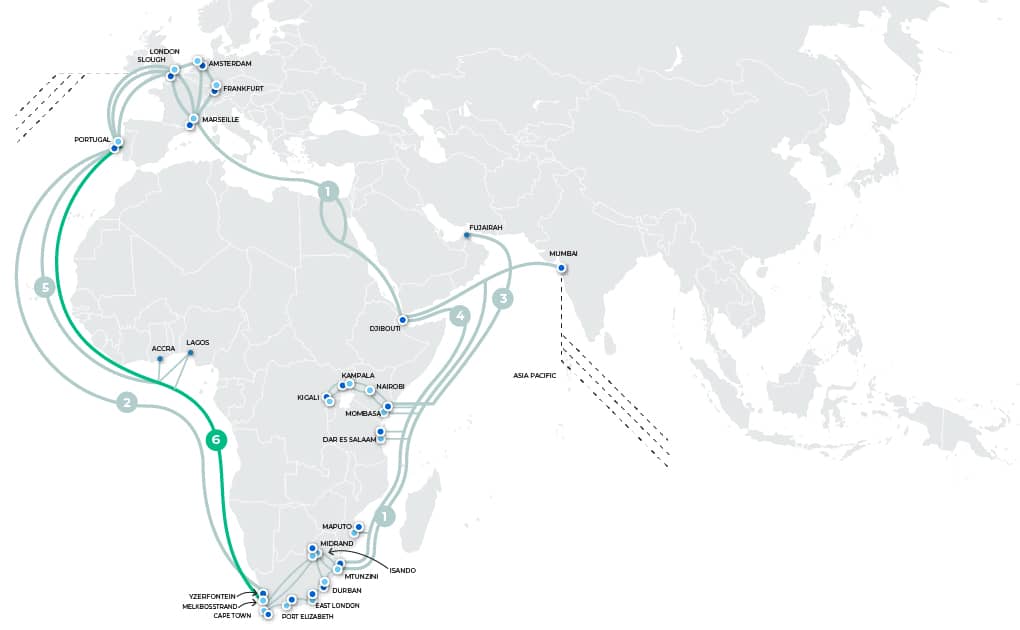
SEACOM’s Subsea Cable Ecosystem, Image courtesy: SEACOM
- Make Telecom Talk My Trusted Source



SEACOM, Africa’s leading telecommunications and managed services provider, announced that it has launched its services on the Equiano subsea cable, which landed in Cape Town, South Africa, in August 2022. As a result, the company now provides Private Line services, with an impressive latency speed of approximately 110 milliseconds (ms) between South Africa and Europe, making it the fastest direct route between the two continents.



Also Read: Du and Omantel Launch OEG Subsea Cable Project
The announcement comes after SEACOM fulfilled the necessary equipment and installation requirements with the help of its technology partner, Infinera. The cable now forms part of SEACOM’s subsea cable ecosystem surrounding Africa, supported by a continent-wide Internet Protocol Multi-Protocol Label Switching (IP-MPLS) network.
Equiano subsea cable
Google announced the Equiano subsea cable in 2019, which is among Africa’s most high-capacity cables. The cable spans 15,000 kilometers from Portugal to South Africa, has twelve fibre pairs, and has a design capacity of 144 Tbps. The cable has a landing station in Melkbosstrand, Cape Town, as well as in other African locations, including Rupert’s Bay, St. Helena; Lome, Togo; Lagos, Nigeria; and Swakopmund, Namibia. Branching units from these stations will further extend connectivity to other African countries.
Also Read: Sparkle Starts Laying the BlueMed Subsea Cable in Genoa
SEACOM express route from Cape Town to Lisbon
According to the statement by the company, “The launch comes after SEACOM has completed extensive work to support the new connection, including upgrades to its transmission and IP network both locally and internationally. As part of the service available to wholesale and enterprise clients from March, SEACOM will offer an express route from Cape Town to Lisbon. This means clients will enjoy high-speed connectivity without having their data rerouted to other countries during transmission.”