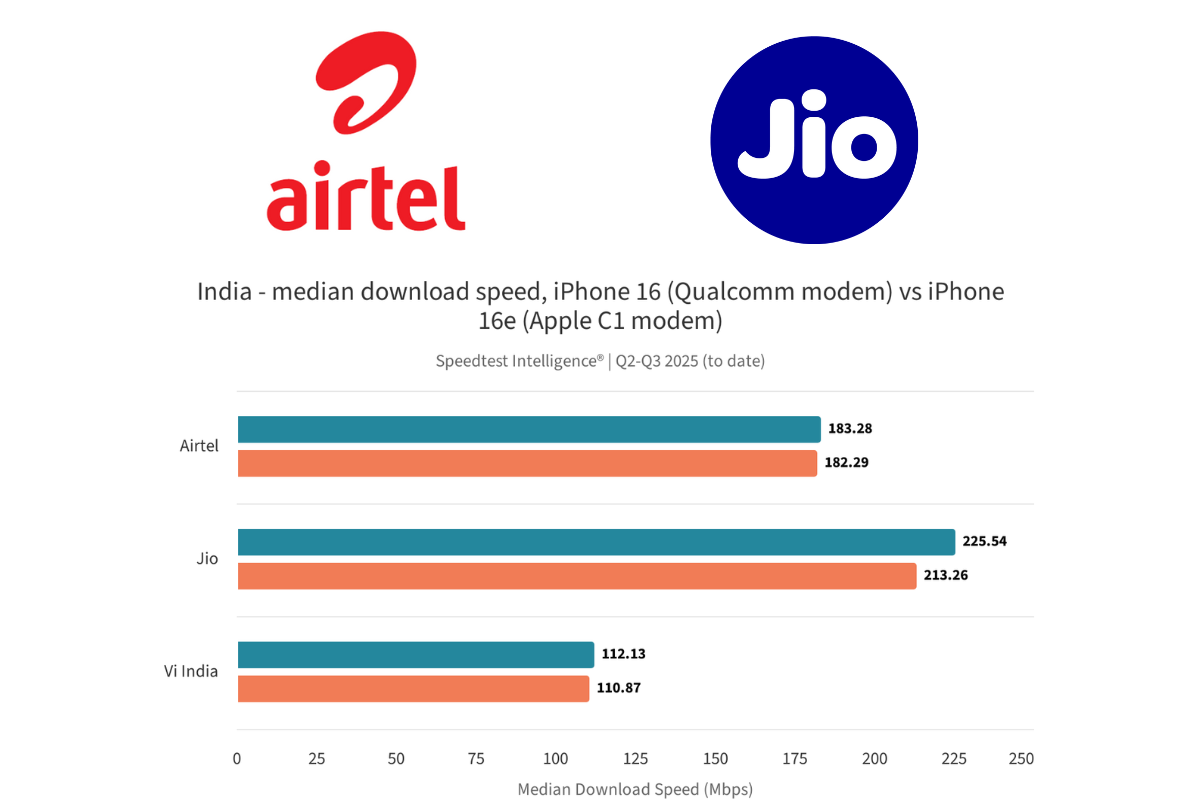
Apple’s iPhone 16 series has not only captured attention for its new design and features but also sparked debate over performance differences between the standard iPhone 16, powered by Qualcomm’s modem, and the iPhone 16e, which debuts Apple’s in house C1 modem. In India, those differences become clearer when tested against the country’s three major 5G operators Reliance Jio, Bharti Airtel, and Vodafone Idea (Vi).
Make Telecom Talk My Trusted Source
According to Ookla’s Speedtest Intelligence data for Q2–Q3 2025, network capability plays a decisive role in which modem performs better. On Jio and Airtel, the iPhone 16 consistently edges ahead, while on Vi the iPhone 16e often matches or even surpasses it. The findings highlight how the quality of the 5G network can determine whether Apple’s own modem can stand shoulder-to-shoulder with Qualcomm.
Jio: Building for Standalone 5G
Jio has invested heavily in creating a nationwide 5G standalone (SA) network, the only one of its kind in India. Its approach combines 700 MHz low-band spectrum for broad coverage, 3.5 GHz mid-band for capacity, and 26 GHz mmWave for ultra-high speeds in select locations. By integrating massive MIMO and advanced carrier aggregation, Jio allows devices like the iPhone 16 to connect across multiple spectrum bands at once.
This network architecture plays directly to Qualcomm’s strengths. At both the median speed what the typical user experiences and at the 90th percentile, representing the top 10% of fastest results, the iPhone 16 shows a clear lead. In essence, Jio’s robust and flexible spectrum strategy highlights the advantage of Qualcomm’s modem over Apple’s C1.
Airtel: Non-Standalone, But Still Powerful
Airtel’s rollout has followed the non-standalone (NSA) model, anchored to its 4G infrastructure. Even so, Airtel has implemented carrier aggregation in key circles, enabling faster connections when multiple spectrum bands are combined.
Here too, the iPhone 16 maintains an advantage, particularly at the higher 90th percentile speeds. Median speeds between the two iPhones remain nearly identical, but in areas where Airtel’s aggregation is strongest, the Qualcomm modem in the iPhone 16 stretches ahead. Airtel may not match Jio’s SA depth, but its spectrum strategy ensures users of the iPhone 16 see better performance in demanding conditions.
Vi: No Clear Winner
Vodafone Idea’s network tells a different story. With a smaller 5G footprint and limited use of advanced aggregation techniques, Vi does not provide the same environment for Qualcomm’s modem to demonstrate its edge. At the median level, the iPhone 16e occasionally even outperforms the iPhone 16. At the 90th percentile, the difference is negligible, leaving both models essentially neck and neck.
This makes Vi the one network where Apple’s C1 modem holds its own without disadvantage, raising questions about how much of the performance debate comes down to hardware versus network maturity.
What Consumers Should Know
For Indian users, the report underscores an important point: a smartphone’s performance is only as good as the network it runs on. On Jio and Airtel, the iPhone 16 provides a clear edge for those chasing the fastest possible 5G speeds. For Vi customers, however, both the iPhone 16 and 16e deliver virtually the same experience, making the more affordable 16e a practical choice.
The findings also mirror trends seen internationally. In the US, Ookla noted similar results with T-Mobile, where advanced networks exposed Qualcomm’s modem advantage. Simpler or less developed networks, meanwhile, showed little difference between Qualcomm and Apple’s solutions.
The Bigger Picture
Apple’s shift to its own modem technology has been closely watched, and India’s results reveal the complexities involved. On advanced networks, Qualcomm still has the upper hand. But on networks without high levels of aggregation, Apple’s C1 modem keeps pace.
As 5G matures in India, and as Vi expands its deployment, the balance may shift further. For now, though, the iPhone 16 remains the device that can squeeze the most out of Jio and Airtel’s networks, while the iPhone 16e shows that Apple’s in-house modem can hold firm on less demanding infrastructure.
Every article you read here is the result of time, research, and effort. If you feel it adds value, you can support TelecomTalk.
 Support Telecomtalk