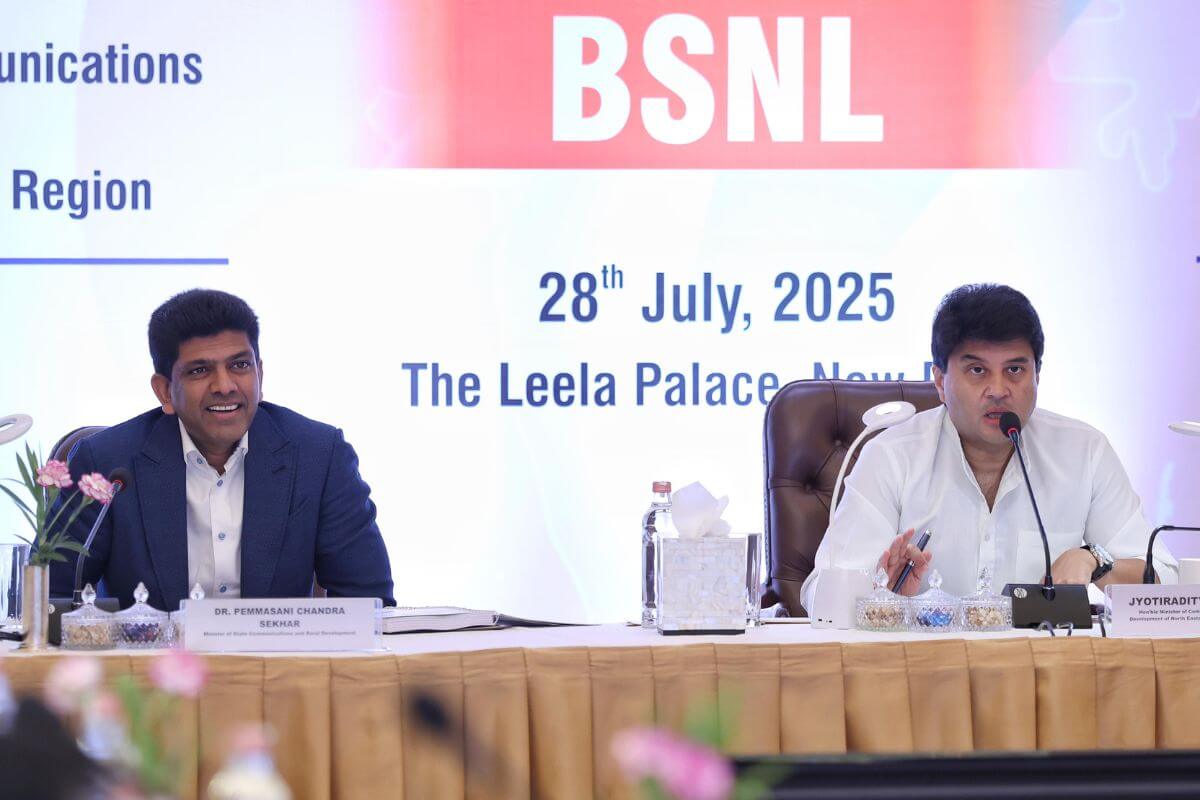
Union Communications Minister Jyotiraditya Scindia on Monday outlined ambitious growth targets for state-owned telecom operator Bharat Sanchar Nigam Limited (BSNL), calling for a 50 percent rise in its consumer mobility business and a 25–30 percent increase in enterprise services over the next financial year. The directives were issued during a review meeting with BSNL officials, according to an ETTelecom report.
After years of losses, BSNL posted a net profit in the last two quarters of FY24. Scindia stressed that the company must now focus on sustaining this momentum by ensuring revenue growth outpaces expenditure. He added that BSNL should work toward turning quarterly losses into profits, with an emphasis on improving top-line performance and reducing operational costs.
During the review meeting, Scindia reportedly said BSNL should grow its revenues faster than its expenditure next fiscal to maintain the current momentum.
“Wide-ranging discussions during the review focused on BSNL’s growth strategy, improving network performance, customer service delivery, and organizational modernization. This comprehensive dialogue reinforced BSNL’s positioning as a consumer-centric telecom service provider with a clear mandate of “Revenue First” targets across all business units. The forum helped align BSNL’s top management in driving these priorities at every level, emphasizing accountability for outcomes,” the Ministry of Communications said on Monday, July 28, 2025.
ARPU and Customer Experience
The minister also highlighted several persistent challenges facing BSNL, including competition from private telecom players, outdated technology, slow 4G rollout, low average revenue per user (ARPU), and service quality concerns, particularly in fixed broadband. He noted that BSNL’s rural-heavy footprint, while offering unique advantages, requires strategic positioning to compete effectively in urban markets.
“We have a structural problem and we have a competitive problem. We are more rural focused than urban. Our product today is not as competitive as our competitors…We’ve got to build our moats… Moats are our areas of very distinct competitive environments. So, if there are areas in your SBU (strategic business unit) where other private sector players are not going because they don’t want to go that route, make that your moat,” Scindia said at the meeting, as reported.
The minister underscored the need to enhance ARPU, which currently ranges widely from Rs 40 to Rs 175 across cities. He recommended initiatives such as cross-selling, upselling, improving customer satisfaction, and rolling out bundled plans, family data sharing options, and referral programs to boost both mobile and broadband revenues.
“Your enterprise business must grow by a range of 25-30 percent. There’s no reason why your consumer mobility business should not grow by 50 percent. This is for next year. Even if you grow your ARPU (average revenue per user) by 50 per cent, you’ll already be there,” Scindia was quoted as saying.
On the broadband front, BSNL has been asked to actively engage with government departments, industries, and MSMEs (micro, small and medium enterprises) to expand its fixed-line offerings and increase user value. Scindia urged the company to conduct customer perception surveys to align its internal assessments with real user experiences.
Scindia also reportedly asked BSNL executives to improve the quality of service and customer relationships by conducting surveys to understand customer perception, which may differ from internal beliefs. The minister said he will undertake a quarterly review of BSNL’s progress while minister of state Chandra Sekhar Pemmasani will undertake a monthly meeting with BSNL executives.
Key Focus Areas and Outcomes
During the CGM meeting, BSNL’s Circle Heads were briefed and aligned on several priority areas for customer outreach and service quality improvement. The special focus areas identified included:
Reconnecting with customers across rural, urban, enterprise, and retail segments
Enhancing Quality of Service (QoS) in mobile networks and fiber-to-the-home (FTTH)
Addressing customer grievances in billing, provisioning, and network uptime
Driving accountability with “revenue-first” targets at every operational level
Expanding enterprise services such as connectivity, VPN solutions, leased line services, and other new business opportunities.
New Service Initiatives
As part of the review, several new initiatives recently launched by BSNL were highlighted, aimed at enhancing service offerings and customer value. The initiatives include:
4G expansion and rollout in multiple telecom circles
Introduction of IFTV for FTTH and BiTV for mobile customers platforms for next-generation infotainment
BSNL National Wi-Fi Roaming (nationwide Wi-Fi roaming service for customers)
Tailored BSNL VPN services and bundled packages for enterprise and government clients
CNPN projects (private network initiatives) for high-reliability connectivity in mission-critical infrastructure
A Spam-Free Network — a first-of-its-kind solution to eliminate scam and spam communications in real time
Online portal for BBA ( BSNL Business associate) have been launched, enabling the educated youth to engage with the BSNL sales channel strengthening and earn on sales commissions.
Scindia also said BSNL’s focus will be on improving its operating margins and cash flows rather than just net profit, as depreciation and amortisation costs from large capital expenditure can distort the bottom line.
BSNL made a capital expenditure of Rs 25,000 crore in FY24 to deploy indigenous 4G infrastructure, installing over 100,000 towers across the country. Minister of State for Communications Chandra Sekhar Pemmasani said initial issues with the homegrown 4G stack have been largely resolved, with over 90 percent of technical glitches addressed. The current focus is on network optimisation, gaining market share, and improving user experience.
The government plans to gradually phase out BSNL’s 2G and 3G services and transition most users to 4G. There are no immediate plans to raise tariffs, with the government aiming to attract users switching from private operators following their price hikes.
A small group of TelecomTalk readers helps keep this platform running. Support us if you find our work valuable.
 Support Telecomtalk