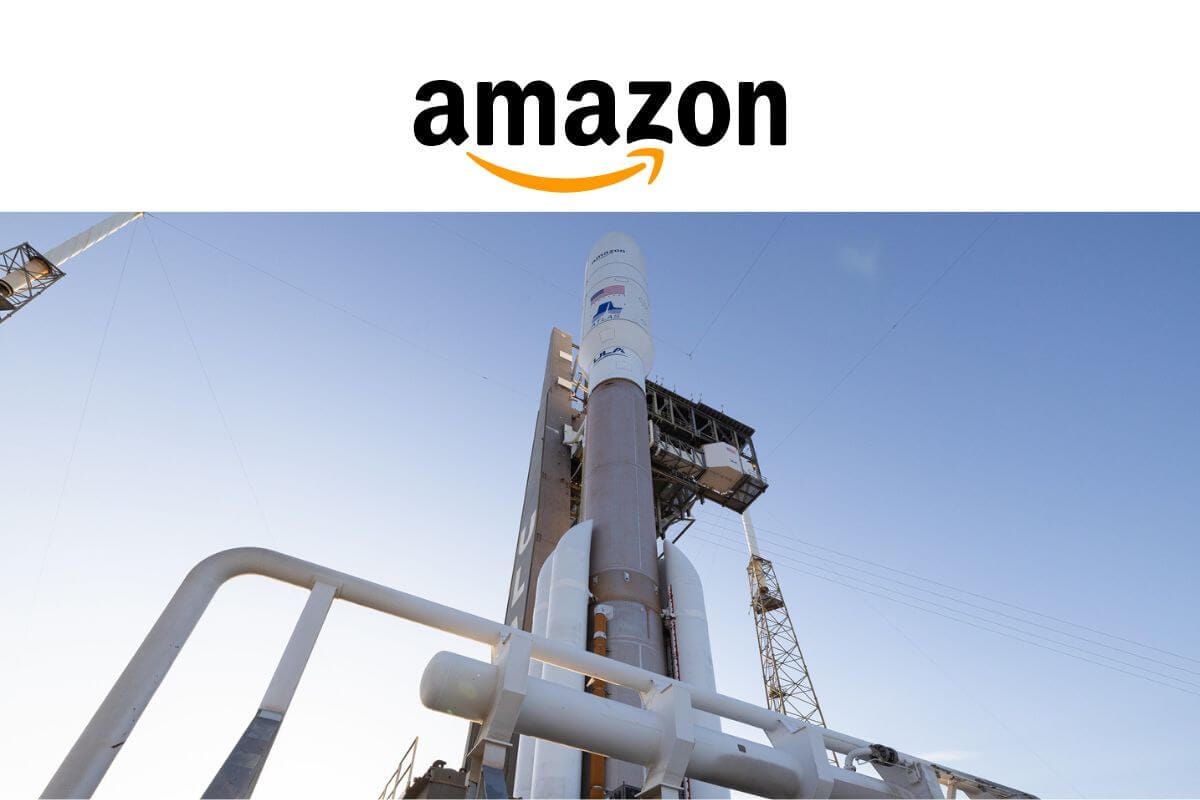
Amazon successfully launched the first 27 operational satellites for its Project Kuiper broadband internet constellation on Monday, marking the company’s formal entry into the competitive satellite internet market. The satellites were launched aboard an Atlas V rocket from the United Launch Alliance (ULA) at Cape Canaveral Space Force Station in Florida at 7 pm EDT, after a previous attempt on April 9 was postponed due to unfavourable weather.
“The Kuiper 1 launch marks the beginning of full-scale deployment of the Kuiper constellation and a new chapter in the commercial launch industry as Amazon partners with ULA to deliver a majority of its advanced satellites in low-Earth orbit (LEO)” United Launch Alliance (ULA) said in a statement on April 28, 2025.
Project Kuiper is Amazon’s low-Earth orbit satellite broadband network. Its mission is to provide fast, reliable internet to customers around the world—including those in unserved and underserved communities—using a constellation of more than 3,200 LEO satellites.
In addition to the launch of two Kuipersat prototypes in 2023 and another seven launches aboard Atlas V, Project Kuiper will leverage the next-generation Vulcan rocket for 38 high-cadence, rapid-fire launches, positioning ULA to deliver more than half of the constellation’s more than 3,200 satellites through the world’s largest commercial launch agreement, ULA said.
Mission to Deliver Global Broadband
The deployment marks a major milestone in Amazon’s USD 10 billion initiative, first announced in 2019, to deliver global broadband internet through LEO satellites. The service is aimed at consumers, businesses, and government customers—particularly in rural and underserved areas where internet access remains limited or nonexistent.
Amazon faces significant pressure to ramp up deployment. The US Federal Communications Commission (FCC) requires the company to launch at least 1,618 satellites—half of its constellation—by mid-2026. Analysts anticipate Amazon may seek an extension due to the delayed start; the inaugural operational launch was originally scheduled for early 2024, according to a Reuters report.
The satellites launched Monday are expected to establish initial contact with Amazon’s mission operations center in Redmond, Washington, within hours or days. If successful, Amazon plans to begin customer service later this year. According to filings, service can begin in certain northern and southern regions once 578 satellites are operational, with global coverage expanding as more are deployed.
ULA, Vulcan Rocket to Power Future Deployments
ULA may conduct up to five additional Kuiper launches in 2025, CEO Tory Bruno was quoted as saying in the report. Amazon has already secured 83 launch contracts from ULA, Arianespace, and Blue Origin—the largest commercial launch deal in the industry to date.
Despite its late market entry, Amazon brings considerable advantages to the table, including its vast experience in consumer hardware and its dominant cloud computing business through AWS, which Kuiper aims to integrate with. In 2023, the company revealed compact Kuiper terminals, including a primary model roughly the size of a vinyl record and a smaller version akin to a Kindle device. Each is expected to cost under USD 400, with tens of millions slated for production.
Project Kuiper’s entry intensifies competition with Starlink, which has launched more than 8,000 satellites since 2019 and currently serves over 5 million users in 125 countries. Starlink’s rapid deployment, enabled by SpaceX’s reusable Falcon 9 rockets, has made it a key player in both commercial and defence markets, according to the report.
Amazon Executive Chairman Jeff Bezos remains optimistic about Kuiper’s prospects, citing “insatiable demand” for internet access. “There’s room for lots of winners,” Bezos was quoted as saying in the report. “Starlink will continue to be successful, and I predict Kuiper will be successful as well.”
 Support Telecomtalk