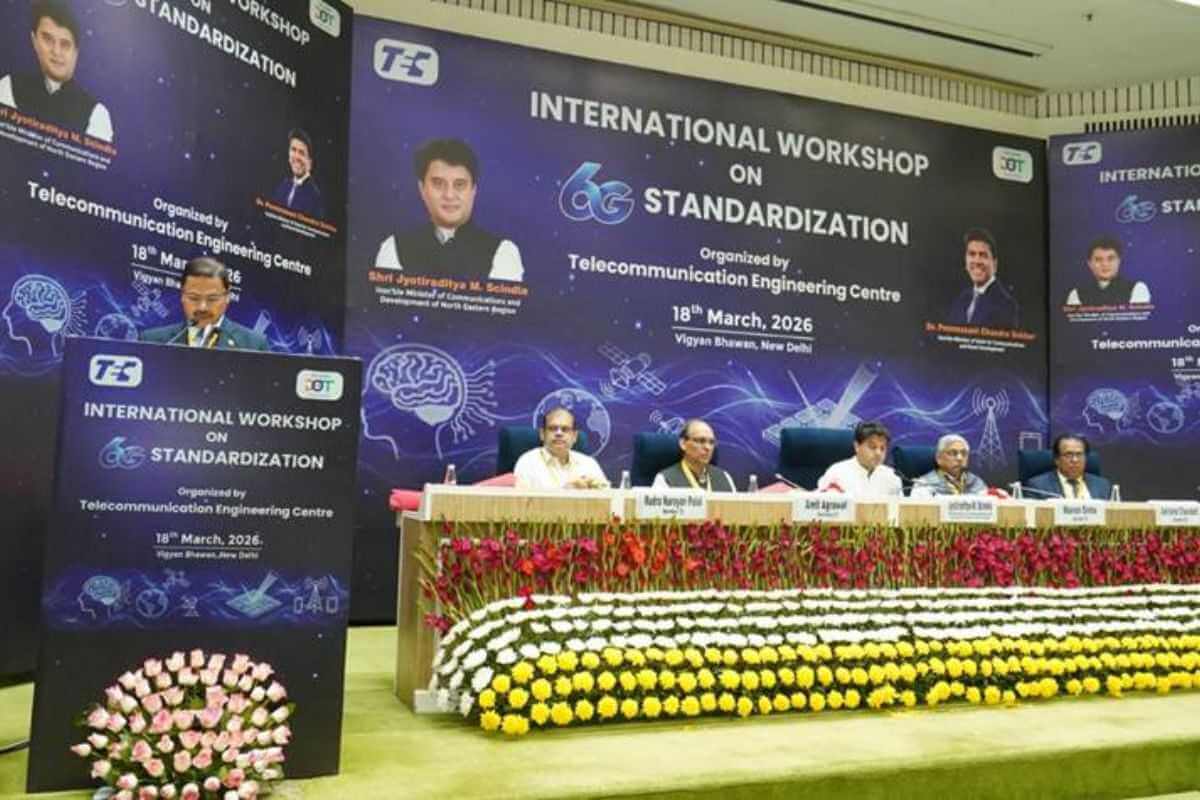
Delivering his inaugural address at an International Workshop on 6G Standardisation, Scindia emphasised India’s ambition to play a meaningful role in shaping the global telecommunications architecture of the future, according to the official statement from the Ministry of Communications.
He stated: “As we advance on this journey, our role must be anchored in four key pillars. First, ensuring global interoperability—across devices, networks and services—so that the world communicates seamlessly within a unified ecosystem. Second, developing a common technical framework, in collaboration with global bodies such as 3GPP and ITU, to establish shared standards across radio interfaces, core networks, spectrum and service architecture. Third, accelerating innovation and research, where clear global standards guide researchers, startups and industry in transforming breakthroughs into real-world solutions.
Fourth, and most importantly, ensuring inclusive growth and indigenous innovation. Open standards create a level playing field, enabling nations to contribute, build intellectual property and ensure that the benefits of technology reach every citizen across the globe. To realise these pillars, sustained international cooperation, global dialogue and continuous engagement are essential.”
Workshop Highlights and Key Participation
The workshop served as an important platform to review global developments in 6G research, spectrum planning, network architecture, artificial intelligence-enabled networks and emerging applications, while strengthening India’s participation in international standards development processes, the Ministry said.
“Under the leadership of Prime Minister Narendra Modi, the Bharat 6G Alliance was established in 2022, articulating India’s Bharat 6G Vision. Our ambition is clear—to contribute at least 10 per cent to global standards and patents as 6G evolves”, Scindia said.
He emphasised that “the promise of 6G lies not only in technological sophistication, but also in the democratisation of opportunity. It is here that India’s story comes to the fore on the global stage.”
“This journey (of 6G) is not the case only for India. This has to be the case across the world so that the world communicates seamlessly across a unified global communication ecosystem,” Scindia said at the international 6G standardisation conference organised by TEC, according to an Economic Times report dated March 18, 2026.
Innovation, Startups, and Industry Alignment
According to the report, he noted that clear global standards will guide Indian researchers, startups, and industries, allowing them to align investments and transform laboratory breakthroughs into real-world applicable solutions.
“I believe…the most important aspect is to ensure inclusive growth and indigenous innovation. Open standards create a level-playing field to ensure that nations contribute to technology, build intellectual property (IP), and ensure that benefits reach every marginal citizen,” Scindia reportedly said.
Industry stakeholders, including vendors, chipmakers, and telecom carriers, have commenced trials and demonstrations for next-generation mobile technology, which is expected to deliver significantly faster internet speeds, lower latency, and ubiquitous connectivity by leveraging untapped frequency bands such as centimeter wave (cmWave) and terahertz (THz), the report added.
“India is working steadfastly with the Bharat 6G Alliance (B6GA) that it has set up under the leadership of Prime Minister Narendra Modi, to be a partner at the table of setting those standards that the ITU and 3GPP will decide,” Scindia was quoted as saying.
6G’s Transformational Potential
The minister reportedly added that 6G could enable innovation on a wide scale and deliver it to the grassroots levels. He explained that the 6G networks may enable a farmer to access the moisture quality of soil, assess weather patterns, and, in the medical industry, pave the way for remote robotic surgery. “When you put these three elements together – speed, latency, and integration of AI – what you get in return is the intelligent internet of everything.”
With 6G, India envisions a future dominated by holographic communications, autonomous mobility, digital twins, and sustainability. “The promise of this 6G technology not only lies in the power of technological sophistication, but also lies in the democratisation of opportunity,” Scindia reportedly said.
India’s Long-Term Digital Economy Vision
“We are looking at a new environment where a USD 1 trillion digital economy outlook today is an opportunity for India tomorrow, with close to 200,000 startups,” he added.
Speaking to the media on the sidelines of the International Workshop on 6G Standardisation, Scindia, according to an ANI report dated March 18, 2026, said: “We have a commitment that the Bharat 6G Alliance will work steadfastly across its seven working groups to show India’s participation in setting standards on 6G. This technology has exponential possibilities.”
He also noted that “it will not only bridge the digital divide but provide tremendous opportunities” for the country. This focus on future technology follows a period of expansion in the domestic telecom infrastructure.
Scindia concluded: “Let us pledge today to build a secure, resilient and truly global 6G ecosystem—one that connects not just devices, but people, opportunities and possibilities across the length and breadth of our world.”
Some people read for free. A few choose to support. If you found TelecomTalk useful, you can help keep us running.
 Support Telecomtalk