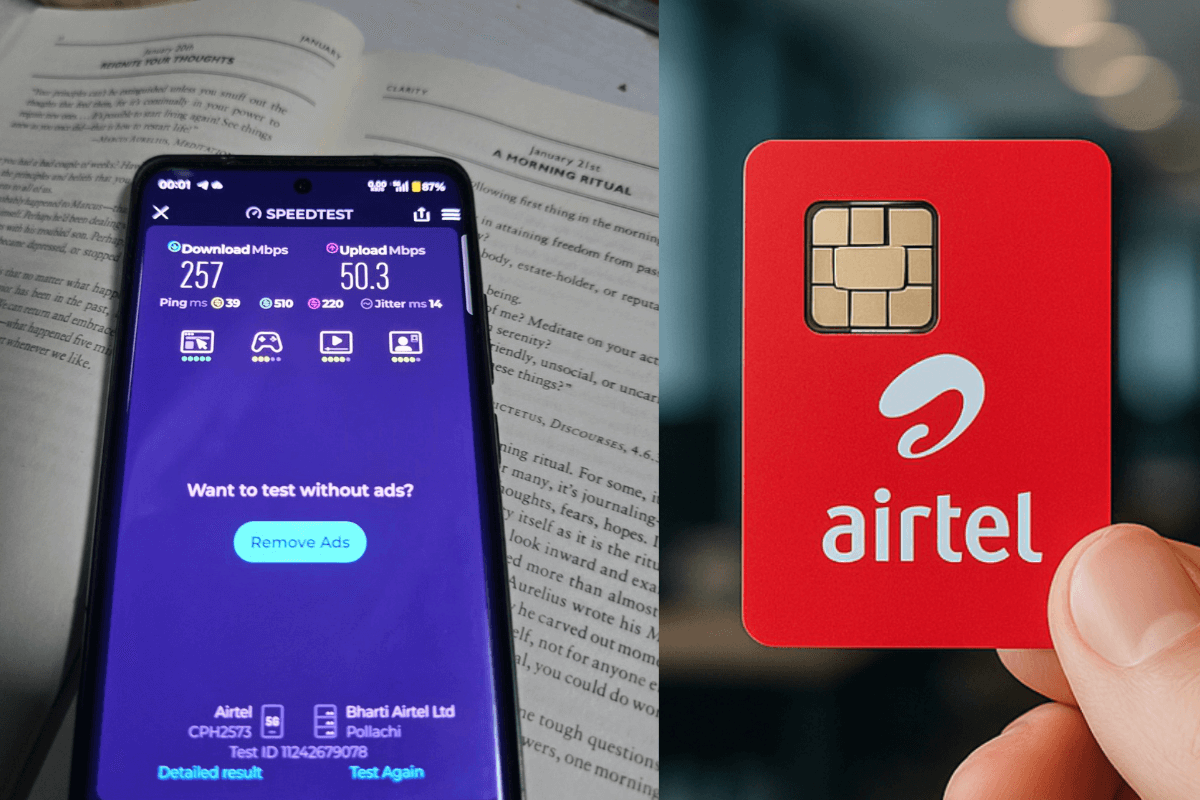
A late-night speed test conducted on a fast-moving train has highlighted the growing maturity of Airtel’s 5G network, delivering impressive speeds under one of the most challenging mobility environments in the country. During the test, conducted on a train travelling at more than 100 kmph along Kerala’s coastal stretch, Airtel 5G recorded 257 Mbps download and 50 Mbps upload speeds. The test results with video were shared on TelecomTalk’s official Twitter account, along with a screenshot confirming the train’s live route and movement.
The readings stand out because mobility performance particularly at high speeds remains a complex area for telecom networks. While operators often showcase peak 5G speeds above 1 Gbps under ideal, static conditions, real-world mobility exposes a different set of engineering challenges. Rail routes, in particular, serve as one of the toughest benchmarks owing to continuous handovers, rapidly changing signal environments, tower spacing irregularities and sudden SINR drops around curves, bridges and tunnels.
Why Mobility Performance Matters
In India’s expanding digital environment, users increasingly rely on stable connectivity during travel. Whether it is students attending classes online, remote workers joining video calls on the go or travellers streaming content, network stability during high-speed movement has become an essential requirement. A fast-moving train forces the device to switch between towers every few seconds, and maintaining consistent throughput under these conditions demands precise mobility tuning.
During this test, Airtel’s ability to sustain 257 Mbps download while the train moved at over 100 kmph indicates strong mid-band performance on the 3500 MHz layer. More significantly, the 50 Mbps upload recorded during the run is a notable metric, as uplink typically experiences the sharpest degradation during motion. Uplink performance is crucial for video calls, sending large files, cloud backups, real-time collaboration and social media uploads all commonly used applications by commuters and travellers.
Indicators of a Strong Mid-Band Layer
Several factors appear to have contributed to Airtel’s stable performance during this mobility test:
Smooth handovers: The device did not experience sudden drops or long freeze periods, indicating well-optimised handover parameters along the corridor.
Beam management: Strong uplink and downlink values reflect effective beam tracking even under rapid motion.
Consistent tower footprint: Throughput remained stable across multiple tower boundaries, suggesting evenly distributed signal strength and improved inter-site overlap.
Useable SINR values: Signal quality remained within ranges suitable for mid-band throughput, despite frequent changes in position and direction.
These factors collectively point to a mobility environment that has been engineered beyond mere coverage expansion.
Airtel’s Position in India’s 5G Rollout
As India’s 5G rollout enters a phase of deeper optimisation, mobility performance will become a more important differentiator among operators. The first phase of nationwide 5G launch focused largely on coverage and peak speeds. The next phase will hinge on consistency, uplink strength, low jitter and stability under motion especially across highways, rail routes and inter-city corridors.
Bharti Airtel’s performance in this field test positions the operator competitively in terms of mobility readiness. The ability to deliver strong throughput during high-speed travel reflects network depth, especially on the mid-band, which plays a key role in achieving balanced range and capacity.
A Real-World Indicator of Network Growth
The test underscores how India’s 5G ecosystem is transitioning from showcasing theoretical peak speeds to demonstrating real-world reliability. Airtel’s 257 Mbps at 100+ kmph suggests that the operator is strengthening its network for scenarios that reflect actual user behaviour. As operators continue refining their deployments, such field results will play an important role in understanding the performance users can expect across the country.
A small group of TelecomTalk readers helps keep this platform running. Support us if you find our work valuable.
 Support Telecomtalk