



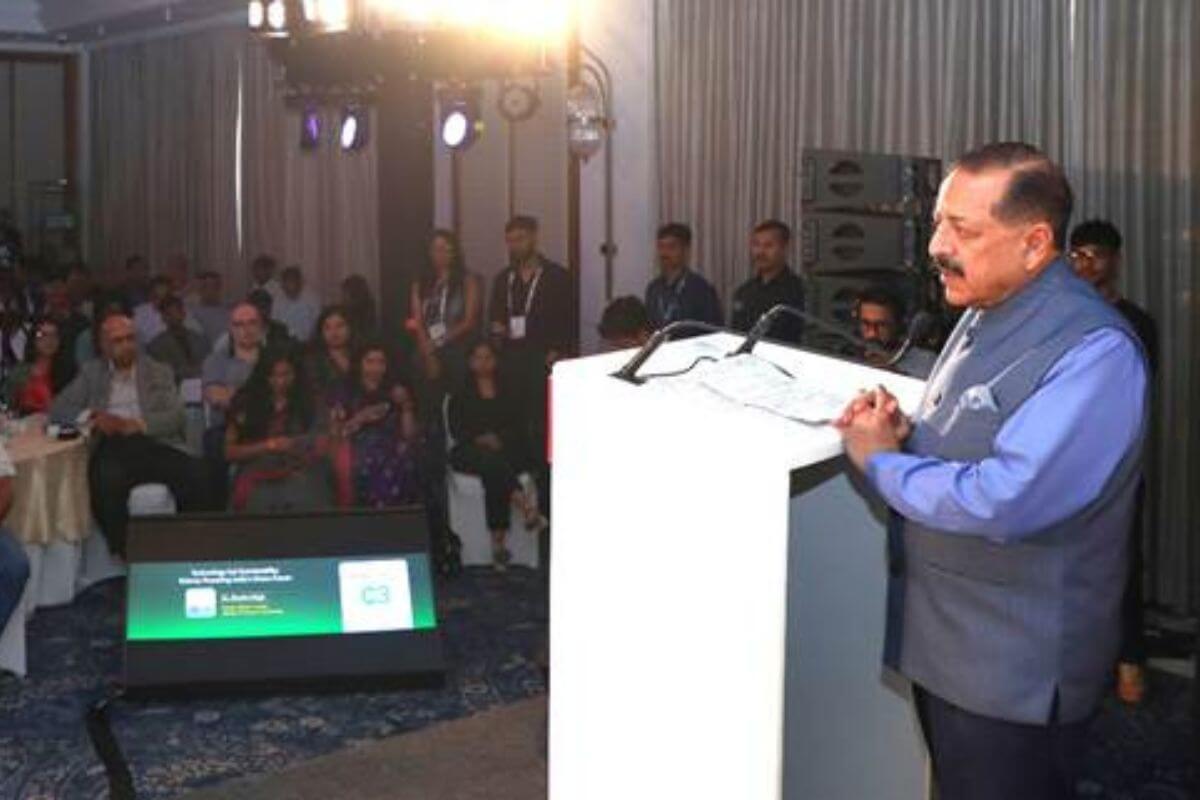
Union Minister of State (Independent Charge) for Science and Technology, Earth Sciences, and other key portfolios, Jitendra Singh, on March 27, 2026, said India’s clean energy transition is part of a larger national strategy aimed at reducing import dependence, strengthening indigenous capacities, and enabling the country to play a leading role in the global shift towards a greener future.
Also Read: India Commissions 8,000 TPA Green Hydrogen Capacity; Targets 5 MMT by 2030
Rising demand for critical minerals raises urgency
Speaking at the Planet C3 Summit on Climate, Circularity and Community, the Minister noted that India’s clean energy agenda spans securing critical resources such as lithium and rare earth-based permanent magnets, scaling up domestic manufacturing, accelerating innovation, and introducing targeted policy interventions.
Singh said, "India has emerged as an important global voice in the transition towards sustainable development, and maintaining this position requires both accelerated scaling of existing initiatives and the launch of new ones in a time-bound manner," according to an official statement from the Ministry of Science and Technology.
He highlighted that sectors such as electric mobility, renewable energy, electronics, space, and defence are increasingly dependent on resources like lithium and permanent magnets, a significant portion of which is currently imported.
Pointing to rising demand, Singh said India’s requirement for permanent magnets is expected to grow sharply in the coming years. While domestic production capacity is being expanded in phases, it is likely to lag behind demand unless scaling efforts are accelerated.
He cited the establishment of the country’s first indigenous permanent magnet plant in Visakhapatnam and ongoing policy measures, including a dedicated rare earth magnet policy, to strengthen domestic supply chains.
Nuclear energy to power future technological growth
The Minister underlined that energy security remains central to India’s technological advancement, particularly with emerging sectors like artificial intelligence requiring uninterrupted power supply. He said nuclear energy is being developed as a dependable source, with the Nuclear Energy Mission aiming for a substantial increase in capacity by 2047 through a phased approach.
The Minister added that the decision to enable wider participation in the nuclear sector reflects a shift towards a more integrated and collaborative development model, bringing together government and non-government stakeholders to accelerate progress in critical areas.
Mission-mode initiatives driving innovation ecosystem
Singh also outlined the government’s mission-mode approach to clean energy and technology development, citing initiatives such as the National Green Hydrogen Mission, India AI Mission, National Quantum Mission, and biotechnology programmes as part of an integrated strategy. These efforts are supported by increased public investment in research and innovation, including the establishment of the National Research Foundation.
Highlighting improvements in collaboration, the Minister said structured platforms now enable coordination between industry, academia, and government, replacing earlier fragmented systems. These interfaces are helping align research with market needs and accelerate technology deployment across sectors.
Startups and collaboration reshaping India’s tech landscape
Referring to India’s evolving innovation ecosystem, Singh noted the rapid growth of startups, which are generating employment and driving technological progress. He noted that a significant proportion of startups are led by women, reflecting changing dynamics in the innovation landscape.
Stressing the urgency of coordinated action, Singh said India’s approach balances self-reliance with global engagement, ensuring that advancements in clean energy and emerging technologies contribute to both national priorities and global sustainability goals.