TRAI conducts Audit and Assessment of Quality of Service being provided by the service providers through independent agencies for Cellular Mobile Telephone Services, Basic Services and Broadband Services. As a part of this audit, the Audit Agency, M/s TUV SUD has carried out special independent drive test for 2G Cellular Mobile Telephone Services of Bharti Airtel, Vodafone India, Idea Cellular, Reliance Communications, Aircel and Tata Docomo in Mumbai in June July, 2015 and verified the findings with a second independent drive test conducted on the same routes in the city in September 2015.
Make Telecom Talk My Trusted Source
The report assess the network condition most specifically Radio Frequency coverage, the accessibility of the network (measured by the call setup success rate and the block call rate), the retainability of the network (measured by drop call rate) and voice quality. Both the 900 MHz as well as 1800 MHz networks being used by all operators to provide 2G voice services were considered in the study. The details of the number of BTS set up by each operator in Mumbai circle and the number of users being served by each BTS is given in the table below. The more the number of users per BTS the more congested the network is considered.
Operator name
Technology
Band (MHz)
BTS Count
Subscribers* (Prepaid + Postpaid)
Subscribers / BTS
Idea
GSM
1800
3477
4010062
1153
Airtel
GSM
900 & 1800
4025
4700857
1168
Vodafone
GSM
900 & 1800
4543
8609116
1895
Reliance (GSM)
GSM
1800
2178
2780944
1277
Aircel
GSM
1800
1869
2536925
1357
Tata(GSM)
GSM
1800
2887
2851020
988
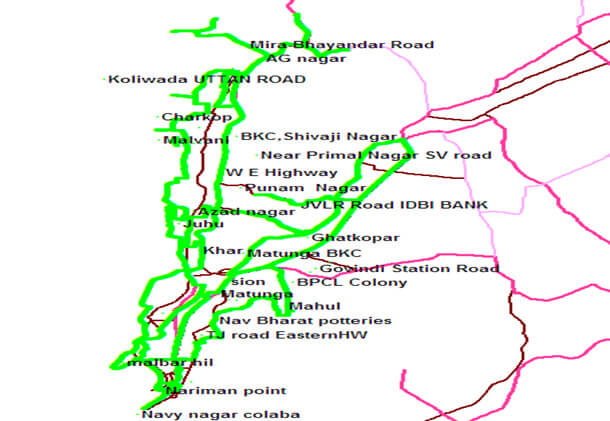
Drive test route for Mumbai circle:
The drive test was conducted over a total route length of 300 kilometres in Mumbai circle passing through areas of Navi nagar, Colaba, Nariman point, Churchgate, Marine lines, Pedar road, Malabar Hill, Dadar, Khar, Andheri, Charkop, Malad, Dahisar, Mira-Bhayandar, Matunga, Sion, Ghatkopar, Sakinaka, Mankhurd, Govandi, Punam nagar, Nilam nagar, JVLR, etc. The drive test was carried out from 9AM to 8.30PM along these routes and a total of 2913 calls were made from all 6 networks. The performance was measured on 7 parameters which are enlisted below.
RF coverage rate:
RF Coverage relates to the geographical footprint within the system that has sufficient RF signal strength to provide for a call/data session. The Coverage rate of an operator is calculated basis of % of samples in which the Rx level is better than -85 dbm. The coverage rate varies from 95.00% (for Idea) to 87.30% (for Reliance GSM). The details are as follows.
Accessibility is the ability of a service to be obtained within specific tolerances and other given conditions, when requested by the user. In other words, the ability of a user to obtain the requested service from the system. Accessibility is monitored by measuring Call Setup Success Rate (CSSR) which is defined as the ratio of Established Calls to Call Attempts. Call block is when a call is attempted but fails to be established. The benchmark is 95%. The performance of the operators varies from 95.82% (for Idea) to 85.51% (for Reliance GSM). The details are as follows.
Operator Name
Total CallsAttempted
Total Calls Blocked
CSSR
Ranking
Aircel
497
23
95.37%
4
Idea
502
11
97.81%
1
Vodafone
498
13
97.39%
2
Airtel
464
14
96.98%
3
Reliance (GSM)
497
37
92.56%
6
Tata (GSM)
455
22
95.16%
5
Retainability:
Retainability is “The ability of a service, once obtained, to continue to be provided under given conditions for a requested duration.” For determining the retainability a parameter namely Call completion success rate (CCSR) is used which implies the percentage of established calls which continue till manually disconnected by the caller and are not cut off mid sentence due to loss of signal or congested BTS. The call drop and Connection with good voice quality were monitored by the drive test. The performance of TSPs varies from 97.36% (for Idea) to 94.49% (for Vodafone) as shown below.
Operator name
Total CallsEstablished
Total CallsDropped
CCSR
Ranking
Aircel
476
14
97.06%
3
Idea
492
13
97.36%
1
Vodafone
472
26
94.49%
6
Airtel
448
12
97.32%
2
Reliance (GSM)
463
15
96.76%
4
Tata (GSM)
439
24
94.53%
5
Mobility:
In a cellular system a base station has only a limited coverage area. Hence it is possible for a moving subscriber to get out of reach of a base station while making a call. The process by which a mobile telephone call is transferred from one base station to another as the subscriber passes the boundary of a cell is called a handover (HO). The Handover success rate (HOSR) more than 95% is considered to be good. The performance of the TSPs varies from 98.23 % (for Idea) to 94.95% (for Airtel) as shown below.
Operator name
Total HO Attempt
Total HO Success
HOSR %
Ranking
Aircel
897
872
97.21%
3
Idea
1358
1334
98.23%
1
Vodafone
1560
1517
97.24%
2
Airtel
1446
1373
94.95%
6
Reliance (GSM)
1248
1210
96.96%
5
Tata (GSM)
1360
1321
97.13%
4
Voice Quality:
The quality of voice during a call is measured using an index called RxQual which is measured on a scale of 0 to 7 for GSM networks where values closer to 0 indicate better voice quality and values closer to 7 indicate poorer voice quality. 5 is set as a benchmark value for voice quality and values between 0 to 5 are considered acceptable while values above 5 are considered unacceptable. The table given below shows the percentage of voice samples which had RxQual values less than 5 out of the total number of samples and the performance has varied from 95.13% (for Airtel) to 91.34% (for Aircel).
Operator name
Total samples with RxQual between 0-5
Total number ofSamples
% of samples with RxQual above threshold value
Ranking
Aircel
583328
638650
91.34%
6
Idea
604464
641521
94.22%
2
Vodafone
609026
646986
94.13%
3
Airtel
620596
652342
95.13%
1
Reliance (GSM)
579130
631673
91.68%
5
Tata (GSM)
587595
625451
93.95%
4
Speech quality index:
Speech Quality Index (SQI) is a more sophisticated measure which is dedicated to reflecting the quality of the speech (as opposed to radio environment conditions). This means that when optimizing the speech quality in network, SQI is the best criterion to use. The SQI is measured on a scale of 0 to 30 with values between 18 to 30 considered good and values less than 18 considered bad. The table given below shows the percentage of speech samples which had SQI values higher than 18 to the total number of samples and the performance varied from 88.86% (for Idea) to 82.33% (for Aircel).
Operator name
Total Samples with SQI between 18-30
Total number of Samples
% of samples with SQI above threshold value
Ranking
Aircel
473836
575523
82.33%
6
Idea
527397
594826
88.66%
1
Vodafone
520130
594606
87.47%
2
Airtel
509210
591521
86.08%
3
Reliance (GSM)
437391
516892
84.62%
5
Tata (GSM)
488303
574697
84.97%
4
Carrier over interference:
the carrier over interference ratio (C/I) is the quotient between the average received modulated carrier power from the serving cell site and the average received co-channel interference power from undesired signal components, i.e. cross-talk, from other transmitters than the useful signal. C/I is measured on a scale of 0 to 30 with values between 15 to 30 considered good and values less than 15 considered bad. The table given below shows the percentage of samples which had C/I values higher than 15 to the total number of samples and the performance varied from 83.59% (for Airtel) to 77.39% (for Reliance GSM).
Operator name
Total Samples with C/I between 15-30
Total number of Samples
% of samples with C/I above threshold value
Ranking
Aircel
319898
397912
80.39%
3
Idea
291720
356197
81.90%
2
Vodafone
166948
215218
77.57%
5
Airtel
215050
257270
83.59%
1
Reliance (GSM)
197660
255409
77.39%
6
Tata (GSM)
306533
381297
80.39%
4
The overall performance of Idea cellular 2G network is the best in Mumbai circle followed by Airtel, Vodafone, Tata Docomo, Aircel and Reliance in that order. Delhi circle drive test results coming soon, keep reading TelecomTalk for the latest updates in the Indian telecom industry.
Every article you read here is the result of time, research, and effort. If you feel it adds value, you can support TelecomTalk.
 Support Telecomtalk