




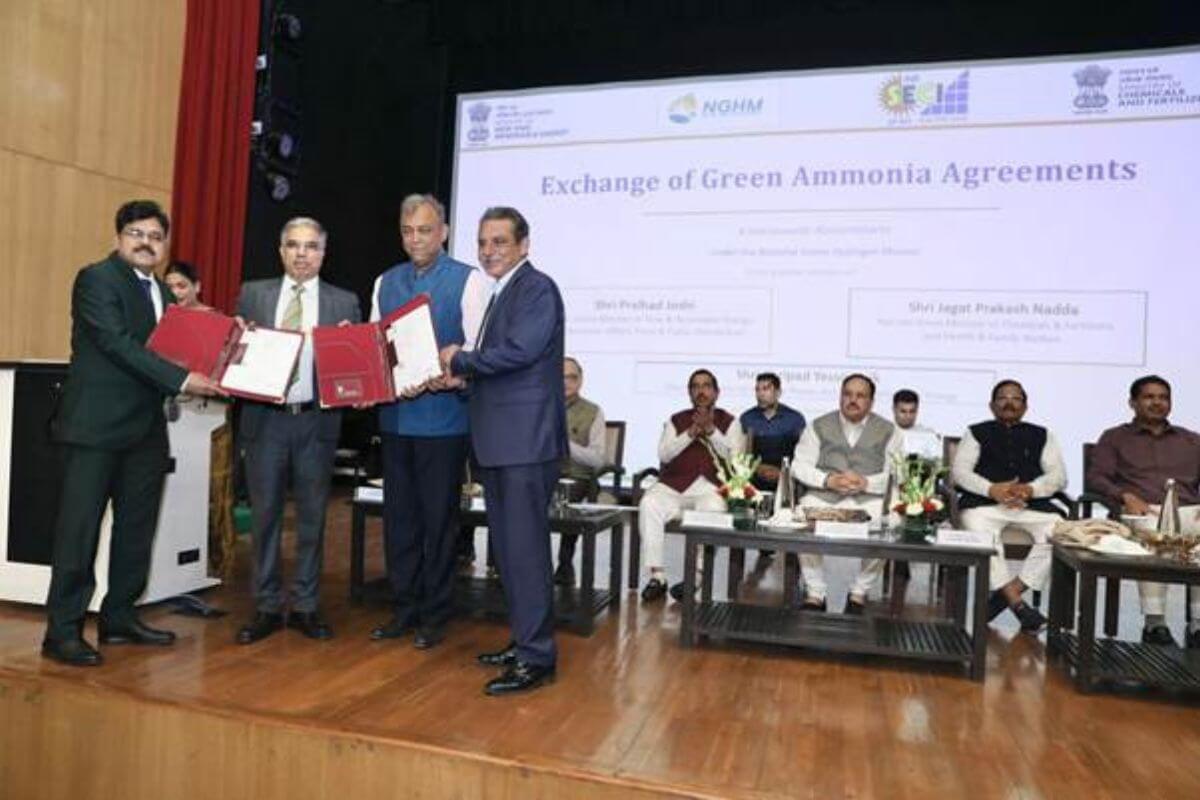
In a significant push towards decarbonisation and energy security, the Department of Fertilizers (DoF), Government of India, has facilitated the exchange of Green Ammonia Purchase Agreements (GAPA) and Green Ammonia Supply Agreements (GASA) between fertilizer companies and green ammonia producers. The move marks a key milestone in operationalising projects under the National Green Hydrogen Mission (NGHM) and advancing India’s clean energy transition, according to an official statement issued by the Ministry of Chemicals and Fertilizers on March 31, 2026.
11 Projects Signed to Operationalise Green Hydrogen Mission
The agreements, covering 11 projects in the fertilizer sector under the National Green Hydrogen Mission, were exchanged in New Delhi in the presence of Union Minister for Chemicals and Fertilizers J.P. Nadda, Union Minister for New and Renewable Energy Pralhad Joshi, and the Minister of State for Power and New and Renewable Energy. Senior officials and industry leaders, including secretaries from the Department of Fertilizers and the Ministry of New and Renewable Energy, along with heads of fertilizer companies and green ammonia firms, also attended the ceremony.
Addressing the event, Nadda described the initiative as a “historic step” towards sustainable fertilizer production. “The exchange of Green Ammonia Agreements marks a historic step in India’s journey towards sustainable fertilizer production. By integrating green ammonia into our supply chains, we are not only reducing carbon emissions but also ensuring long-term energy security and self-reliance. This initiative reflects the Government’s unwavering commitment to building a cleaner, greener future for our farmers and for the nation,” he said.
10-Year Contracts to Ensure Stable Ammonia Supply
India currently produces around 165–170 lakh metric tonnes (LMT) of phosphatic and potassic fertilizers (P&K), including DAP and NPK variants, but remains heavily dependent on imported ammonia. The Ministry noted that the ongoing geopolitical developments have disrupted the global ammonia market, leading to volatility in both availability and prices, which in turn affects the stability of fertilizer production in India. To address this challenge, fertilizer companies have entered into long-term agreements for green ammonia supply at fixed prices for a period of 10 years, ensuring stability in availability and pricing.
"This strategic move is expected to ensure a stable and reliable supply of ammonia, thereby supporting consistent domestic production of P&K fertilizers and helping maintain price stability in the Indian market," the Ministry added.
The adoption of green ammonia is expected to yield multiple benefits. "It will help conserve foreign exchange by reducing import dependence, promote self-reliance in the fertilizer sector, and create new employment opportunities. Furthermore, it is likely to encourage investments in the development of green ammonia production capacity within the country. A stable supply environment will also attract new players to the fertilizers sector, leading to the establishment of additional manufacturing units in the future," the Ministry said.
According to the Ministry of Chemicals and Fertilizers, this transition towards green ammonia marks a significant step towards strengthening India’s fertilizer security, enhancing sustainability, and building long-term resilience in the sector.
Push to Reduce Import Dependence and Save Forex
Under the Strategic Interventions for Green Hydrogen Transition (SIGHT) Programme, the Solar Energy Corporation of India (SECI) conducted competitive bidding, discovering prices ranging from Rs 49.75 to Rs 64.74 per kg—significantly lower than global benchmarks of about Rs 110 per kg. A total green ammonia supply capacity of 7.24 lakh tonnes per annum has been allocated to 13 fertilizer units nationwide.
The agreements are expected to generate foreign exchange savings of approximately $2.5 billion over a decade by replacing imported grey ammonia. They also aim to reduce the carbon footprint of the fertilizer industry and facilitate a transition towards sustainable inputs.
The National Green Hydrogen Mission, with an outlay of Rs 19,744 crore, targets production of at least 5 million metric tonnes of green hydrogen annually by 2030. The initiative seeks to position India as a global hub for green hydrogen and its derivatives while reducing reliance on fossil-based imports.