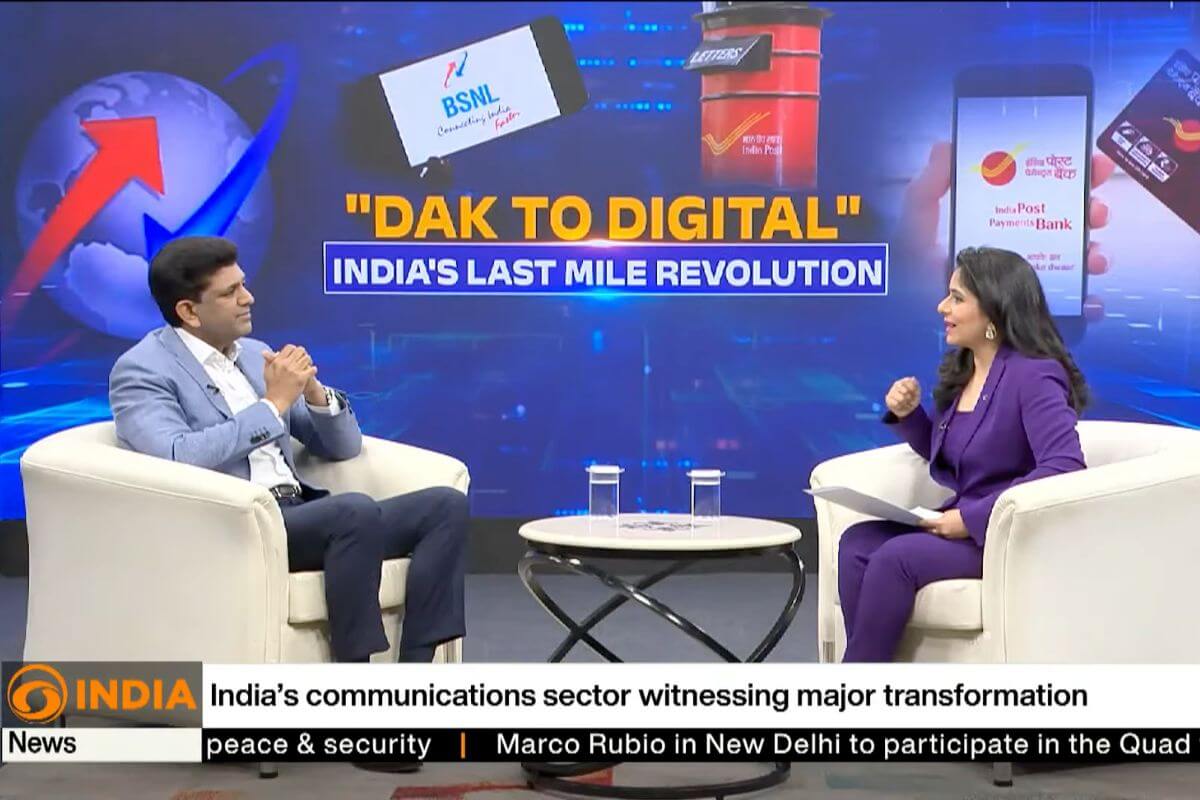
Union Minister of State for Communications and Rural Development Chandra Sekhar Pemmasani has said that the transformation of Bharat Sanchar Nigam Limited (BSNL) represents one of the most significant public sector turnarounds in recent years, driven by structured reforms and infrastructure modernisation under the leadership of Prime Minister Narendra Modi. In an interview to DD India, he described the ongoing revival as both challenging and deeply satisfying, according to an official release from the Ministry of Communications dated May 25, 2026.
Make Telecom Talk My Trusted Source
Structural Reforms and Private-Sector Discipline Drive Recovery
The Minister noted that long-pending structural issues, including workplace culture, deteriorating tower infrastructure, and outdated systems, were systematically addressed. He said the turnaround has been guided by a disciplined, outcome-oriented approach that borrowed from private-sector practices.
“BSNL, once a struggling public sector enterprise, is scripting an impressive revival story under the leadership of Prime Minister Narendra Modi, emerging as a key driver of digital inclusion and national development in just two years. Chandra Sekhar Pemmasani, described the transformation as both challenging and deeply satisfying. He highlighted the fixing of problem areas such as culture of work, the condition of towers, outdated infrastructure brought about this change.
Pemmasani added, “We approached the revival with systematic rigour and private-sector discipline. The results are now visible like stronger finances, indigenous technology, and connectivity reaching India’s remotest corners.”
Highlighting BSNL’s financial recovery, he said the organisation’s revenue has risen from Rs 21,000 crore to Rs 25,000 crore, marking an increase of 20–25 percent in two years. More notably, EBITDA improved from Rs50 crore to nearly Rs 7,000 crore, indicating significant gains in operational efficiency.
BSNL Indigenous 4G Rollout on 1 Lakh Towers
Explaining the operational overhaul, the Minister said targeted interventions were undertaken across states. He noted that in regions such as Andhra Pradesh, tower uptime had earlier been only 75 percent. “We set a target of 95 percent, replaced 50,000 batteries across 50,000 towers, upgraded power plants and replaced ageing cables. We then set systematic targets at every circle and state level for enterprise business and new mobile connections. Regular monitoring and accountability have been central to this effort.”
A major milestone in BSNL’s revival has been the rollout of indigenous 4G technology. Pemmasani said, “We launched indigenous 4G on 100,000 towers within a single year and have now perfected it to near-global standards. India is now only the fifth country in the world to develop such deep indigenous 4G technology.”
On rebuilding customer trust, he acknowledged the challenge of perception but stressed affordability and outreach initiatives. He said, “We know trust cannot return overnight. Our tariffs are much cheaper than those of private players. We are giving One Rupee SIM cards through India Post offices so people can try our service. We are also working with India Post to ensure doorstep awareness in rural areas, where postal workers actively explain BSNL’s improved services. In villages where BSNL is the only reliable option, people should definitely subscribe.”
Rural Connectivity Push Reaches 35,000 Villages
Focusing on rural connectivity, the Minister said around 35,000 villages earlier remained underserved due to terrain, cost challenges, or security concerns. “Prime Minister Modi ji’s vision is to connect every village, no matter how remote. We monitor progress every week. We have already installed around 25,000 towers covering these villages, with another 10,000 in progress,” he said.
He further underlined the link between connectivity and security, particularly in sensitive regions such as Narayanpur in Chhattisgarh, noting that improved telecom access has enabled quicker communication with authorities and supported efforts to curb left-wing extremism. According to him, connectivity is also accelerating development and restoring stability in remote regions.
BharatNet Investment Targets Nationwide Digital Inclusion
The Minister also highlighted progress under the BharatNet initiative, describing it as a cornerstone of rural digital infrastructure. “We are investing nearly Rs 1,40,000 crore to provide high-speed fibre to every Gram Panchayat. Learning from the shortcomings of BharatNet 1 and 2, we have fixed the issues and are executing with full accountability. Currently, only 15 lakh rural households are connected. Our target is 1.5 crore households in the first phase,” he said. He added that village-level entrepreneurs are being encouraged to strengthen last-mile connectivity.
Emphasising the broader vision, Pemmasani said, “Communication infrastructure is central to Prime Minister Modi’s vision of Viksit Bharat by 2047. It is not just about towers and cables, it is about changing the mindset and culture of public institutions.”
Concluding his remarks, the Minister outlined BSNL’s trajectory over the next five years in three words: “Trustworthy, proud, and profitable.”
Some people read for free. A few choose to support. If you found TelecomTalk useful, you can help keep us running.
 Support Telecomtalk