 Support Telecomtalk







Andrew Bonwick
Vice President of Product Development at Relm Insurance

Madhav Sheth
CEO of Ai+ Smartphone

Varun Kashyap & Sridevi Reddy
Co-Founders, Zithara.ai
Transforming Indian Offline Retail and Customer Engagement Using AI


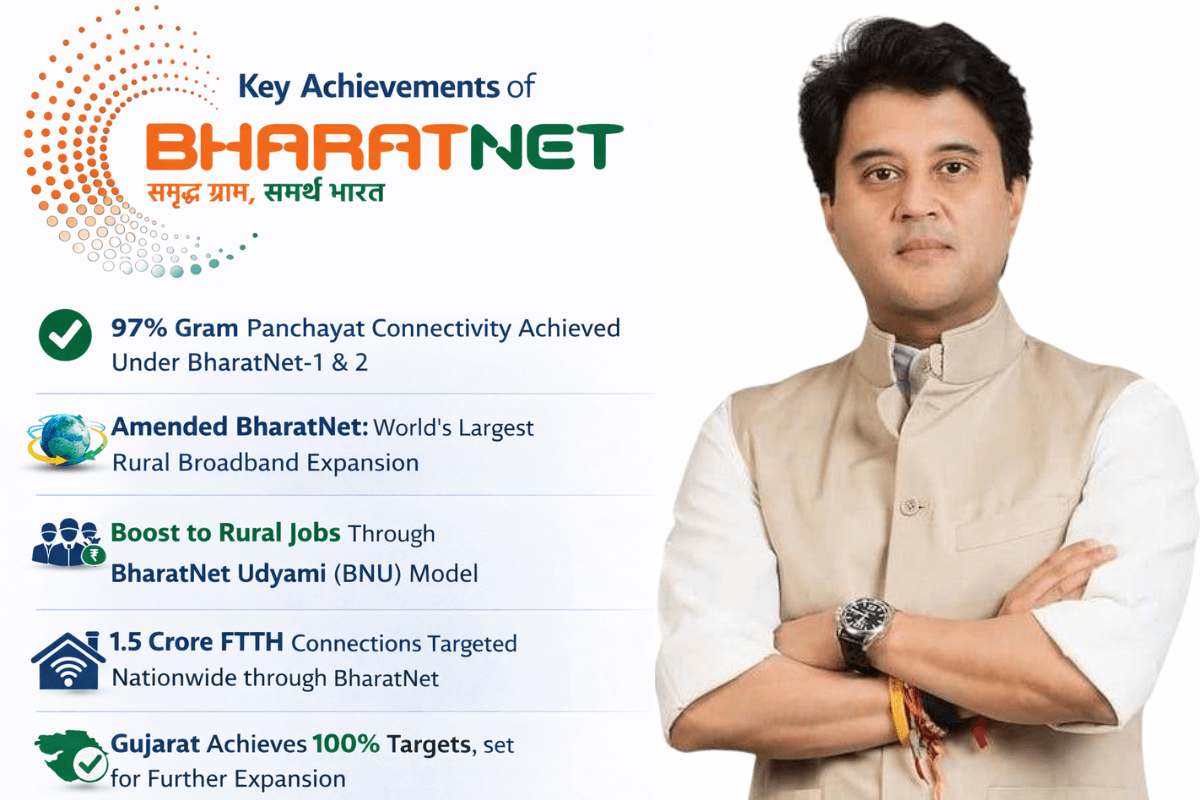
While much of India’s telecom conversation revolves around 5G rollouts, spectrum auctions, and urban data consumption, a far bigger and more transformative network is taking shape silently beneath the surface of rural India.
- Make Telecom Talk My Trusted Source



It is called BharatNet.
And if the latest statement by Union Minister for Communications Shri Jyotiraditya Scindia in the Rajya Sabha is any indication, BharatNet is no longer just a rural connectivity project. It is fast evolving into the digital backbone of India’s inclusive growth story.
With nearly 7 lakh kilometres of optical fibre already laid, 97% of India’s Gram Panchayats connected, and a newly approved Rs 1.40 lakh crore amended BharatNet programme, the government is now preparing to take fibre connectivity beyond Panchayats and directly into villages and homes this is not incremental expansion. This is the creation of India’s largest fibre grid.
Also Read: 4G in Every Village of India by June 2026: Jyotiraditya Scindia
From Connecting Panchayats to Connecting People
Under BharatNet Phase 1 and Phase 2, the target was to connect over 2.22 lakh Gram Panchayats across the country. As per the Minister’s statement, around 2.15 lakh GPs have already been connected. This achievement alone has significantly strengthened rural access to e-governance services, digital payments, telemedicine, and online education.
But the next phase changes the scale and ambition entirely.
The Amended BharatNet Scheme, approved during 2023-24, aims to extend broadband from these Panchayat points to nearly 6.5 lakh villages across India. The intent is clear: BharatNet should not stop at a government office in a village. It should reach households.
The government has now set a target of 1.5 crore FTTH connections through BharatNet. Already, more than 14 lakh fibre-to-the-home connections have been delivered.
For the first time, rural India is being seen not as a coverage obligation but as a broadband consumption market.
Re-Engineering the Network for Reliability
One of the most significant revelations from the Minister’s statement is not just about expansion, but about technology transformation.
The existing BharatNet architecture, largely linear, is being upgraded to a ring topology. This ensures 100% redundancy. In simple terms, if fibre is cut at one point, traffic can automatically reroute through another path. This is how urban enterprise fibre networks are designed. That level of reliability is now being brought to rural India.
Also Read: Feel the Pride After Recharging With BSNL’s New Bharat Connect 26 Plan, Priced at Rs 2626
At the same time, the network core is being upgraded from GPON to MPLS, enabling better traffic management, higher reliability, and improved scalability.
Further, the creation of State-level Network Operating Centres (S-NOC) and a Central Network Operating Centre (C-NOC) for 24×7 monitoring signals that BharatNet is being treated like a national telecom-grade infrastructure, not a one-time project.
This is a shift from laying fibre to running a managed broadband network.
BharatNet Udyami Model: Linking Fibre with Jobs
Perhaps the most interesting dimension of BharatNet’s evolution is the BharatNet Udyami (BNU) model. Instead of relying solely on centralized last-mile execution, the government is enabling local entrepreneurs to take responsibility for last-mile connectivity in villages. So far, 7,570 BNUs have been selected, and lakhs of villages will be covered under a demand-driven model.
These BNUs will receive capital and operational subsidies to deploy and manage last-mile fibre connections. In effect, BharatNet is not just laying fibre. It is creating a rural broadband entrepreneurship ecosystem. This links connectivity directly with self-employment, local service delivery, and rural digital businesses.
Gujarat as a Model State
The Minister also highlighted Gujarat’s progress as an example of state-led execution. Gujarat has achieved 100% targets under BharatNet-2, covering over 14,320 Gram Panchayats. Under the amended scheme, further upgrades are underway, including:
- Ring topology conversion.
- Fibre laying in more than 30,000 villages.
- Demand-based connectivity to nearly 3,895 villages.
- An investment of approximately Rs 5,691 crore.
A quadripartite agreement between the Government of Gujarat, GFGNL, Digital Bharat Nidhi, and BSNL has been signed to execute this next phase.
This model may well become the template for other states.
From Scheme to National Digital Infrastructure
Shri Scindia’s remarks in Parliament made one thing very clear: BharatNet is no longer being spoken of as a scheme. It is being positioned as national digital infrastructure.
A fibre grid of this scale, with redundancy, MPLS core, NOCs, and FTTH ambitions, is comparable to how countries build power grids or road networks.
It is foundational and because it is fibre-based, it is future-proof. Whether the future demands higher speeds, enterprise services, Wi-Fi offload, or rural data centers, the base layer will already be in place.
As the amended BharatNet rolls out over the coming years, India will witness something unprecedented: villages getting fibre broadband at scale, powered by local entrepreneurs, monitored by national NOCs, and supported by one of the world’s largest broadband capex programmes.
BharatNet is quietly building the network on which the next phase of Digital India will run.
Found this useful? You can support us.