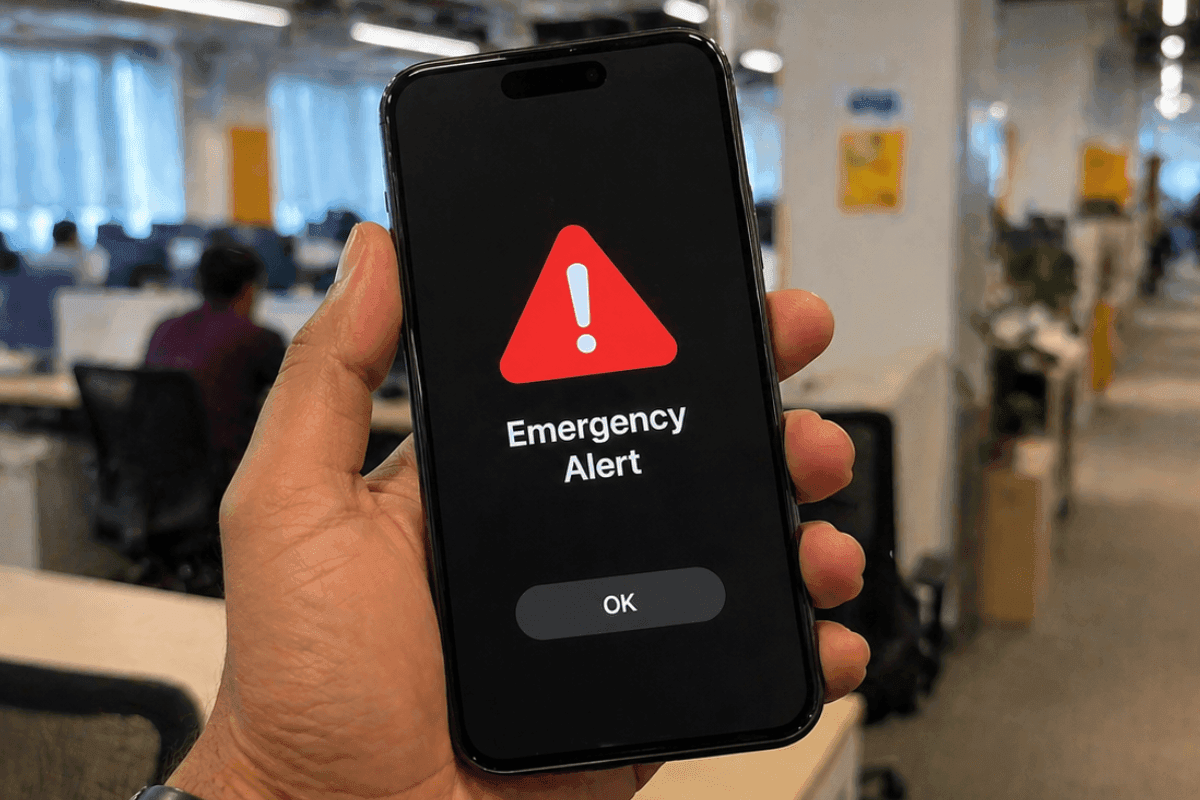
The government has clearly stated that these are only test messages and do not require any action from users. However, the rollout marks a significant shift in how disaster alerts will be delivered in India in the future.
While SMS alerts have played a crucial role, the government is now introducing Cell Broadcast technology to further strengthen alert dissemination in time critical scenarios. These include events such as earthquakes, tsunamis, lightning strikes, and even man made emergencies like gas leaks or chemical hazards unlike SMS, which sends messages individually to users, Cell Broadcast technology transmits alerts to all mobile devices within a defined geographic area simultaneously. This allows for near real time delivery of alerts, even in situations where mobile networks may be congested due to high usage during emergencies.
The indigenous development and implementation of this Cell Broadcast based alert system has been entrusted to C-DOT, aligning with the government’s push towards building local telecom technologies and infrastructure.
As part of the rollout, nationwide testing and trials are currently underway these tests are aimed at assessing the system’s performance, reliability, and compatibility across networks before its formal launch and dedication to the nation.
During this testing phase, users may receive multiple test alerts on their mobile devices. These messages will be sent in English, Hindi, and regional languages to ensure broad reach and inclusivity across diverse user groups.
Importantly, these test messages will only be received on devices where Cell Broadcast test channels are enabled. Users can control this setting by navigating to their phone settings under Safety and Emergency alerts and enabling Wireless Emergency Alerts followed by Test Alerts. Since this is a system level validation exercise, some users may receive the same message multiple times as authorities test delivery across different regions and network conditions.
The government has reiterated that these alerts are part of a planned testing exercise and should be ignored. No action is required from the recipient side, even if the message is received more than once.
To avoid confusion, the authorities have also shared the exact format of the test message being sent. The English version reads:
This is a TEST Cell Broadcast message sent by the National Disaster Management Authority in coordination with the Department of Telecommunications, Government of India, as part of testing the Cell Broadcast solution for disseminating alerts. During the testing of the Cell Broadcast solution, you may receive this message multiple times on your mobile handset. Please ignore these messages; no action is required at your end.
A similar message is also being sent in Hindi and other regional languages to ensure that users across the country clearly understand that this is only a test.
Once fully operational, the Cell Broadcast system is expected to work across all mobile handsets, regardless of whether test channels are enabled. This means that during actual emergencies, alerts can be delivered instantly to a wide population without requiring any manual settings from users.
For India, this marks an important evolution in disaster preparedness. With increasing climate related risks and rising urban density, the ability to deliver real time alerts can play a critical role in saving lives and minimising damage.
Globally, Cell Broadcast systems are already used in countries like the United States and Japan for emergency communication. India’s adoption of this technology brings it in line with global best practices, while also tailoring the system for local requirements such as multilingual support and large scale deployment.
The ongoing testing phase is expected to continue until authorities are confident about the system’s performance across networks and devices. Public cooperation during this period remains important, even if it simply involves ignoring the test alerts.
In the long run, the integration of Cell Broadcast with existing SMS based systems signals a more robust and layered approach to disaster communication in India. Instead of relying on a single channel, authorities are building redundancy to ensure that critical alerts reach citizens through multiple pathways.
For now, users receiving these alerts can view them as part of a larger effort to build a faster, more reliable, and inclusive emergency communication system for the country.
Every article you read here is the result of time, research, and effort. If you feel it adds value, you can support TelecomTalk.
 Support Telecomtalk