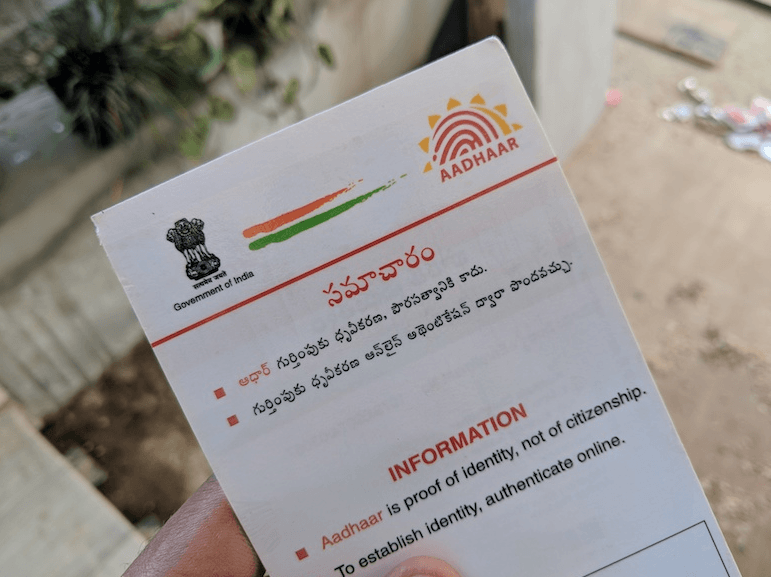
A five-judge Constitution bench headed by Chief Justice Dipak Misra, in the Supreme Court today questioned the government’s order of making Aadhaar mandatory for mobile users. SC highlighted the fact that Aadhaar ruling which was done previously by the court was used as a ‘tool’. The bench which also consisted of renowned justices like Justices A K Sikri, A M Khanwilkar, D Y Chandrachud and Ashok Bhushan on hearing array of petitions challenging Aadhaar and its enabling 2016 law, said its order on a PIL filed by ‘Lokniti Foundation’ had ruled that it was because of national interest that mobile users had to be verified using Aadhaar.
In an official statement, the bench said: “In fact, there was no such direction from the Supreme Court, but you took it and used it as a toll to make Aadhaar mandatory for mobile users.” Senior advocate Rakesh Dwivedi in the hearing subtly pointed out that the notification which Department of Telecommunication (DoT) issued, discussed about re-verification of mobile numbers by using e-KYC process and also the Telegraph Act granted “exclusive power to the central government to decide license conditions” of service providers.
To this statement, the bench countered by asking “How can you (DoT) impose a condition on service recipients for seeding Aadhaar with mobile phones,” and also clarified that the license agreements existed between the government and the service providers and the users were not involved.
Dwivedi said that the modus operandi which was taken up to link users’ Aadhaar with their phone numbers was done according to Trai’ recommendations. He further added that the government was fully entitled and had legitimate state interest to ensure that a sim card is given to only those people who applied for it. This way Dwivedi emphasised the absence of intention of surveillance of users on the government’s part.
Dwivedi further debated saying “My submission is that the government had a legal basis to link Aadhaar with SIM by virtue of section 4 of the Telegraph Act and also, the measure is reasonable in the interest of national security.” He also went onto say the that the Aadhaar scheme was being “unfairly targeted” and also that the chosen course of action was carried out because no one was batting an eye towards telecom companies or banks.
He also pointed out saying that the telecom companies were a much bigger database for public information “For example, Vodafone has a much bigger database of information even without Aadhaar. The Aadhaar data is immaterial for them.” He went onto say “Appreciate the fact as to how much information a bank possesses about its customers. Every transaction as to what I purchase by using cards, where and when, all this information is with banks. Aadhaar does not tell all this. This information are already there and is being used for commercial purposes.”
The lawyer also pointed out that people were being “scared” of Aadhaar but “nobody questions the telecom companies, banks…. Their single target is Aadhaar.” Dwivedi also furnished information about an application on the Google Play Store which published extensive information about people after being used by him and his family. The bench was taken aback at the revelation as Dwivedi went on illustrating how the website contained information like how much he charged from the Jammu and Kashmir government for appearing in a case. The advocate said out pointing out that UIDAI enjoyed control over both private and government entities who sought to provide authentication services to the general public.
He said the following while demonstrating that these entities could not track people like the public was fearing “Vodafone can do targeted advertising using the data which is already happening without Aadhaar. Vodafone has far more demographic data about an individual than UIDAI has.” He further added defending the Aadhaar scheme “Google and Facebook process tremendous data on a daily basis. UIDAI does not have that kind of algorithm.”
At last, the advocate made his case saying that the Aadhaar scheme should be saved and asked for SC’s input on the same to bring the scheme to its righteous path.
A small group of TelecomTalk readers helps keep this platform running. Support us if you find our work valuable.
 Support Telecomtalk