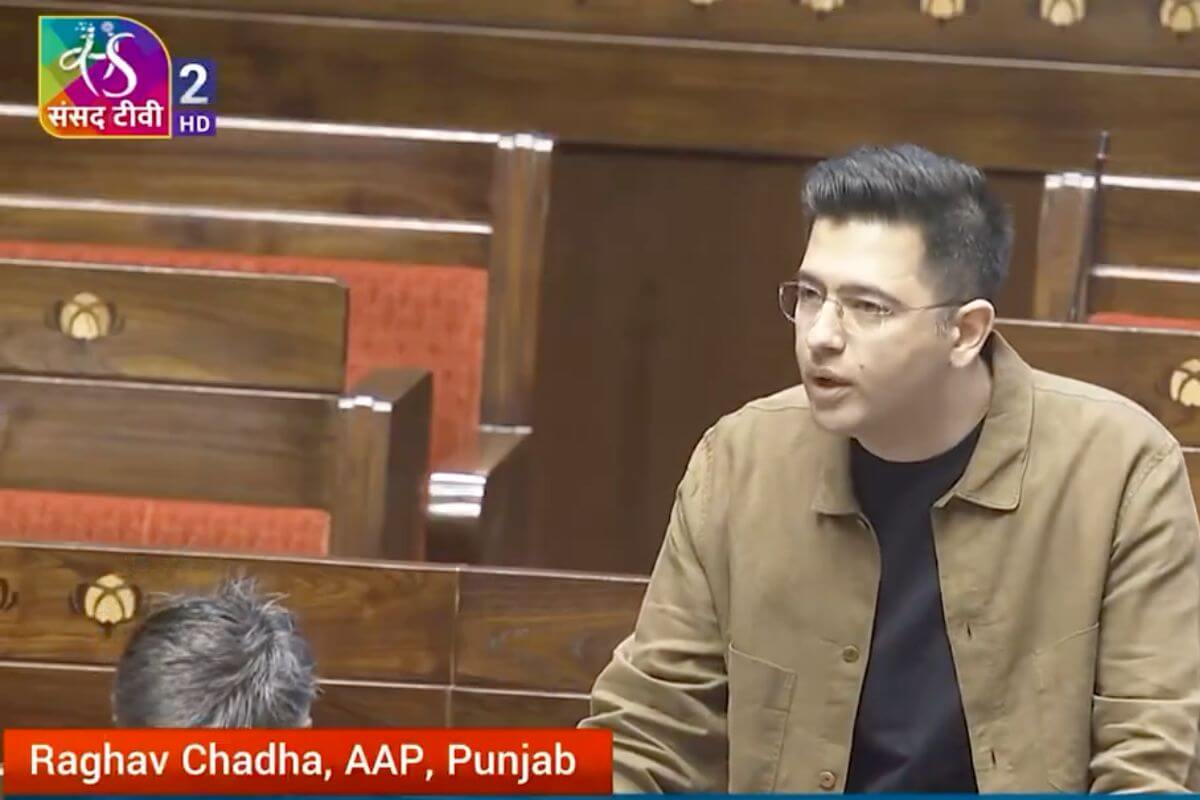
Chadha outlined specific demands including data rollover provisions, adjustment of unused data against future recharge costs, and the ability for users to transfer unused data to others. He emphasised that “UNUSED DATA should carry forward into the next cycle, so consumers can use what they have already paid for.”
“Telecom companies offer Recharge Plans with ‘Daily Data Limits’ like 1.5GB, 2GB or 3GB per day, resetting every 24 hours. Any Unused Data EXPIRES at midnight, despite being fully paid for.
You are billed for 2GB. You use 1.5GB. The remaining 0.5GB disappears as day ends. No refund. No rollover. Just gone. This is not an accident. This is policy.
Use it unnecessarily, or lose it by midnight. That’s how mobile data works today.
I raised this issue in Parliament – Why should data that we have paid for be FORFEITED?
UNUSED DATA should carry forward into the next cycle, so consumers can use what they have already paid for.
My demands are clear:
- Allow Data carry-forward/Data rollover for all users
All telecom operators should provide Rollover of Unused Data. What remains unused at the end of the day should be added to the next day’s Daily Data Limit, not erased the moment validity ends. - Give option of Adjustment of Unused Data against next month’s Recharge Amounts
If a consumer consistently under-utilises their data over multiple cycles, there should be a mechanism for Adjustment or Discount of that value from the following month’s Recharge Amount. Consumers should not repeatedly pay for capacity they do not use. - Allow Transfer of Unused Data to relatives & friends
Unused data should be treated as the consumer’s digital property. Users should be allowed to transfer their unused data to others, from their Daily Data Limit, just as they transfer money to others.
As we build a Digital India, access cannot depend on data that disappears.
If you’ve paid for it, it should carry forward and remain yours to use.”
-Quote End-
India’s Prepaid Recharge Scenario
Earlier, on March 11, 2026, Chadha flagged issues affecting India’s prepaid mobile users, who constitute nearly 90 per cent of the country’s 125 crore subscribers. He questioned the discontinuation of incoming calls and SMS services after recharge expiry, stating, “If a recharge expires, stopping outgoing calls may be understandable. But why are incoming calls stopped as well?” He warned that such practices could disrupt essential communication, including bank OTPs, and called for measures to keep incoming services active for at least one year after the last recharge.
-Quote Start-
“Today in Parliament, I raised concerns affecting India’s prepaid recharge customers, who account for nearly 90% of the country’s 125 crore mobile users.
(1) If a recharge expires, stopping outgoing calls may be understandable. But why are incoming calls stopped as well? Once validity ends, people cannot be reached, and even essential messages like bank OTPs may not come through. In emergencies or urgent situations, this can leave a person completely cut off.
My demands: First is that incoming calls and SMS should continue for at least one year after the last recharge so essential communication does not stop. Second, a mobile number should not be deactivated for at least three years after the last recharge. Third, telecom operators should introduce a low cost “incoming only” plan for users who simply need their number to remain active for essential calls, OTPs and government services.
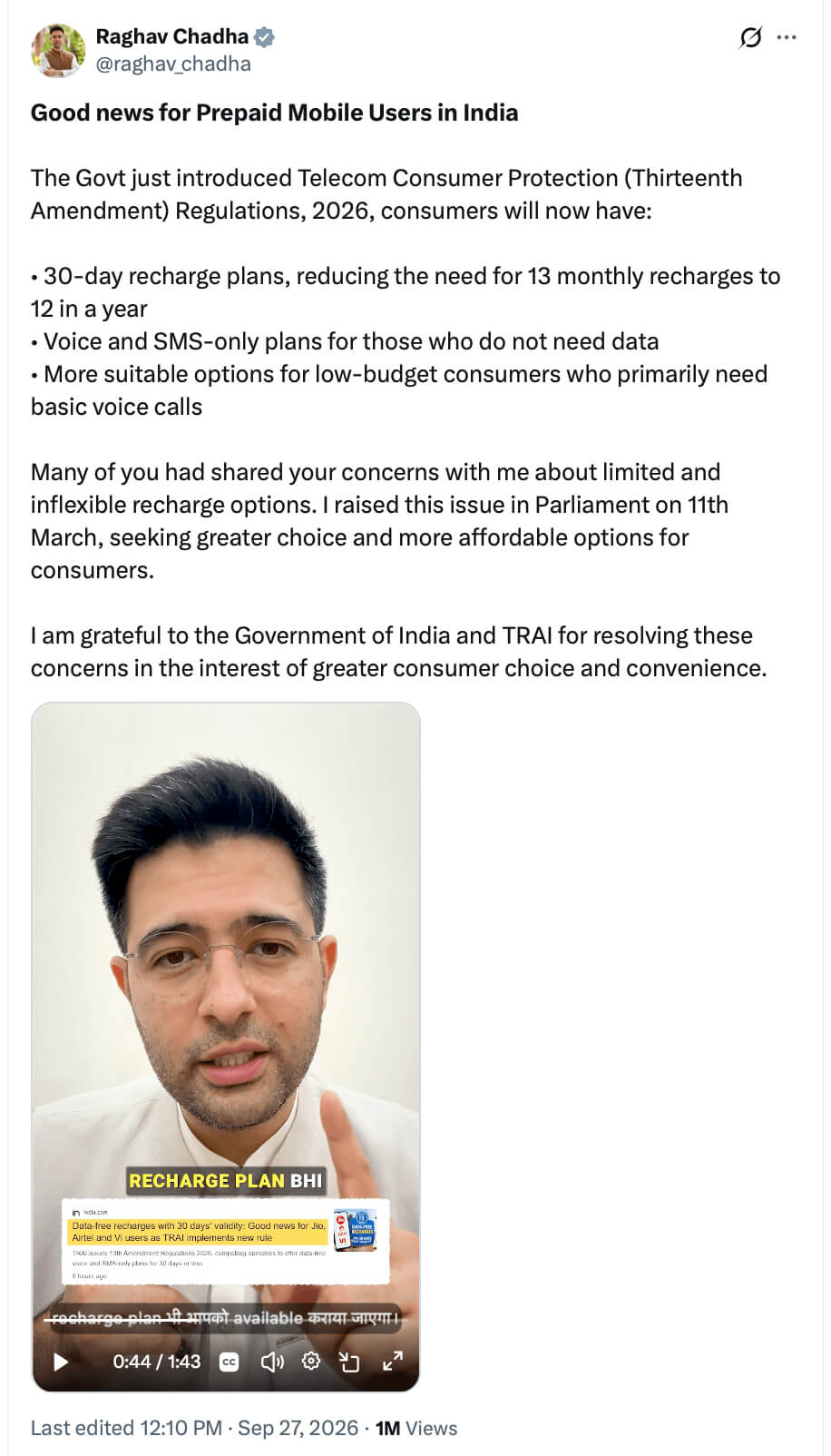
(2) I also raised the issue of 28 day recharge “monthly” plans. If something is called monthly, it should follow the calendar month of 30–31 days. Because of the 28 day cycle, consumers effectively end up paying for 13 recharges in a year. (28 days × 13 recharges = 364 days)
Telecom Operators should sync up their Recharge Plans with the true calendar months, and not 28 day plans.
A mobile phone today is not a luxury. It is a lifeline.
Prepaid recharge customers deserve fairness and transparency. Not clever fine print.”
-Quote End-
The 28-Day Monthly Recharge SCAM
He also criticised the prevalent 28-day recharge cycle, describing it as misleading. In a separate post titled “The 28-Day “Monthly” Recharge SCAM,” Chadha said, “Telecom companies call their plans ‘monthly’ — but they last only 28 days.” He added, “That means prepaid users pay for 13 recharges in a year instead of 12.” Urging alignment with calendar months, he remarked, “Consumers deserve better. Not these clever tricks.”
-Quote Start-
“The 28-Day “Monthly” Recharge SCAM:
I raised this in Parliament today.
Telecom companies call their plans “monthly” — but they last only 28 days.
That means prepaid users pay for 13 recharges in a year instead of 12.
28 days × 13 recharges = 364 days
If it’s monthly, it should follow the actual calendar month.
Consumers deserve better. Not these clever tricks.”
-Quote End-
India’s AI journey
On the technology front, Chadha has consistently advocated for strengthening India’s AI ecosystem. Reflecting on India’s AI journey in a February 21, 2026 post, he said, “First, from Make in India to Make AI in India. Build our own capability, invest in research, and strengthen the infrastructure and compute we need to compete.” He further stressed inclusivity, adding, “Second, make advanced generative AI tools accessible and affordable for every Indian, in every language, so that no one is left behind.”
-Quote Start-
“Last year in Parliament, I spoke about India’s AI journey and two clear priorities.
First, from Make in India to Make AI in India. Build our own capability, invest in research, and strengthen the infrastructure and compute we need to compete.
Second, make advanced generative AI tools accessible and affordable for every Indian, in every language, so that no one is left behind.
It is good to see AI back at the centre of national conversation as India hosts key discussions on its future. Now the focus must shift from intent to implementation.
If we expand access and build with ambition, India can move from being a technology user to a technology leader.
The question is not whether AI will shape the future. The question is whether India will help define it.”
-Quote End-
India AI Summit 2026
At the AI Summit 2026 held in New Delhi, Chadha underscored the strategic importance of compute infrastructure and semiconductor capabilities. He remarked, “In the 20th century, power depended on OIL and STEEL. In the 21st century, power depends on AI, CHIPS and COMPUTE CAPABILITY.” Highlighting geopolitical dependencies, he noted, “Today, design monopolies, manufacturing concentration and export controls determine who gets access. India controls none of these critical levers.”
-Quote Start-
“In the 20th century, power depended on OIL and STEEL. In the 21st century, power depends on AI, CHIPS and COMPUTE CAPABILITY.
At AI Summit 2026 India, I spoke about why the GPU challenge is not just a ‘supply chain issue’ but a ‘sovereignty issue’.
In the AI century, power will rest with those who control chips, compute capacity and data centres.
Today, design monopolies, manufacturing concentration and export controls determine who gets access. India controls none of these critical levers.
We have the talent. We have the ambition. We have the intent. We have the capital.
But talent without compute is aspiration.
And compute without sovereignty is dependence.
The role of policymakers is not to slow AI down; it is to remove bottlenecks, diversify access, set clear national targets, and build sovereign AI infrastructure in India.
This is not partisan. It is strategic.”
-Quote End-
According to multiple media reports, Chadha reiterated the need for India to develop indigenous compute capabilities and diversify supply chains. He stated, “India needs to build its own compute capability.. India needs to prepare itself when it comes to design, fabrication and the export challenges to diversify supply and ultimately build a big AI structure.” Emphasising the strategic nature of the issue, he added, “This is not partisan. It is strategic.”
According to an IANS report, Raghav Chadha says, “There is tremendous energy among the people here, everyone is very excited. The AI Summit being held in Delhi from February 16 to 20 places India firmly on the map in the AI world. There were very interesting discussions, my session too was discussed in detail, especially on the issue of AI sovereignty. The conversation focused on how, at this time, the entire world is rapidly embracing AI…”
“India needs to build its own compute capability.. India needs to prepare itself when it comes to design, fabrication and the export challenges to diversify supply and ultimately build a big AI structure,” says Raghav Chadha, according to a Moneycontrol report.
According to a PTI report, Raghav Chadha said, “In the 21st century, the levers of power will essentially be controlled by those who have access to AI, GPUs, compute capability and data centres. That was the key element of my argument, how India needs to build its own compute capability. Today, we are in an AI ecosystem where there is, in some sense, a monopoly. Design is controlled by one company based in the US, while nearly 90 per cent of chip manufacturing and fabrication is controlled by a company based in Taiwan. Then there are export controls, where certain countries, particularly the US, have defined these chips, GPUs and the entire AI architecture as strategic assets and imposed controls on their export.”
Legalisation of Virtual Digital Assets
In addition, Chadha has called for a clear regulatory framework for virtual digital assets (VDAs), including cryptocurrencies. In a post dated February 10, 2026, he said, “Legalise Virtual Digital Assets (like Crypto, Stablecoin) in India. Don’t drive them offshore.” Criticising the current approach, he observed, “India taxes VDAs (virtual digital asset) like they are legal. But regulate it like they are illegal.”
Highlighting the economic implications, Chadha pointed out the migration of trading activity and startups abroad, stating, “12 crore Indians invest via overseas platforms” and “Rs 4.8 lakh crore in VDA trading moved offshore.” Advocating regulation over prohibition, he said, “Let us not fear innovation, let us regulate it. Prohibition is not protection, Regulation is protection.”
-Quote Start-
“Legalise Virtual Digital Assets (like Crypto, Stablecoin) in India. Don’t drive them offshore.
India taxes VDAs (virtual digital asset) like they are legal. But regulate it like they are illegal.
India taxes cryptocurrency at 30% Capital Gain Tax + 1% TDS; yet offers no legal recognition, no investor protection, no dedicated AML (anti-money laundering) framework.
The result is:
- 12 crore Indians invest via overseas platforms
- Rs 4.8 lakh crore in VDA trading moved offshore
- 73% of India’s trading volume shifted to foreign exchanges
- 180 Indian crypto startups relocated abroad
The answer is : compliance in India. Give VDAs clear asset class status in India.
A clear domestic regulatory sandbox, with strong AML guardrails can bring activity back onshore, protect investors, improve compliance and add Rs 15,000–20,000 crore in annual tax revenue.
Let us not fear innovation, let us regulate it.
Prohibition is not protection, Regulation is protection.”
-Quote End-
Through his interventions, Chadha has sought to draw attention to consumer rights in telecom services, the urgency of building sovereign AI capabilities, and the need for balanced regulation in emerging digital asset markets.
Update on September 27

If this article saved you time or helped you decide better, consider supporting our work.
 Support Telecomtalk