We have already stirred a hornet’s nest with our recent poll – Mobile VAS, is it really driving the Indian telecom market? Now that we have already started something, just wanted to cover all the aspects of VAS in a consumer-centric approach and we have come up with an analysis on VAS activation procedure followed by most of the Indian telecom operators before we come up with our poll results.
Make Telecom Talk My Trusted Source
Activation of Value Added Services by service providers has been the cause of many consumer complaints and is also the major concern for TRAI as well. In order to protect the interest of consumers, TRAI has issued directions to service providers on the procedures for providing and deactivating VAS.
Silent features of TRAI’s guidelines on Activation/Deactivation procedures:
1.VAS activation procedure to include all forms of activations and scenarios –OBD (Outbound Dialing), IVRS (Interactive Voice Response System), WAP (Wireless Application Protocol), Mobile Internet, USSD (Unstructured Supplementary Services Data), SMS, Tele-calling and any other mode of activation.
2.The service provider has to provide a system which takes a second consent from the customer before providing a value added service through any means- OBD, IVRS, WAP, Mobile Internet, USSD, SMS, Tele-calling or any other mode of activation. The first offer of a service is on the service providers’ platform and a second confirmation from the customer is through a dedicated consent gateway which is owned by a third party and not by the service provider. It is only after receiving a second confirmation from the customer, that the service provider shall activate the value added service.
3.Common Deactivation procedure using toll-Free Common Short Code 155223. (all requests for de-activation to be completed in 4 hours)
4. 24hrs before auto-renewals of the VAS services, information about renewals to be provided to the customers, through SMS and Outbound Dialing (OBD).
5.In the case of wrong activation, the amount shall be refunded within 24 hours of the customer’s request. Such customer requests should be within 24 hours for value added services with validity of more than one day and within 6 hours for value added services with validity of one day.
6.In case of USSD and SMS mode of activation, no activation response time should be greater than 10 seconds and 60 minutes respectively and in case of non-response, the same should be treated as ‘no activation required’.
7.Upon activation of VAS service, the Deactivation number, the validity of the VAS service and charges for renewal should be explicitly informed.
*In any case, the consent logs are stored in the system in an uneditable format.
Now let us see the procedure followed by our operators:
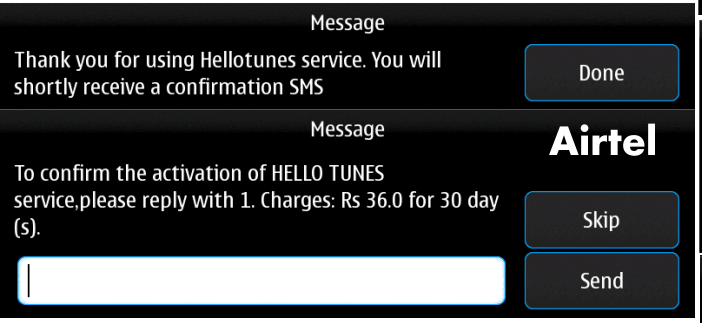
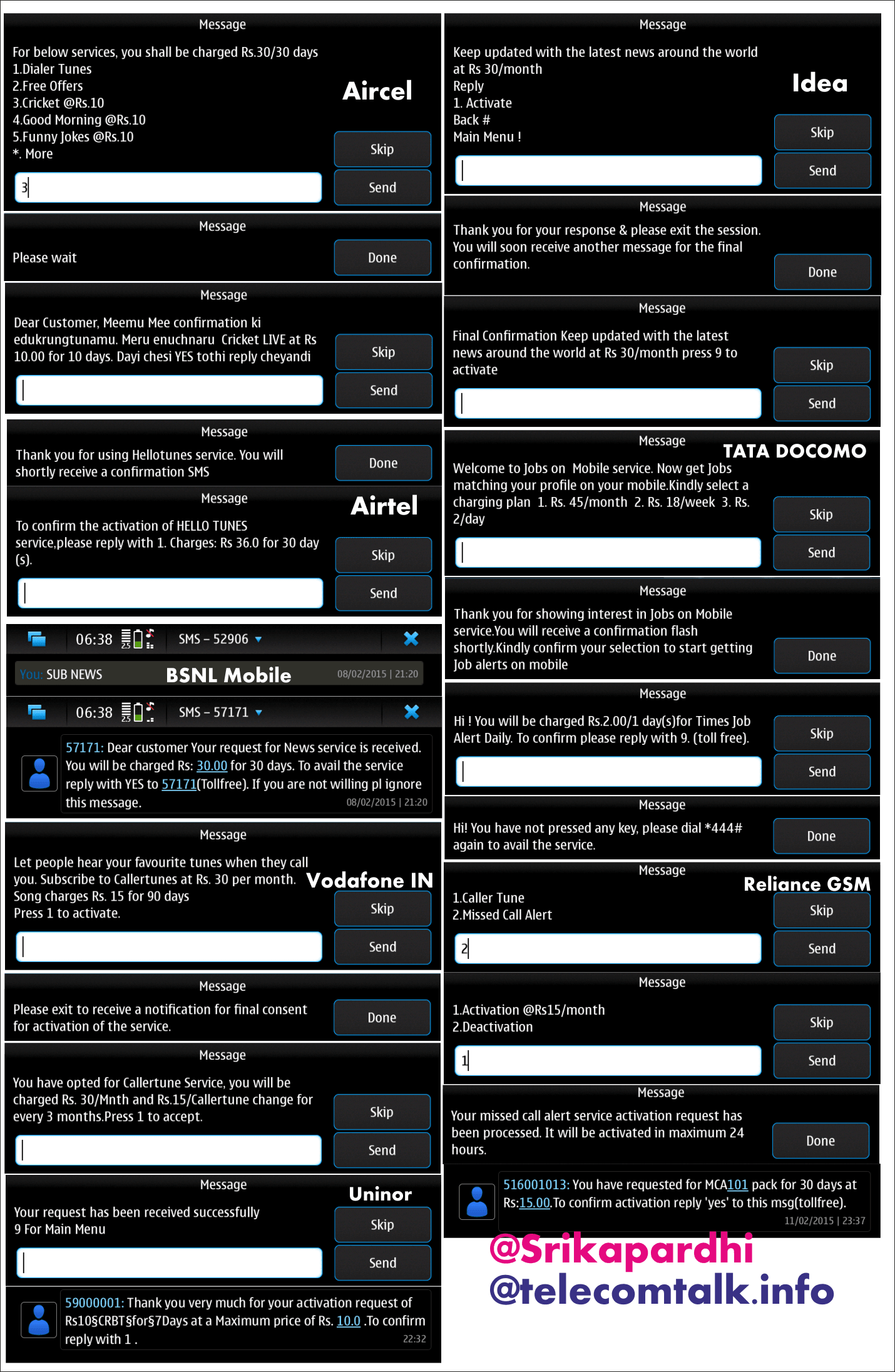
Below info-graphic shows the activation confirmation and procedure screens from various operators – Aircel, airtel, BSNL mobile, Vodafone IN, Uninor, Idea, TATA Docomo and Reliance GSM.
From the infographic:
One can clearly see the useful information provided by TATA DOCOMO post ignoring activation confirmation and also the misleading information showed by Reliance GSM in the step 3 of the image (as if the final activation is completed).
Personal Experience:
Today, irrespective of the implementation measures provided by TRAI, I’m not hesitant to mention at this juncture that I have been a victim of unwanted VAS activations and deductions especially with Uninor. Ignore the second consent of the customer, the activation just happens like a magic with just final SMS saying so and so amount is deducted and so and so service is activated. Tired of calling customer care and fed up after listening their answers, I stopped maintaining balance in amount and instead started maintaining minutes.
I willingly activated and deactivated a service for cross checking, later confirmed with CC the mode of activation. The way I activated the service is different from the way activation was confirmed by CC. So, just a question to the operator – Is everything fine with IT implementation or another ignorance case? *Case with Uninor itself
So, after listening to this any customer will loose faith in the information provided by CC. Also as an end user, all I can do is just hear and believe the information provided by the executive from the other end and curse my luck as I can’t go and check/verify the consent logs.
— A victim
Dear readers, Do let us know your experiences on the same via comments.
Note: Following inputs are taken from numbers belonging to AP circle. May or may not be same with your operator/circle. The above infographic/information is to completely bring awareness among readers and not to share personal experiences. Personal experience, may or may not be the same with your case.
A small group of TelecomTalk readers helps keep this platform running. Support us if you find our work valuable.
 Support Telecomtalk